
Our two-part article on letters shared between Dimitri Tiomkin and Lowell Thomas touched on a proposed film production on Benjamin Franklin.
READ: The Lively Letters of Dimitri Tiomkin and Lowell Thomas, part 1
During the summer of 1960, Dimitri Tiomkin, while discussing his view of the plight of the composer in Hollywood with New York Times reporter Murray Schumach, proposes a new kind of Hollywood musical, “I want to do musical for movies on Benjamin Franklin.”
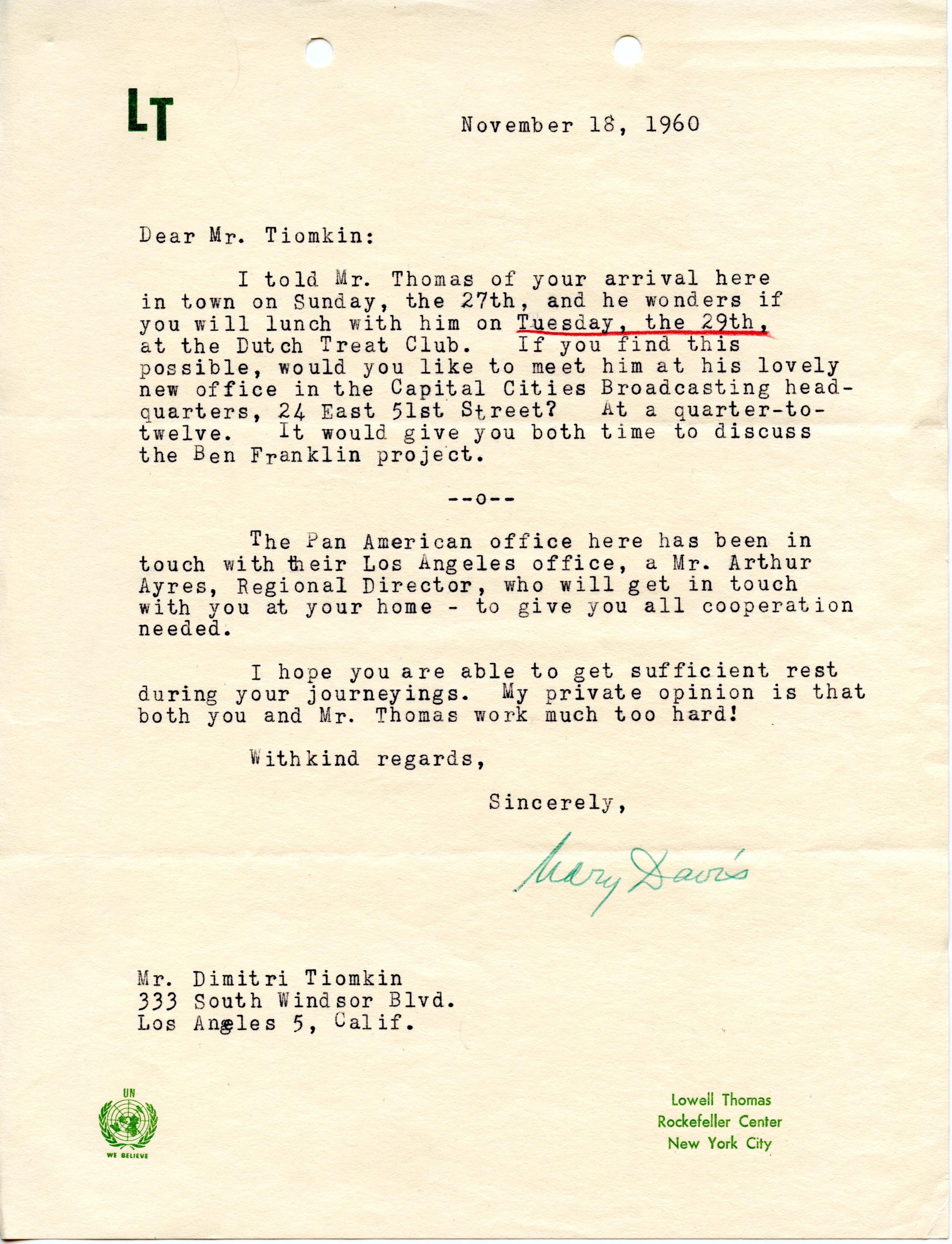
The “Ben Franklin project” becomes a topic for a meeting in New York with Lowell Thomas, set up by his administrative assistant, Mary Davis.
Around the same time syndicated columnist Dorothy Manners reports that Tiomkin and Thomas plan to co-produce a musical drama based on the life of the Benjamin Franklin, staged first on Broadway, followed by a filmed version in Hollywood.
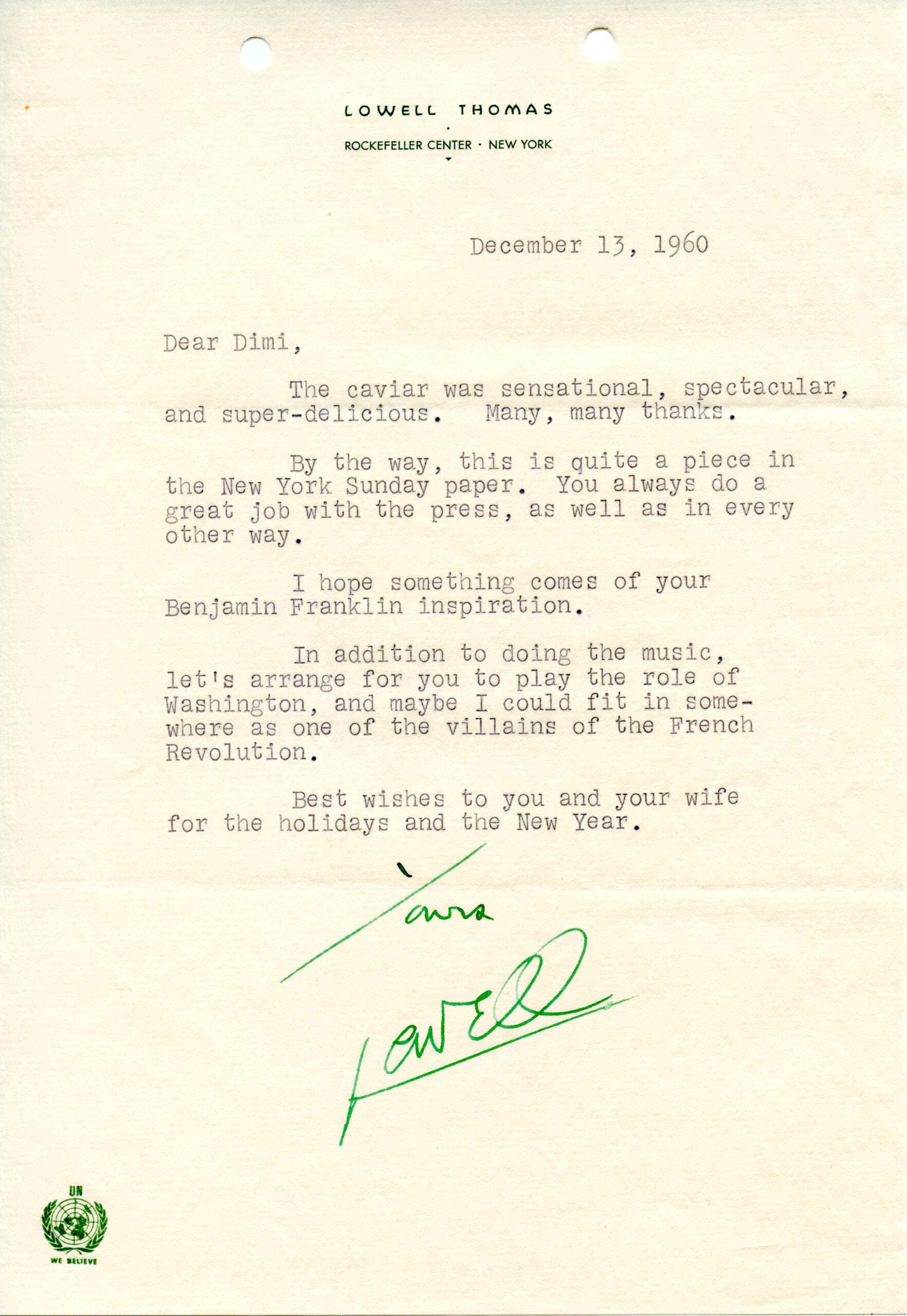
“I hope something comes of your Benjamin Franklin inspiration,” writes Thomas to Tiomkin in mid-December 1960. “In addition to doing the music, let’s arrange for you to play the role of Washington, and maybe I could fit in somewhere as one of the villains of the French Revolution.”
The proposal was in its early stages when, coincidentally, a Saturday Evening Post cover story on Benjamin Franklin arrived in the mail in January 1961, addressed to “Mrs. D. Tiomkin.” The issue contained two serials, four short stories, and seven articles, including the portrait of Franklin by historian Samuel Eliot Morison.
During the studio era, story departments routinely provide coverage on a large number of novels and serialized magazine articles as part of their constant search for source material to turn into new films to tame the voracious appetite consumers had for movies. The demise of the studio system in the late 1950s provided an opening for independent producers to join the hunt.
As the Soaring Sixties—promising international jet travel and space exploration—replaced the Fabulous Fifties, Dimitri Tiomkin and Lowell Thomas partook in the unending search for material to transfer to the screen.
An undated five-page prospectus or press release announces the producing duo’s desire to bring Benjamin Franklin’s life story to the big screen, similar to other biographical films on notable Americans, such as The Story of Alexander Graham Bell (1939), Edison, the Man (1940), and The Story of Louis Pasteur (1936). “The theme of the picture, though biographical, would be in no way burdened and hampered by the stodgy pitfalls and staid pace that usually govern costume filmizations.” [The latter could be referring to MGM’s Raintree County (1957).]
READ (downloadable pdf): Benjamin Franklin proposal
Tiomkin may have consulted with Charles L. Glett (1901-1963) to help get the project rolling. Tiomkin and Glett had a long shared history, having served in a production capacity on at least a half-dozen films scored by Tiomkin. Glett served as vice president and general manager in charge of production for David O. Selznick during the making of DUEL IN THE SUN and PORTRAIT OF JENNIE and as the managing director of the Motion Picture Center Studios during the filming of the Stanley Kramer Productions including, CHAMPION, HIGH NOON, HOME OF THE BRAVE, and THE MEN.
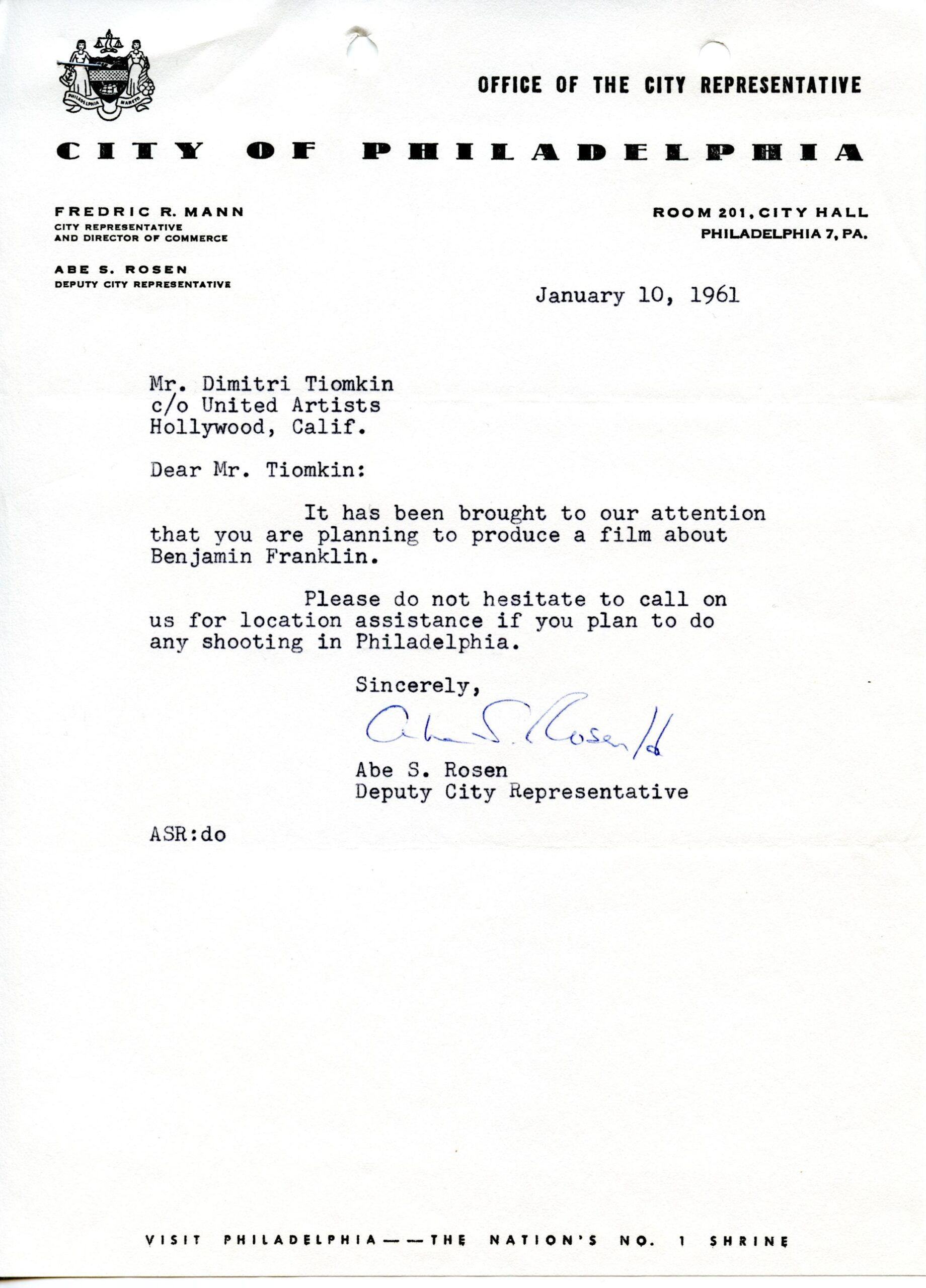
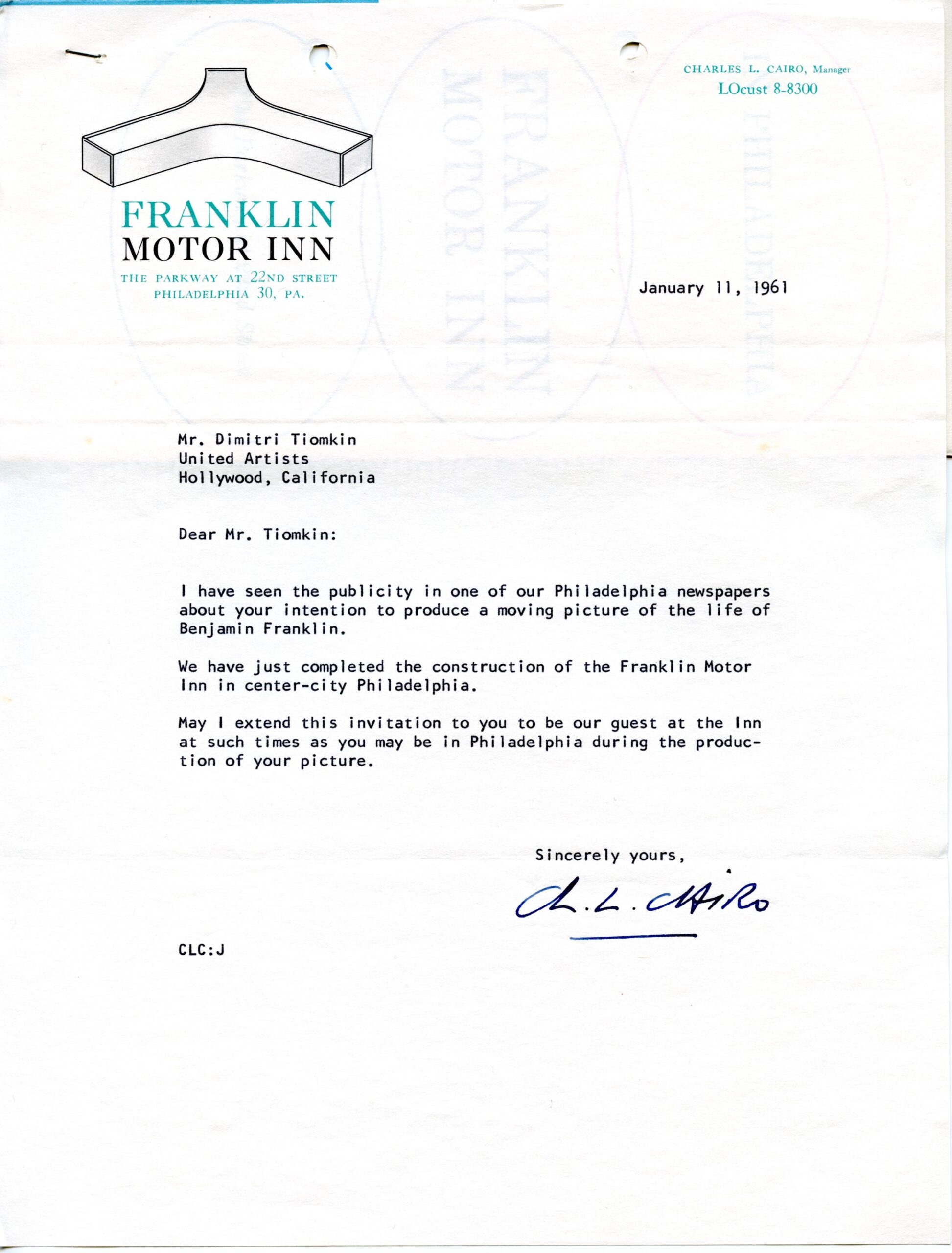
After word of the proposed film appeared in Philadelphia-area newspapers in January 1961, the City of Philadelphia offered Tiomkin location assistance, “if you plan to do any shooting in Philadelphia.” And the newly-built Franklin Motor Inn offered Tiomkin a guest room.
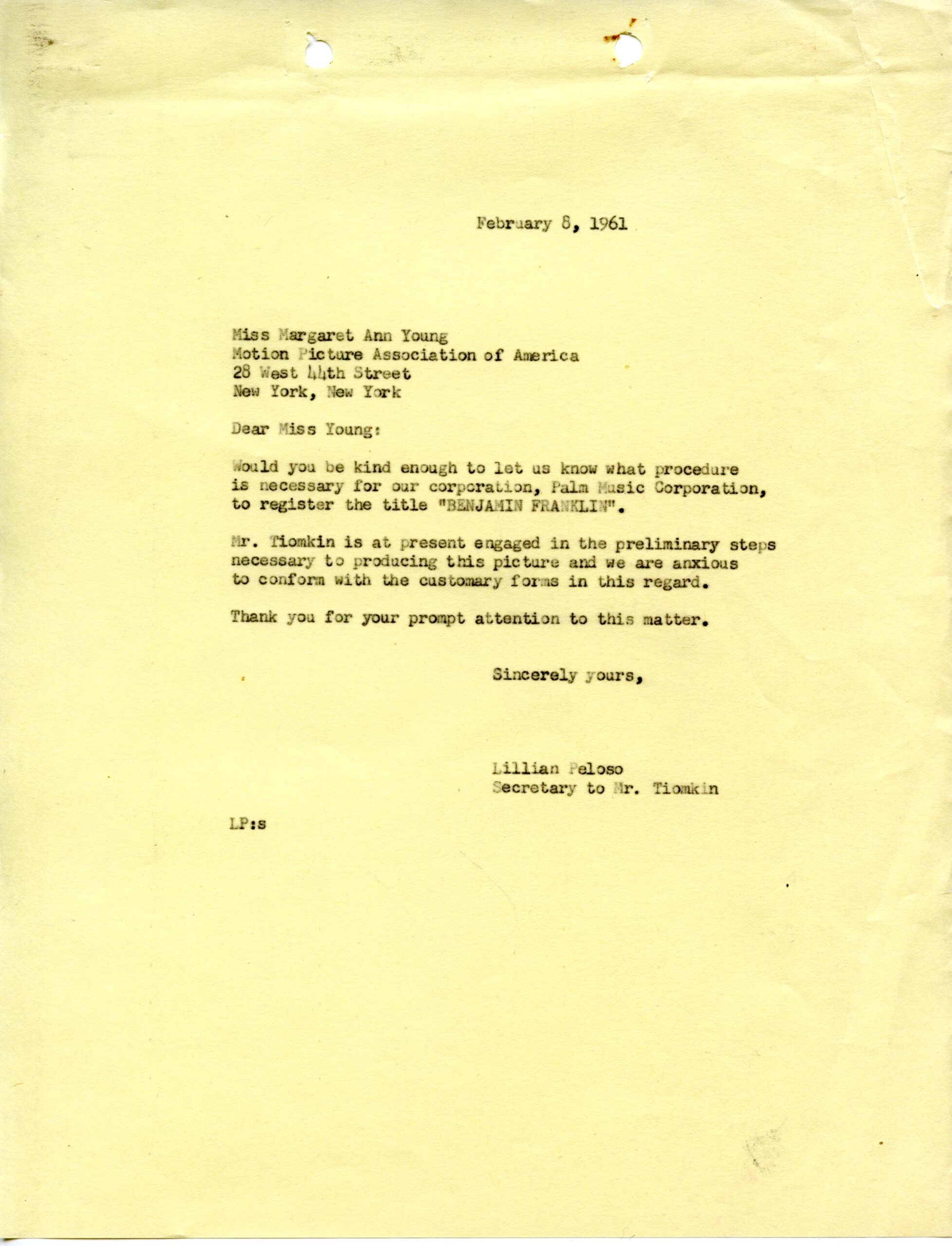
A year later, Tiomkin attempted to register the film’s title with the Motion Picture Association of America (MPAA) through his company, Palm Music Corporation (the same company responsible for his music theme for the television Western Gunslinger).
Another year went by, in January 1962, Tiomkin writes to Thomas, “I am now working on ‘HOW THE WEST WAS WON’, which in my opinion, promises to be a great western.”
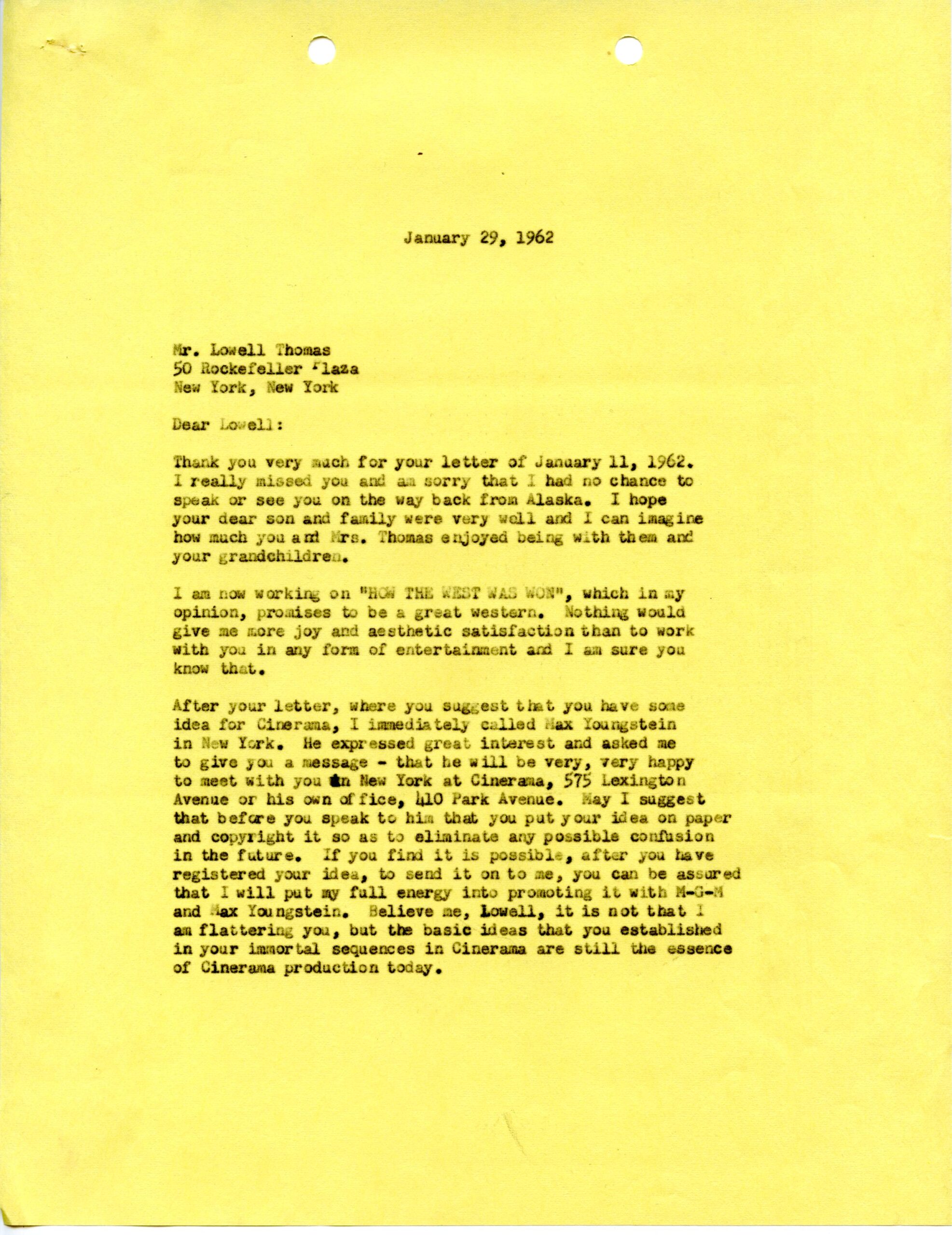
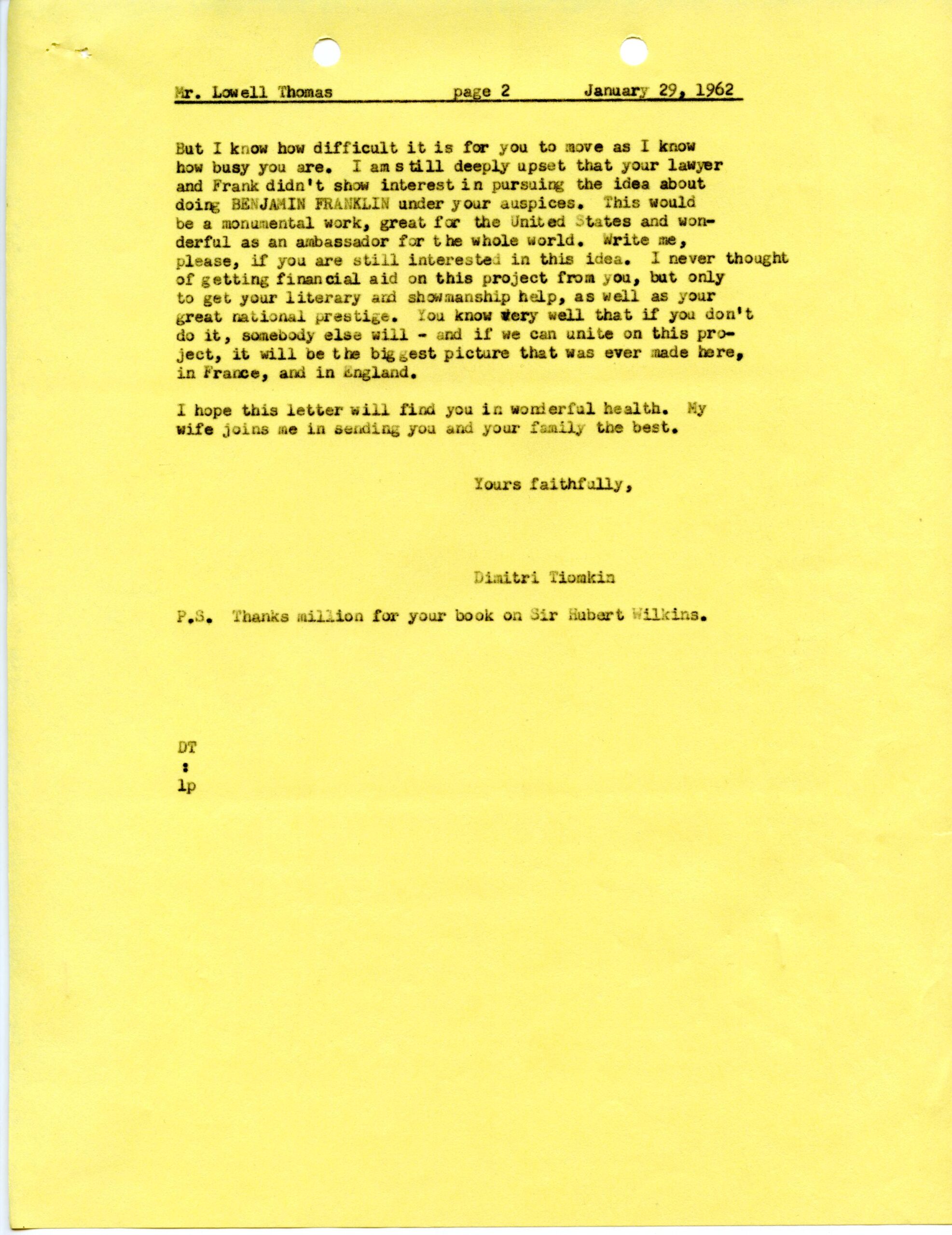
The composer goes on to express his deep disappointment with Thomas’s team, specifically “your lawyer” and “Frank,” both of whom who had no interest in pursuing a film on Benjamin Franklin. Tiomkin states that he is not looking for financial support for the project from Thomas, he is only seeking Thomas’s “literary and showmanship help, as well as your national prestige.”
“You know very well that if you don’t do it, somebody else will – and if we can unite on this project, it will be the biggest picture that was ever made here, In France, and in England.”
Thomas wrote back two days later, “Please don’t be too disturbed about the Ben Franklin matter. Frank Smith hasn’t had time to think about anything except the major TV station projects on which he has been working – with such fabulous success – for the past two or three years.”
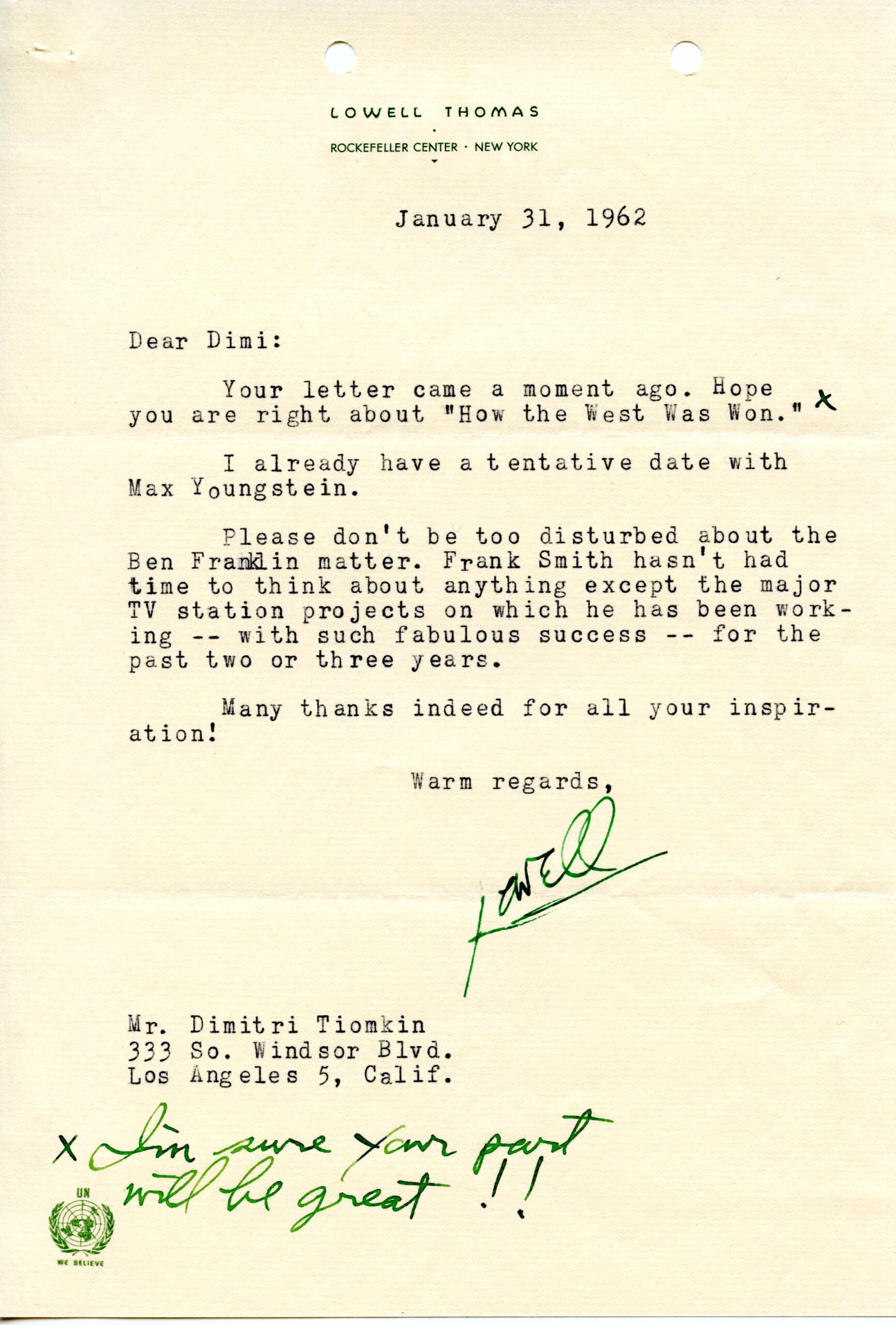
Thomas is referring to, Tennessee businessman Frank Milton Smith, his business partner and agent. By this time, the TV stations he was snapping up became Capital Cities Broadcasting Corporation for which Smith served as chairman of the board and chief executive officer prior to his death in 1966. (A 1952 conversation between New York governor Thomas Dewey with two of his friends, Frank Smith and Lowell Thomas, resulted in the writing and publication of Dewey’s book “Journey to the Far Pacific.”)
(The company went on to become Capital Cities/ABC before it merged with the Walt Disney Company which rebranded it Disney–ABC Television Group in 1996.)
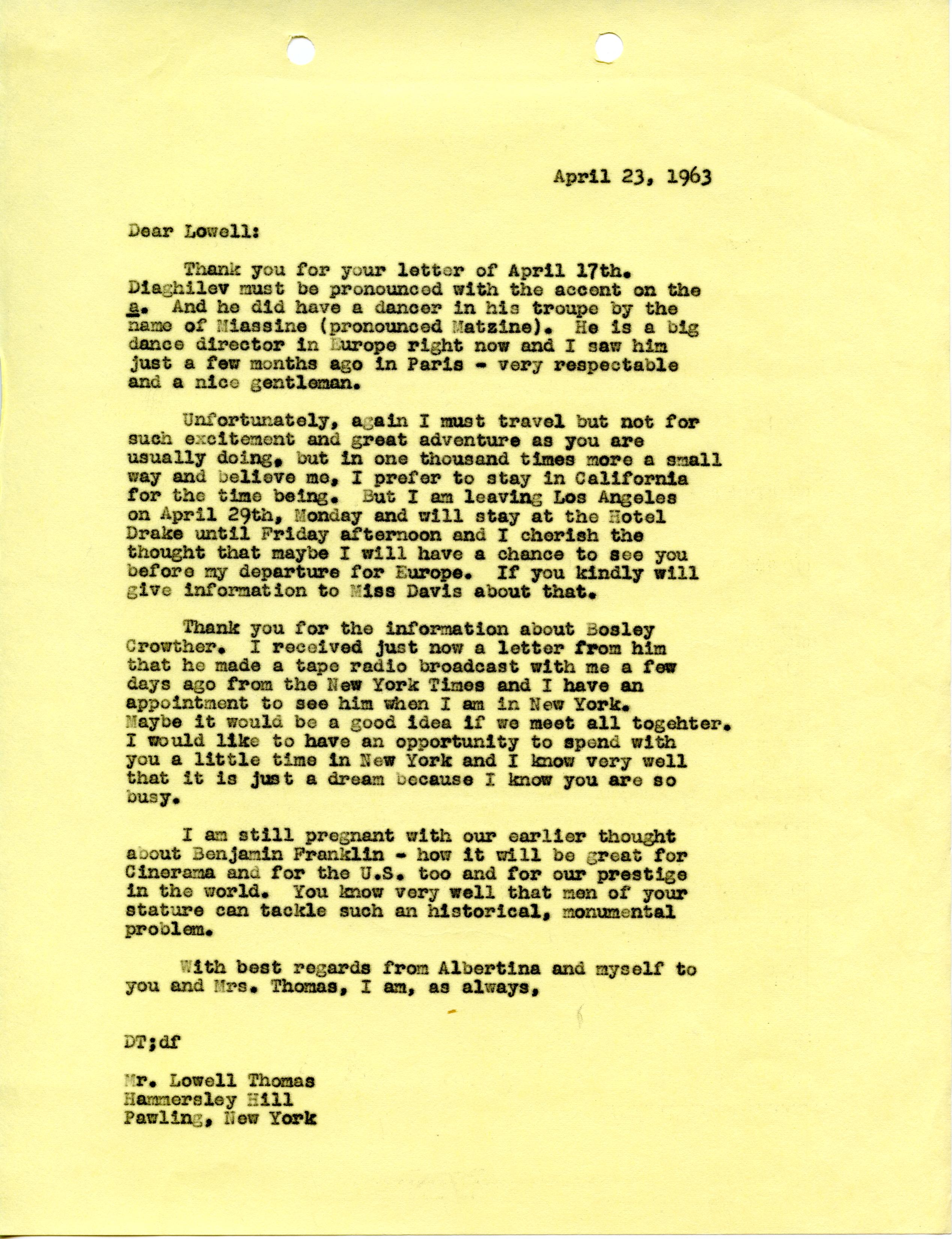
The last word on the project appears in a letter from Tiomkin dated April 23, 1963. The film is mentioned as a prospect for filming in Cinerama.
The Los Angeles Times ran a short blurb announcing the reactivation of their plans for a musical production based on the later years of Benjamin Franklin in August 1963.
Over time Tiomkin gathered a few other articles on Franklin; however, the project never got far and is not mentioned after 1963.
While Benjamin Franklin has made appearances in films devoted to Andrew Jackson or John Paul Jones, there is no film dramatization of his life story. On the other hand, television offerings include two movies and a mini-series. In the four-episode television mini-series, The Lives of Benjamin Franklin (1974–1975), Franklin is depicted by a different actor in each episode showing a different stage in his life.
Sources
Correspondence courtesy of Olivia Tiomkin.
“Musical Planned,” Los Angeles Times, August 14, 1963
“Tiomkin Laments Composer’s Lot,” by Murray Schumach, New York Times, August 25, 1960
“The Wisdom of Benjamin Franklin,” by Samuel Eliot Morison, Saturday Evening Post, January 21, 1961