
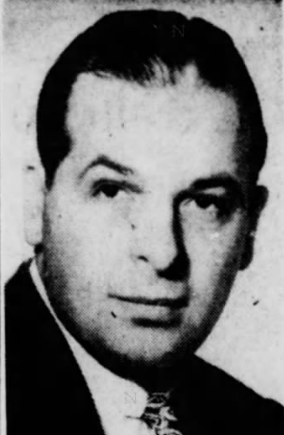


Five days shy of celebrating 54 years of life, Carmen Coppola grabs a sheet of hotel stationery from his recent travels and pens a letter to “Mr. Tiomkin,” to announce he is “back in Hollywood, ready for work.” That statement could be taken metaphorically; however, he actually does live in the neighborhood of the moviemaking capital, his home on Rosewood Avenue is on the south border of East Hollywood, a half mile below Los Angeles City College.
Carmine Valentino Coppola (1910–1991), also professionally known as Carmen Coppola, is back in Los Angeles fresh from serving as the musical director for the national touring company of Stop the World – I Want to Get Off, the Anthony Newley musical about an Everyman character named Littlechap, who wanders the bleak world in search of his soul.
For Carmen, roaming the country comes with the territory. Later that same year in 1964, Carmen, as musical director, toured with Half a Sixpence and 110 in the Shade, featuring dances and musical numbers staged by choreographer Agnes de Mille. By the late-1960s, he apparently was ready to leave behind the travel necessitated of musical directors, staying closer to home to find work as a session musician, arranger, and composer.
With The People, a 1972 ABC Movie of the Weekend, he found his calling as a film and television composer. His “lush, romantic score” captured “the spirit of the story.” The Godfather series, Apocalypse Now, Black Stallion, The Outsiders, and the restored/rescored silent film, Napoleon, would follow.
Carmen had previously dabbled in film music, providing unspecified work for composer Victor Young at Paramount in 1952 and 1953. Since Young scored eight Paramount releases during those years, Coppola could have assisted on a number of films ranging from The Greatest Show on Earth to Shane or Roman Holiday.
A flutist first, at age fifteen Carmen performs as a “boy flutist” on a New York radio station. Because on radio you are heard and not seen, one Canadian newspaper misgenders Carmine as a “15-year-old girl” “who despite her youth, has won considerable reputation for her playing.” At age nineteen, Carmine plays Carnegie Hall performing works by Bach, Chaminade, and Mozart.
After a lengthy career as a flutist, including first flute under Ernö Rapée at Radio City Music Hall in New York, Carmine transitions to arranging and conducting and by the mid-1950s to serving as music director for touring companies for Kismet and other productions.
Early in his career, he considered musical composition a hobby, alongside travel and sports. He began composing during his student days at the Julliard School of Music and continued during his career as an orchestra musician, completing a pagan dance, Danse Pagane, in 1939. He conducted his own Pittsburgh Bi-Centennial March as the winner of a 1957 music composition contest sponsored the Friends of Harvey Gaul in Pittsburgh.
The list of his music composition teachers reads like a who’s who of American and European-born composers with Dutch, German-Austrian, and Russian heritage: Paul Creston, Norman Dello Joio, Hal Overton, Karol Rathaus, Joseph Schillinger using the Schillinger System of Musical Composition, and Bernard Wagenaar.
In the early 1950s, Carmen returned to Radio City Music Hall to become a staff arranger. Music director Charles Previn put in a good word for Coppola with Dimitri Tiomkin and according to this letter Tiomkin considered him as an orchestrator at the time of High Noon. (Paul Marquardt and Herb Taylor orchestrated the 1952 film.)
UPCOMING CONCERT: High Noon – In Concert in Switzerland, November 8, 2020
For references, in addition to Previn, he lists Meredith Willson and Leith Stevens (a fellow Schillinger student), and Leon Leondidoff. Leondidoff spent his life producing hundreds of the extravaganzas that dazzled Radio City Music Hall audiences with a level of grandeur only New York could produce featuring a unique blend of orchestra, chorus, and the Rockettes.
The Barrymores, Bridges, Coppolas, Fondas, Hustons, and more represent the pinnacle of Hollywood families. As the patriarch of the Coppola dynasty, Carmen fathered August Coppola, Francis Ford Coppola, and Talia Shire. With The Godfather Part II, Carmine Coppola joined Dimitri Tiomkin as an Oscar winner. Carmine closed his acceptance speech with a family sentiment, “I want to thank my son Francis Ford Coppola for being up here, because without him I wouldn’t be here. However, if I wasn’t here, he wouldn’t be here either, right?” Two generations of the Coppola family followed in his footsteps. Francis Ford Coppola, Nicolas Cage, and Sofia Coppola each earned Academy Awards.
Carmen spent three weeks in Boston in late November 1963 with the touring company version of Stop the World. Back in Los Angeles writing on stationery from the Avery, a ten-story hotel overlooking Boston Common frequented by actors and actresses in town for theatrical performances, Carmen ends his letter, “If you feel you can use me in the future and would like to interview me, then I shall be pleased to come to see you anytime at your convenience.”
At the time, Dimitri Tiomkin was scoring epic films, with Circus World and The Fall of the Roman Empire both released in 1964. Tiomkin or his secretary sent an immediate reply to Carmen’s letter but we don’t have any indication if a meeting between the two took place.
(First in an occasional series featuring rare or unusual letters.)
Sources
Letter from Carmen Coppola to Mr. Tiomkin, June 6, 1964, courtesy of Olivia Tiomkin
“Radio Features for Today,” WGBS, New York, September 19, 1925
“Radio Gossip,” The Border Cities Star (Windsor, Ontario), February 17, 1926
“Henri Presents Modern Music Dance Recital: Makes First Appearance in Six Years in Program at Provincetown Playhouse / Barbizon Concert Held / Carmine Coppola, Flutist, Plays at Carnegie Hall,” New York Herald Tribune, September 30, 1929
“The First Desk,” Detroit Free Press, December 10, 1939
“Harvey Gaul Music Contest Rues, Procedure Posted,” Allentown Morning Call, July 24, 1955
“Bicentennial March Played: Carmen Coppola Was Composer,” Pittsburgh Press, May 8, 1958
“The Boston Stage,” Boston Globe, November 3, 1963
“TV REVIEW: ‘The People’ Fine for Children, Too,” by Cecil Smith, Los Angeles Times, January 22, 1972
Academy Awards Acceptance Speech database
“Leon Leondidoff, 95, the Producer of Radio City Shows for 42 Years,” [obituary] by Richard F. Shephard, New York Times, August 1, 1989