
PART 2 of 2 (read Part 1)
On Broadway, 44th Street Theatre, January 18-February 27, 1932
When the show finally opens on Broadway the initial reviews are good, including this acknowledgment of the composer, “Dimitri Tiomkin has contributed music for several Spanish dances [referencing the “Brazilian Dance,” “Gitana,” and “Tango”]. This music and dancing are both beautiful.” The emphasis on dancing is noted, “A dull and formula book made almost worth the money by its surroundings of a brisk dancing show…” and further, “It is the dancing in this production that gives it what lure it has.”
“One of the two productions that have a good chance of becoming hits is ‘The Little Racketeer,’ a story of sentimental and non-existent underworld, taken from the German and set to music for Broadway consumption. ‘The Little Racketeer’ features Queenie Smith, the nimble little dancer, in lights, but on the stage, one discovers, the honors go to the Albertina Rasch dancers and to Barbara Newbuerry [Newberry], who looks something like Jean Harlow and dances as lightly as falling Autumn leaves.” A Brooklyn Times Union review credits “Music by Dimitri Tiomkin and Lou Alter, Lyrics by Edward Eliscu and Haskell Brown.” Those credits conflict with the Playbill program for the week beginning Monday, January 18, which read: music by Haskell Brown, lyrics by Edward Eliscu; there is no mention of Lou Alter.
The Variety review claim that “pretty much all its original German book was jettisoned and made over” was probably true, in fact, before the show ended, the billing for the German writers was dropped in favor of a sole writing credit that read “By Harry Clarke.” The review continues, “In all probability the score was considerably Americanized…” “If the story is more than occasionally charming, the music is rather poor. Almost every song has been turned into jazz. It doesn’t sound very German. There is, however, a romanza, ‘Danger If I Love You,’ which might very well have been in the original.”
These comments are off-base since there was no music in the original German play and, in fact, “Danger If I Love You” was a recent addition to the musical revue, among several changes that may have been put in place during the final tryouts in Hartford and New Haven and were now appearing in the first week Broadway program.
- “Danger If I Love You” [Haskell Brown] replaces three songs, “My Big Adventure” [Lew Alter]; “Or Anything” [Lew Alter]; “All I Can Do Is Hope” (Lee Warner, Lupin Feine, Moe Jaffe)
- “Throwing a Party” [Haskell Brown] replaces “You’ve Got to Eat” (composer: [Lew Alter]; lyrics: Edward Eliscu)
- “Thanks to You” (composer: Bernece Kazounoff; lyrics: Earle Crooker) is moved earlier in order to replace “Thrills” (composer: [Lew Alter]; lyrics: Edward Eliscu)
- Two songs are dropped and not replaced: “Flesh and the Devil” (Manny Sherwin, Milton Pascal, Arthur Lippman), the solo for Ethel intended for Lita Grey Chaplin, and “Loveable You” (Gus Kahn and Harry Aroody)
- and a second ballet number by Dimitri Tiomkin, “When that Band Plays” (Southern Belles ballet music) is added.
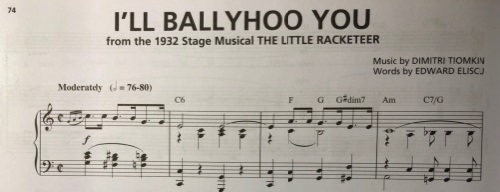
Within three days of opening, fifteen minutes is cut from the running time, including two songs, “Dou Dou” and “I Have a Run in My Stocking. The latter song by Dimitri Tiomkin, although copyrighted, remains unpublished unlike the Tiomkin song “Ballyhoo” that can be found in Volume 1 of the Dimitri Tiomkin Anthology, excerpt below. The music scores for the Brazilian Suite ballet have been located in the Dimitri Tiomkin collection and may be recorded for a follow-up volume under consideration to Dimitri Tiomkin Paris Under the Stars: Ballet Music for Albertina Rasch. As a last minute addition, “Southern Belles” may have been a pre-existing ballet number for the Albertina Rasch dancers; the music score has eluded discovery or identification thus far.
Queenie Smith created the role of Dixie and by most accounts embodied the part. Her husband, drama critic Robert Garland, reportedly did not attend a single rehearsal or the premiere saying, “After all, she never hangs around my newspaper shop.” He wasn’t the only one avoiding the show. After a “mild” opening the production did not break even at the box office. By week five Variety reported the show was “well in the red.” It didn’t help that during its Broadway run the Shubert Theatre Corporation was in receivership, in need of a cash infusion to pay off bondholders and other creditors, and facing liquidation or reorganization. (To be fair, a single runaway hit may not have been enough to save the company.)
Complicating the financial picture were the arrangements for the theater itself. The 44th Street Theatre had been under a lease to the Shubert Corporation; however, the lease was disaffirmed by the receivership and at this time the theater was being rented with the Shuberts holding only a one-third ownership interest.
By week four, the conducting baton was passed to Maury (Maurice) Rubens, another Shubert stalwart, who held it through the end of the road show. The composer, conductor, and music director once accused jazz band leader Ted Lewis of striking him during an argument at Shubert’s Winter Garden Theatre; however, the assault charge was dropped after Rubens failed to appear at three consecutive hearings. Of all the musicians associated with A Little Racketeer, Rubens came late to the show, but as we will learn he may have contributed a song to the score.
On February 27, after forty-eight performances on Broadway, A Little Racketeer closes; however, that’s not the end of this story. A one-week extension to March 5 is announced and then rescinded to allow Earl Carroll’s Vanities to open in its place at the 44th Street Theatre.
A Little Racketeer then heads out of town even though the road show’s future was in jeopardy as late as February 23, when Variety reported the production may “ignore a road try.” When the Shuberts decide to move the road show of A Little Racketeer up a week it is booked in Philadelphia at the Forrest instead of the Shubert Theatre, a move that would have unforeseen consequences in the days ahead.
The road show begins and ends in Philadelphia
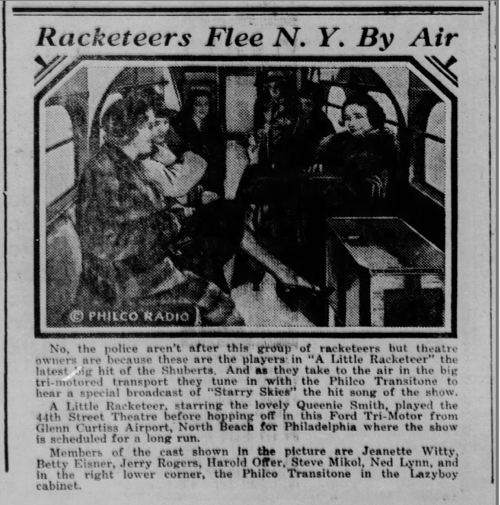
A catchy headline, “Racketeers Flee N.Y. By Air,” sits above a newspaper image picturing dancers from the Broadway cast aboard a Ford Tri-Motor plane. For an elaborate publicity stunt and advertising tie-in with Philco Radio some cast members were to be flown to Philadelphia—or at least boarded a plane equipped with a Philco Transitone radio for a photo op—to listen to a special broadcast of the Dimitri Tiomkin song, “Starry Skies.” (If they really did listen while airborne would that make this the earliest song from a Broadway musical heard on an airplane in flight?) Expensive stunts like that may partly account for the Shubert’s financial straits.
 A two-week run at the Forrest Theater in Philadelphia begins on February 29. Philadelphia is at an economic nadir, home to just two shows during peak theater season, and business is described as “deplorable.” A Little Racketeer would bring in around $6,000 in five performances.
On March 4, two thousand patrons were already in their seats expecting to see Queenie Smith when the musicians union called an impromptu strike. When the theater management is informed that the orchestra is on strike an attempt is made to negotiate with the musicians and when that fails the show is cancelled.
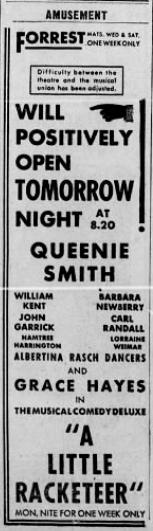
A local union official explains the dispute centered around the hiring of three additional musicians. The issue is soon settled—Shubert receivers claim the theater lease was disaffirmed and the union agrees to arbitrate the existing agreement—and the show continues with its scheduled run. An ad on March 6 in the Philadelphia Enquirer blares, “WILL POSITIVELY OPEN TOMORROW NIGHT,” explaining that the “Difficulty between the theatre and the musical union has been adjusted.”
The loss of revenue from three shows may have been the last straw as the road show ends abruptly the following week as announced in a local paper, “Queenie Smith’s ‘Little Racketeer’ closed Saturday night, getting only as far as Philadelphia on its projected tour.” The production scheduled to open March 28 at the Alvin Theatre in Pittsburgh is cancelled, as was a planned appearance at the Apollo Theatre in Chicago.

Who was Haskell Brown?
Noted author Ken Bloom writes in American Song, “Henry Sullivan and Louis Alter were credited with the music when the show was out-of-town. Haskell Brown may be a pseudonym for those composers,” and further postulates, Haskell Brown was “probably a pseudonym for Henry Sullivan.”
Haskell Brown appears to be a pseudonym, but for whom? A Little Racketeer is the sole musical work credited to this enigma. After first being named in a New York newspaper on January 11, 1932, composer Haskell Brown disappears after March 13, 1932, never to be heard from—musically, or otherwise—again. A search of ancestry.com reveals no composer or songwriter by the name of Haskell Brown living or working in New York at the time.
There is evidence of others alive at the time that share the name, such as,
- Haskell Brown of Okmulgee, Oklahoma, who upon turning 21 years of age in 1920 asks for a pair of marriage licenses (maybe he thought he needed one for himself and one for his potential wife, Mamie Jordan?)
- Haskell Brown of Aiken, South Carolina, selling a lot of corn, fodder, and peas to the highest bidder at an estate sale in 1924
- Haskell Brown “from the west side of the county” arrested for unlawful possession of liquor during Prohibition in Wagoner, Oklahoma in 1929, and fined a year later for coming to blows with “Curley” Madding over his “low-down ways”
- and Haskell Brown of Sullivan, Indiana, sentenced to prison in 1933 for participating in the killing of two farmers over a mortgage foreclosure dispute.
Imagine my surprise, when while perusing more than 500 news items that mention A Little Racketeer, I chance upon the following biography of Haskell Brown buried in a Daily Boston Globe column titled “Drama Music Pictures: Notes About the Players,” published January 24, 1932, one week after the show opened on Broadway.
“Haskell Brown, composer of ‘A Little Racketeer,’ has been engaged by Julian Wylie, English producer, to write the score for a musical version of the farce, ‘Charley’s Aunt,’ by Brandon Thomas. The book and lyrics will be done by Kenneth Furber. Mr. Wylie expects to place the production in rehearsal Feb. 15, and is negotiating with Stanley Lupino to play the title role.
Mr. Brown, who made his Broadway debut as composer with ‘A Little Racketeer,’ was formerly a member of the San Francisco Symphony Orchestra. He organized the Golden Gate Jazzeteers three years ago, and has been their director ever since. In 1929 he composed the score for ‘Vilona,’ a comic opera with libretto by John Wigham, which was produced in Los Angeles and later toured the West coast.”
The preceding day, the Courier-Post of Camden, New Jersey, similarly reported “Julian Wylie has engaged Haskell Brown, composer of ‘Little Racketeer,’ to write the score for a musical version of ‘Charley’s Aunt.’”
Curiously, I have not been able to corroborate independently or confirm by any other source the above information in the only known biographical profile of composer Haskell Brown. While Julian Wylie and Stanley Lupino were living persons, no other mention of this Charley’s Aunt production could be found. Nor is there evidence of performances of the opera Vilona, of the existence of librettists John Wigham or Kenneth Furber, or of the Golden Gate Jazzeteers. Further, the San Francisco Symphony Orchestra could not confirm Haskell Brown was ever a member. What purpose did this biography serve in a Boston newspaper nearly three months after the show closed there? Was it because the identity of Haskell Brown was being questioned after the show opened on Broadway?
Edward Eliscu would have known Haskell Brown because he provided lyrics to all the songs by the composer. Eliscu may have taken that knowledge to his grave. In his autobiography he writes of working for the Shuberts on The Duchess of Chicago, but not one word about A Little Racketeer, Haskell Brown, Dimitri Tiomkin or any of the composers he collaborated with for the revue, one of the last musicals he worked on in New York before he took a job at RKO in Hollywood in 1933. Eliscu went on to a career as a screenwriter before returning to New York after being blacklisted in the early 1950s. For an insider view, read “What Was It Like to Have a Blacklisted Father?” by his son, David, published in Cinema Journal in 2005.
Can a careful reading of available information combined with logic unmask the identity of Haskell Brown?
A chronological view of the billing derived from programs and reviews presents a clear picture of the evolution of the music in the revue. No music in the five tryout cities is credited to Haskell Brown, yet when the musical revue opens on Broadway Haskell Brown receives sole billing.
Shubert Theater, Newark
Music: Henry Sullivan
Lyrics: Edward Eliscu
Shubert Theater, Boston
Music: Henry Sullivan
Lyrics: Edward Eliscu
Majestic Theater, Brooklyn
Music: Dimitri Tiomkin and Lew Alter
Lyrics: Edward Eliscu
Parsons Theatre, Hartford
Music: Dimitri Tiomkin and Lew Alter
Lyrics: Edward Eliscu
Shubert Theatre, New Haven
Music: Dimitri Tiomkin and Lew Alter
Lyrics: Edward Eliscu
44th Street Theatre, New York
Music*: Haskell Brown
Lyrics: Edward Eliscu
*The songs and ballet music by Dimitri Tiomkin are credited within the program.
Is there a clue to be found in the two songs added to the Broadway production? Who wrote “There’s Danger If I Love You” and “Throwing a Party”?
Nicholas van Pelt, a critic from North Carolina attending a performance of A Little Racketeer on Broadway during the first week of February found “There’s Danger If I Love You” unlike the other songs in the revue. He observed, “The songs are mass productions, each just alike with the exception of ‘Danger If I Love You.’” And added, “A vamp tries to part the lovers, as is customary in musicals, but that is attended to by the latter part of the second act, and the pair reiterate ‘There’s Danger If I Love You, there’s danger if I don’t’ at the slow descent of the asbestos curtain.”
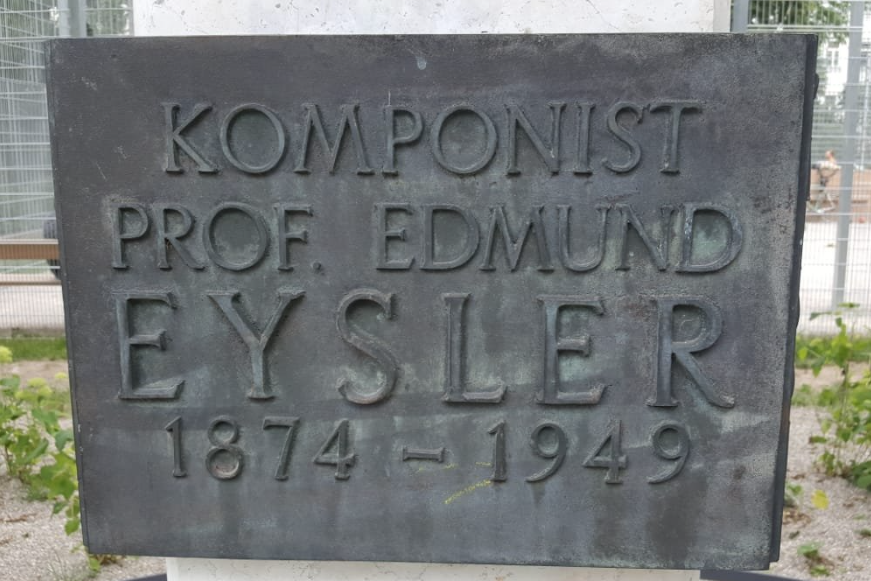
Enter Edmund Eysler, the Austrian composer of Viennese operettas and light opera. In the Eysler score for The Honeymooners mounted by the St. Louis Municipal Opera for a summer season performance in July 1932, among the song numbers is “There Is Danger If I Love You.” The book for the Viennese musical comedy is by none other than Harry Clarke, the settings are by Watson Barratt, Carl Randall is in the cast, and there’s more. The performance in St. Louis will be “almost the first offering on the stage in this country.” It turns out the musical was given “a brief tryout near New York last fall and then withdrawn without being taken into the metropolis, where it will not be seen until September when it goes into one of the Shubert houses for what is expected to be an all season run.” A review notes J. J. Shubert attended and expects to take the production to New York in the fall with a number of the members of the St. Louis cast. This apparently did not come to pass and no evidence has been found for the brief tryout near New York.
Intriguingly, in the fall of 1931, Harry Clarke is responsible for the librettos to two works, one with Austrian roots and the other with German roots for the Shubert organization and a song titled, “There Is Danger If I Love You,” ends up in both productions, in one attributed to the pseudonymous Haskell Brown.
Maury Rubens, who conducted A Little Racketeer for four weeks, reportedly supplied additional music for Eysler’s The Honeymooners. Could Rubens have written “There’s Danger If I Love You” and/or “Throwing a Party”? The attribution of the latter song remains elusive.
Less than a week after biographical details on Haskell Brown appeared in the Daily Boston Globe, Billboard becomes the first and only reviewing organization to question Brown’s identity, literally, placing a question mark in parentheses after the name.
“The music by Haskell Brown (?)…”
Separately in the same issue, the Billboard reviewer, Jack Mehler, writes in “Stage Whispers,” “Haskell Brown is the name of the composer credited with the writing of the score for Queenie Smith’s starring vehicle, A Little Racketeer.” Mehler continues, facetiously, “An investigation revealed that the name had been made by using the first initials of composers responsible. If they all had had to be listed it would have read like the Who’s Who of the American Society of Composers [a reference to ASCAP, the performing rights organization].”
Taking selected first initials of the uncredited composers represented by songs when the show opened on Broadway* does get close to the desired result.
Henry
Alter
Sullivan
Kazounoff
Eysler
Lee
Lew
Berenece
Rubens
O
Wainer
N
Even writer-lyricist Allen Boretz (too bad it wasn’t Ogden Nash!) later claimed to have written lyrics for “Little Racketeer.” If true, it may have been as an assist to Eliscu. Both Boretz and Eliscu previously wrote lyrics for Garrick Gaieties and Sweet and Low.
In the end, perhaps Haskell Brown is akin to “Alan Smithee,” a pseudonym used by filmmakers to disown a project, and was used in that context to represent the contributions of songwriters Henry Sullivan, Lew Alter, Edmond Eysler, Berenece (Bernece) Kazounoff, Lee Wainer, and perhaps even Maurice Rubens.
(*The opening week Broadway program credits only Haskell Brown and Dimitri Tiomkin with music; however, with the exception of Rubens, the above composers were credited in earlier or later programs.)
Among the handwritten list of song titles on the outside of a file on A Little Racketeer in the Music Collection at The Shubert Archive, New York, there is a cryptic reference to “Tiompkin Rubin Scene” in the position where “Ballyhoo” appears in the musical revue. It’s unclear if Rubin is referring to Maury Rubens.
The Girls in the Chorus
Azeada. Inez. Mozelle. Nondas. Snookie. The mellifluous first names of the anonymous dancers evoke a bygone era. Could Azeada be Egyptian dancer Azeada Charkouie who drops out of sight late in 1930?
Some, such as Barbara Pepper and Colleen Ward, went on to minor acting careers in Hollywood. Pepper, who “chucked an impending Virginia finishing – school career for the Shubert chorus,” later admitted she donned a bathing suit to land the dancing job for “Little Racketeer.”
The true life story of Jerry Rogers, who portrayed a “Show Girl,” did not end as well as the fictional story of Dixie. A year after the show closed this young girl, after failing to succeed in New York, ends her life. She is pictured third from left in the airplane for the Philco radio tie-in, above. (Inexplicably, a Hawaiian newspaper ran the same news item and picture a year and a half after the event and three months after Rogers’s life had ended.)
Tying up loose ends
All of the music written by Dimitri Tiomkin for A Little Racketeer featured the Albertina Rasch Dancers in dances stages by Albertina Rasch. Even though Tiomkin continued to pursue a career as a concert pianist, most of his music compositions in the late 1920s and early 1930s were choreographed by his wife for performance on stage, in vaudeville, and in early sound films.
 Queenie Smith’s leading role in this musical has largely been overlooked; however, one could argue the publicity she earned from the show helped launch her career in Hollywood in the mid-1930s. Years later she would appear in a 1947 film scored by Dimitri Tiomkin, The Long Night.
Unrelated, but perhaps of interest to wordsmiths, in late 1932 audiences in Innsbruck and Vienna witnessed a little-known Edmund Eysler operetta, Die Rakete. The title closely resembles a homonym for “The Racketeer,” but “The Racketeer” would translate back into German as “The Gangster.” Die Rakete translates as “The Rocket” in English. The similarly named operetta appears to have no connection to The Little Racketeer.
Carl Randall and Barbara Newberry, the duo who sang and danced to Dimitri Tiomkin’s “Ballyhoo,” went on the road together in a vaudeville act. Newberry was divorced from Eddie Foy Jr. during tryouts for Little Racketeer.
Additional connections to Maury Rubens can be found. Concurrent with the closing week of the show on Broadway, when the next project for Harry Clarke is announced it is a collaboration that reteams some Little Racketeer creators, including Haskell Brown! “Haskell Brown and Edward Eliscu, who wrote the music and lyrics, and William Caryl, who staged the production, are working on a new musical comedy” with a Harry Clarke libretto that is to be a satire on the theater. (This may be referring to Marching By, a musical that opened at Chanin’s 46th Street Theatre in March 1932, and the first project for Edward Eliscu after The Little Racketeer, with additional music by Maury Rubens.)
Emil Newman, brother to Lionel and Alfred, was associated with the Shuberts and musical director Maury Rubens in the mid-1930s. Although his name does not appear in any of the programs consulted, according to a news item appearing after the show closed, Emil Newman directed the orchestra somewhere along the line. If true, he may have been employed as a backup for Rubens.
The vocal selections published by Shubert Music and sold by Harms, copyright 1931 by the Shubert Theatre Corp., include two songs by Henry Sullivan, “Here’s to Night” and “Whiling My Time Away,” and “I’ll Ballyhoo You” by Dimitri Tiomkin, imprint of Miller Music, copyright 1932. Sheet music for “Inside Looking Out” by Henry Sullivan and Edward Eliscu was also published. (Eliscu previously wrote lyrics for “Outside Looking In,” a song by Harry Archer that appears in the 1930-1931 musical revue, Sweet and Low.) In addition to music from “Little Racketeer,” the New York Public Library holds some production photographs, including images of Queenie Smith and John Garrick.
When Robbins Music Corp. acquired Miller Music in 1937, the publisher picked up the rights to “Little Racketeer.” The British Library scores, as above, for The Little Racketeer, bear copyrights from 1931 and 1944.
As the music faded and after it ended, fashionable hats influenced by the Broadway musical were offered for sale in Kentucky and Mississippi during the spring and summer of 1932.

Clipping of advertisement, The Davidson Company, “Hattiesburg American,” August 12, 1932

Clipping from advertisement, H.P. Selman & Co., a high-end apparel and accessories store, “The Courier-Journal,” Louisville, Kentucky, March 5, 1932
Another Dimitri Tiomkin Broadway musical?

Dimitri Tiomkin publicity portrait, circa 1956
While passing through New York on his way to Europe in June 1958, in an interview with the New York Daily News, Dimitri Tiomkin expressed his desire to do another Broadway show. Under the headline, “He Hungers for Show; ‘Game’ for Broadway,” the article notes, “His only previous experience with Broadway was in 1932 when, already a film composer of a couple years standing, he contributed a few songs to a show titled ‘The Little Racketeer’ that lasted for 48 performances.”
There were considerably more than the often-cited 48 performances, since that number only takes into account the Broadway run. Including tryouts and the road show the number of performances total more than twice that figure, some 100 performances between October 1931 and March 1932.
The opening of A Little Racketeer during trying financial times for most Americans made it difficult for the production to find an audience that could afford to pay to see it. This experience may have been a factor in the decision by Dimitri Tiomkin and Albertina Rasch to leave New York for the more lucrative film industry. The power couple would settle permanently in Hollywood as the 1930s wore on to take advantage of the opportunity Hollywood offered to composers and choreographers in the new medium of the sound film.
The songs and ballet music Dimitri Tiomkin provided for A Little Racketeer early in his composing career deserve re-evaluation.
“The Little Racketeer / A Little Racketeer” performance history and musical versions
The Little Racketeer (1931)
music by Henry Sullivan, lyrics by Edward Eliscu
(Version 1, first pre-Broadway tryouts)
October 12-18 Shubert Theater, Newark, New Jersey
October 21-November 7 Shubert Theater, Boston
A Little Racketeer (1932)
music by Dimitri Tiomkin and Lew Alter, lyrics by Edward Eliscu
(Version 2, second pre-Broadway tryouts)
January 4-10 Majestic Theatre, Brooklyn, New York
January 11-13 Parsons Theatre, Hartford, Connecticut
January 14-16 Shubert Theatre, New Haven, Connecticut
A Little Racketeer (1932)
music by Haskell Brown, with additional music by Dimitri Tiomkin, lyrics by Edward Eliscu
(Version 3, Broadway opening days)
January 18-20 44th Street Theatre, New York
A Little Racketeer (1932)
music by Haskell Brown, with additional music by Dimitri Tiomkin, lyrics by Edward Eliscu
(Version 4, remainder of Broadway run and touring version)
January 21-February 27 44th Street Theatre, New York
February 29-March 12 Forrest Theater, Philadelphia
Music by Dimitri Tiomkin in A Little Racketeer
Act I, scene 2, no. 6. “When that Band Plays”
(“Southern Belles” ballet music by Dimitri Tiomkin)
Performed by Queenie Smith and the Albertina Rasch Dancers
Act I, scene 3, no. 11. “Ballyhoo”
Performed by Carl Randall, Barbara Newberry, Albertina Rasch Dancers, and ensemble
Act I, scene 6, “I Have a Run in My Stocking”
Performed by Queenie Smith and Albertina Rasch Dancers
Act II, scene 1, no. 18. “Rio De Janeiro”
(a) Danced by
(b) Tango
(c) Gitana
(d) Brazilian Dance
(Music of Brazilian Suite by Dimitri Tiomkin)
Performed by Paul Cadieux, Carl Randall, Barbara Newberry, Albertina Rasch Dancers
Act II, scene 2, no. 22. “Starry Sky,” also referred to as “Starry Skies”
Performed by John Garrick and the Albertina Rasch Dancers
Note: The above represents the entirety of Tiomkin’s musical contributions to the musical revue across all performances.
Acknowledgments
Thanks to each of the following dedicated music lovers, librarians, archivists, and curators for going beyond the call of duty to provide crucial information and copies of theater programs during a worldwide pandemic.
- Sylvia Wang, Archivist, The Shubert Archive, New York, for a Majestic Theatre program, January 4, 1932, and information and notes from a folder in the Music Collection, including a handwritten list of song titles on the outside of the file.
- Michael Feinstein and his exceptional assistant Starleigh for providing pertinent pages from Ken Bloom’s American Song: The Complete Musical Theatre Companion and insights relating to the Shubert organization.
- Jim Liversidge, Curator, Popular Culture Collections, for a program from the Shubert Theatre, New Haven, January 14-16, 1932, in the Belknap Playbills and Programs Collection, Special and Area Studies Collections, George A. Smathers Libraries, University of Florida, Gainesville, Florida.
- Private collector, for a program from the Sam S. Shubert Theatre, Boston, week beginning November 2, 1931.
- Tim Noakes, Head of Public Services, Department of Special Collections, Stanford University, for a program from the 44th Street Theatre, week beginning January 18, 1932.
- Miles Kreuger, Founder and President, Institute of the American Musical, for reading over the phone the cast and credits for a fourth week program for the 44th Street Theatre.
- Eric Dillalogue, Assistant Director of Operations, Kislak Center for Special Collections, Rare Books and Manuscripts, University of Pennsylvania Libraries for a Forrest Theatre program from the Otto Albrecht Papers.
- Chloe Gerson, Reference and Instruction Archivist, Robert D. Farber University Archives & Special Collections, Brandeis University for a Shubert Theatre, Boston, program in the American Theatre Programs Collection, 1800s-1950s.
- Kristin Lipska, Digital and Media Archivist, San Francisco Symphony Orchestra for checking for the name Haskell Brown in orchestra rosters from the 1920s and 1930s.
- Barbara Rominski, Director of Archives, San Francisco Opera, for searching their databases for Haskell Brown and reporting back that the name was not found.
If you possess a program from the Shubert Theater, Newark, New Jersey, October 12-18, 1931, or Parsons Theatre, Hartford, January 11-13, 1932, please use the Contact form, we would love to compare it to other programs.
Sources
This article was compiled from primary sources, including material in the Dimitri Tiomkin Collection at the University of Southern California (USC) Cinematic Arts Library and theater programs, as well as secondary sources, such as newspapers, books, and magazines. Online sources consulted include Ancestry.com; Newspapers.com (through a Publisher Extra subscription); Proquest databases, access provided by University of California Los Angeles and UCLA Library; and Nexis Uni, accessed through DePaul University.
“In 1920, while in her early twenties”: “The Spoken Stage,” Pittsburgh Inquirer, October 3, 1920
“The Shubert organization had the petite singer and dancer in mind”: Pittsburgh Post-Gazette, May 21, 1931
“Tryouts were to be”: “SHUBERTS PREPARING THREE MUSICAL SHOWS: ‘Kissable Girl,’ ‘Hearts in Repair’ and ‘Cocktail’ Are to Be Produced in August,” New York Times, June 27, 1931
“(Ponder this”: “Worry” [poem], “Just Folks” [column] by Edgar A. Guest, Altoona Tribune, January 9, 1930
Let’s keep our brave hearts in repair,
Our faith the best of all things,
Staunch for the griefs that we must bear;
Not broken down by small things.
“As one reviewer”: “New Shows Out of Town,” quoting from Newark Evening News in New York Times, October 18, 1931
“Harry Clarke would write the book”: Philadelphia Inquirer, May 31, 1931
“Queenie Smith is to start rehearsals”: New York Daily News, August 23, 1931, p. 58
“The title is changed to The Little Racketeer”: Pittsburgh Post-Gazette, September 23, 1931; “and by mid-September the cast includes”: Pittsburgh Post-Gazette, September 16, 1931
“Queenie Smith is scheduled to headline”: Hartford Courant, October 4, 1931
“Songwriter Sullivan’s scant previous experience”: for further reading
“Coincidentally, Queenie Smith sang ‘I May Be Wrong’”: St. Louis Post-Dispatch, June 7, 1931
“Bandleader Paul Ash”: “Ash’s Shubert Job,” Variety, October 13, 1931
“After the title change”: Chicago Tribune, October 11, 1931
and Deutsches Theater-Lexikon, Biographisches und Bibliographisches Handbuch von Wilhelm Kosch, Zweiter Band(Klagenfurt: Verlag Ferd. Kleinmayr, 1960)
“Richard Wilde”: Juden in Berlin, volume 2, 2005
“The U.S. Copyright for Panne des Herzens”: Catalog of Copyright Entries, 1931 Dramatic Compositions Motion Pictures For the Year 1931 Vol 4 Part 1
“Koblenz Germany was the site”: Karusell, volumes 1-2, Harriet Schleber Verlag, 1946
“Hopes were high”: “The Little Racketeer” Madison Eagle, Madison, New Jersey, October 9, 1931
“The first sign of trouble”: Hartford Courant, October 6, 1931
“In ‘A Little Racketeer’ the plot”: “An Actress Favors Laurel for Writers of Good Librettos,” New York Herald Tribune, January 24, 1932
“That ‘extra week’ of rehearsal”: “New Wynn Show Begins 3-Day Run at Parsons’s Oct. 19,” Hartford Courant, October 13, 1931
“Due to the magnitude”: Hartford Courant, October 7, 1931
“Meanwhile astute readers”: display ad, New York Times, October 4, 1931; New York Times, October 9, 1931
“On October 11”: New York Times, October 11, 1931
“After the week-long engagement”: Hartford Courant, October 6, 1931; “due to the necessity”: Boston Globe, October 19, 1931
“The opening in Boston”: New York Times, October 22, 1931; “one day after the Shubert Theatre Corporation went into receivership”: The Passing Show: Newsletter of the Shubert Archive, vol. 22, no. 2, 2002
“A Boston Globe reviewer notes”: Boston Globe, October 22, 1931
“An opening day program lists”: copy of program, Shubert Theatre, Boston, October 21, 1931. Courtesy of the Robert D. Farber University Archives & Special Collections Department, Brandeis University.
“At the eleventh hour the statuesque Grace Hayes”: New York Times, October 22, 1931; “is a ‘show stopper’”: “Boston,” by Len Libbey, Variety, October 27, 1931
“A Harvard student”: The Crimson Playgoer” by G. F. M., The Harvard Crimson, October 29, 1931
“A horse show”: “Horse Show Ruined Legit in Boston,” Variety, November 3, 1931
“A delegation of Texas Longhorn fans”: “National Attention on Texas Migration to Harvard This Week for Important Battle,” Galveston Daily News, October 18, 1931
“The second tryout”: Comparison of Boston programs of October 21 and November 2, 1931 program, Sam S. Shubert Theatre, Boston, week beginning November 2, 1931, listed here, Boston Theater Playbills, a copy of the program was provided by the collector.
“The West Coast press”: Oakland Tribune, October 18, 1931
“for two weeks of intensive revision”: New York Times, November 8, 1931
“When the piece goes on again”: New York Times, November 8, 1931
“Around this time, Paul Ash bails”: “Ash Leaves ‘Racketeer,’” Variety, November 10, 1931; Brooklyn Daily Eagle, November 21, 1931; Oakland Tribune, December 3, 1931
“After the departures”: “Boston,” by Len Libbey, Variety, November 3, 1931
“Mack Gordon and Harry Revel”: Huntington Daily News, November 12, 1931
“According to a later press account, the songwriters”: “Lines for a Scrapbook,” New York Times, January 31, 1931
“Billboard reports on November 21”: “Shubert Play Schedules Cut by Receiver Action,” Billboard, November 21, 1931
“On the next day”: “Mr. Shubert Says a Few Words…,” New York Times, November 22, 1931
“Other sources note”: “Amusement Notes,” Women’s Wear Daily, December 14, 1931
“Queenie Smith and the cast are back in rehearsals”: “‘Racketeer’ Reopening,” Variety, December 15, 1931; New York Times, December 14, 1931
“Within a week Albertina Rasch”: Women’s Wear Daily, December 22, 1931
“Around this time”: based on the program for the Majestic Theatre, Brooklyn, January 4, 1932, a courtesy copy was provided by the Shubert Archive in New York, thanks to archivist Sylvia Wang
“The opening date”: New York Times, December 23, 1931
“Variety led the way”: “Lita Grey’s Walkout,” Variety, January 5, 1932
“After Lita Grey Chaplin was cast as Ethel”: based on a handwritten list of song titles on the outside of a file on A Little Racketeer in the Music Collection at The Shubert Archive, New York, thanks to Sylvia Wang, Archivist. Also listed on the folder is “Where Is the Man” (possibly referring to “Without a Man,” “a song she liked in particular” according to Wife of the Life of the Party: A Memoir, a memoir by Lita Grey Chaplin and Jeffrey Vance, Scarecrow Press, 1998), considered as a closing number to be performed by Chaplin; however, it never made it into the show.
“as Variety later notes”: “A Little Racketeer” [review], Variety, January 26, 1932
“Newspaper display ads”: Display ads, Brooklyn Standard Union, January 4 and 5, 1932
“American gossip columnist Walter Winchell”: syndicated column, “Walter Winchell On Broadway,” in Camden Courier-Post, January 4, 1932
“Tiomkin’s music is praised”: Brooklyn Times Union, January 5, 1932
“The music by Dimitri Tiomkin”: Brooklyn Citizen, January 5, 1932
“The review in the Brooklyn Standard Union”: Brooklyn Standard Union, January 5, 1932
“A rival paper”: Brooklyn Daily Eagle, January 5, 1932
“Critics feared American jazz”: “Vienna Is Alarmed By Inroads of Jazz,” New York Times, April 15, 1928
“RIO DE JANEIRO / Music by Dimitri Tiomkin Lyric by Edward Eliscu”: a courtesy copy was provided by the Shubert Archive in New York, thanks to archivist Sylvia Wang
“Only four musical numbers”: based on a comparison of the available programs
“After the Brooklyn premiere”: New York Times, January 11, 1932
“Lacking a Parsons Theater program”: see Hartford Daily Courant, January 12, 1932
“‘The Little Racketeer’ was being rehearsed in some new forms”: “The Observation Post,” by Walter Brown, Hartford Courant, January 15, 1932
“A program”: “A Little Racketeer,” in the Belknap Playbills and Programs Collection, Special and Area Studies Collections, George A. Smathers Libraries, University of Florida, Gainesville, Florida
“The music and dance numbers”: Women’s Wear Daily, January 19, 1932; “Chic Chats: Footlight Fashions,” Billboard, February 20, 1932
“That production will boast of special music”: “Tiomkin Music for ‘A Little Racketeer,’ Brooklyn Union Times, January 17, 1932
“When ‘The Little Racketeer’ opens on Monday”: “Collaboration,” Brooklyn Standard Union, January 16, 1932
“This, however, will be its first opportunity”: “Tiomkin Music for ‘A Little Racketeer,’” Brooklyn Times Union, January 17, 1932
PART 2
“When the show finally opens on Broadway”: “Little Racketeer” Brooklyn Daily Eagle, January 19, 1932, and New York Times, January 19, 1932
“One of the two productions”: The Evening News, Wilkes-Barre, Pennsylvania, January 29, 1932
“A Little Racketeer” [review], Brooklyn Times Union, January 19, 1932
“pretty much all” and “In all probability”: “A Little Racketeer” [review], Variety, January 26, 1932
“among several changes”: based on a comparison of the New Haven and 44th Street Theatre programs
“Within three days”: “Production Notes,” New York Herald Tribune, January 21, 1932
“Queenie Smith’s husband, drama critic Robert Garland”: Wilkes-Barr Times Leader, January 28, 1932
“the production did not breaking even”: Legitimate theater estimates, Variety, February 2, 1932; February 9, 1932; February 16, 1932; and “Lee Shubert Back, Faces Pressing Need to Save Co. From Liquidation,” Variety, February 16, 1932
“The 44th Street Theatre had been under a lease”: “Easier for Shubert Receiver to Rent Than Own Spot for Musical Shows,” Variety, June 7, 1932
“The composer, conductor, and music director once accused jazz band leader Ted Lewis”: “Nursing His Eye, Maurie Frees Ted,” New York Daily News, January 21, 1928
“A one-week extension”: New York Times, February 25, 1932
“A Little Rackeeter then heads out of town”: “Acts from ‘Racketeer,’” Variety, February 23, 1932
“A catchy headline”: “Racketeers Flee N.Y. By Air,” Edinburgh Daily Courier (Edinburg, Indiana), March 14, 1932
“A two-week run”: Philadelphia Inquirer, February 14, 1932) (reviewed in Camden Courier-Post, March 1, 1932)
“On March 4, two thousand patrons”: New York Times, March 5, 1932 and Tyrone Daily Herald, March 5, 1932
“A local union official”: Tyrone Daily Herald, March 5, 1932
“The issue is soon settled”: New York Times, March 6, 1932; “’Racketeer’ Resumes in Phila, Loses 3 Shows,” Variety, March 8, 1932
“An ad on March 6”: Philadelphia Enquirer, March 6, 1932
“Queenie Smith’s ‘Little Racketeer’ closed Saturday night”: Pittsburgh Post-Gazette, March 15, 1932
“The production scheduled to open”: “THE LITTLE RACKETEER Apollo, 74 W. Randolph. Central 8240. Queenie Smith, always a great favorite here, in a first rate musical comedy. Evenings, $3.00. Matinees, $2.50.” in the Chicagoan, vol. 12, no. 8, March 1932, p. 4, accessed here
“Ken Bloom writes in American Song”: “A Little Racketeer” in American Song: The Complete Musical Theatre Companion, New York: Facts on File, 1985. Thanks to Michael Feinstein and his assistant Starleigh for providing a courtesy copy.
“There is evidence of others” [named Haskell Brown]:
“Cupid Is Doing Big Business Here,” Okmulgee Daily Times, December 7, 1920
“Notice of Sale,” Aiken Standard, Aiken, South Carolina, October 29, 1924
“Other Liquor Arrests,” The Record-Democrat, Wagoner, Oklahoma, May 2, 1929
“Stage Fistic Combat,” The Record-Democrat, Wagoner, Oklahoma, May 29, 1930
“Youth Is Guilty in Farm Deaths,” Indianapolis, Indiana, November 2, 1933
“Drama Music Pictures: Notes About the Players,” column in Daily Boston Globe, January 24, 1932
“Further, the San Francisco Symphony Orchestra”: email communication with Kristin Lipska, Digital and Media Archivist, San Francisco Symphony Orchestra, September 11, 2020. Haskell Brown is not listed on the SFSO roster of orchestra musicians, which does not include substitute musicians.
“Obituary: Edward Eliscu,” by Dick Vosburgh, The Independent (London), July 4, 1998
“In his autobiography”: With or Without a Song: A Memoir, by Edward Eliscu, Lanham, Md. : Scarecrow Press, 2001
“What Was It like to Have a Blacklisted Father?” Cinema Journal, Vol. 44, No. 4, Summer 2005
“Nicholas van Pelt, a critic from North Carolina”: “In Broadway Theatres” by Nicholas van Pelt, The News and Observer, Raleigh, North Carolina, February 7, 1932. Nicholas van Pelt may be a pseudonym. His long-running column, initially titled, “In Broadway Theatres,” first appeared on October 12, 1930, and ended without ceremony after a decade-and-a-half on February 4, 1945.
Edmund Eysler: Ein Musikus von Wien, by Kurt Ewald, Wien: Ed. Strache, ca. 1934 [1935?], 67 p., in German
“In the Eysler score for The Honeymooners”: “‘Honeymooners’ Sung for First Time Here,” St. Louis Post-Dispatch, July 19, 1932
“Billboard becomes the first and only reviewing organization”: “A Little Racketeer” [review], The Billboard, January 30, 1932. “Separately in the same issue”: “Stage Whispers” by Jack Mehler, The Billboard, January 30, 1932. Another reviewer noted, “…since the suspicion forces itself that much of the accessories came out of the reservoir the Shuberts have in the store house.”
“Even writer-lyricist Allen Boretz”: “Boretz, Allen,” biographical entry in International Motion Picture Almanac, 1937-38. Allen Boretz’s first initials can be found in Haskell Brown’s name.
“chucked an impending Virginia finishing – school career”: Liberty, volume 11, issue 3, 1934
“The true life story of Jerry Rogers”: “Penna. Beauty Drops 13 Floors: Jerry Rogers, Contest Winner, Killed in Leap from N. Y. Hotel,” Lancaster New Era, June 8, 1933
“Inexplicably, a Hawaiian newspaper”: “Racketeers Flee N.Y. By Air,” Hilo, Tribune Herald, September 3, 1933
“Carl Randall and Barbara Newberry”: “Acts from ‘Racketeer,’” Variety, February 23, 1932
“Haskell Brown and Edward Eliscu”: “Doing Another,” Brooklyn Daily Eagle, February 23, 1932
“Although his name does not appear”: “Numerous Newmans,” The Brooklyn Daily Eagle, April 13, 1932; “‘Student Prince’ Cast Assembling,” Detroit Free Press, May 20, 1935
“The vocal selections published by Shubert Music”: music for “The Little Racketeer” is available at the New York Public Library, Performing Arts Research Collections – Music
“Sheet music for ‘Inside Looking Out’”: available at the New York Public Library, Performing Arts Research Collections – Music, see American popular songs, 1890-1973 [microform] : reel 144
“When Robbins Music Corp. acquired Miller Music in 1937”: “Robbins Acquires Miller Music,” Variety, February 3, 1937
“Under the headline”: “He Hungers for Show; ‘Game’ for Broadway,” by Douglas Watt, New York Daily News, June 11, 1958