

By Warren M. Sherk
“An exciting movie, filled with drama and tension…” Eleanor Roosevelt
“An honest effort and, at times, a powerful result.” Newsweek

Belgian poster for LE PUITS (THE WELL)
Dimitri Tiomkin’s music score for The Well, at times tender and lyrical, builds tension and drama throughout and concludes with a triumphant climax. As described in the film’s pressbook, the plot focuses on a small town on the brink of a race war after a white mining engineer is charged with kidnapping a young Black girl. Violence is averted when the girl is discovered at the bottom of an abandoned well, and the town’s Black and white citizens work together to organize a rescue.
The music that opens the film deftly interweaves the thematic building blocks that are then used in the underscore. Tiomkin’s complete score, arranged by Paul A. Marquardt and Herb Taylor, clocks in at just over thirty-one minutes of the film’s eighty-five-minute running time.
When scoring the Main Title and opening sequence, in which the girl runs across an open field on her way to school and falls into the well, Tiomkin makes a deliberate choice not to telegraph the girl’s fall and instead catches the action literally as it happens. In the establishing shot, we see a fenced-off field backed by a line of tall trees topped by a drab sky. The miniscule figure of a girl moves into frame from the middle left side of the screen on a road between the field and tree line. The pastoral music shifts abruptly when the credit “Harry M. Popkin / PRESENTS” is met with a musical outburst that turns serious as a dissolve to block letters fills the screen with the film’s title.
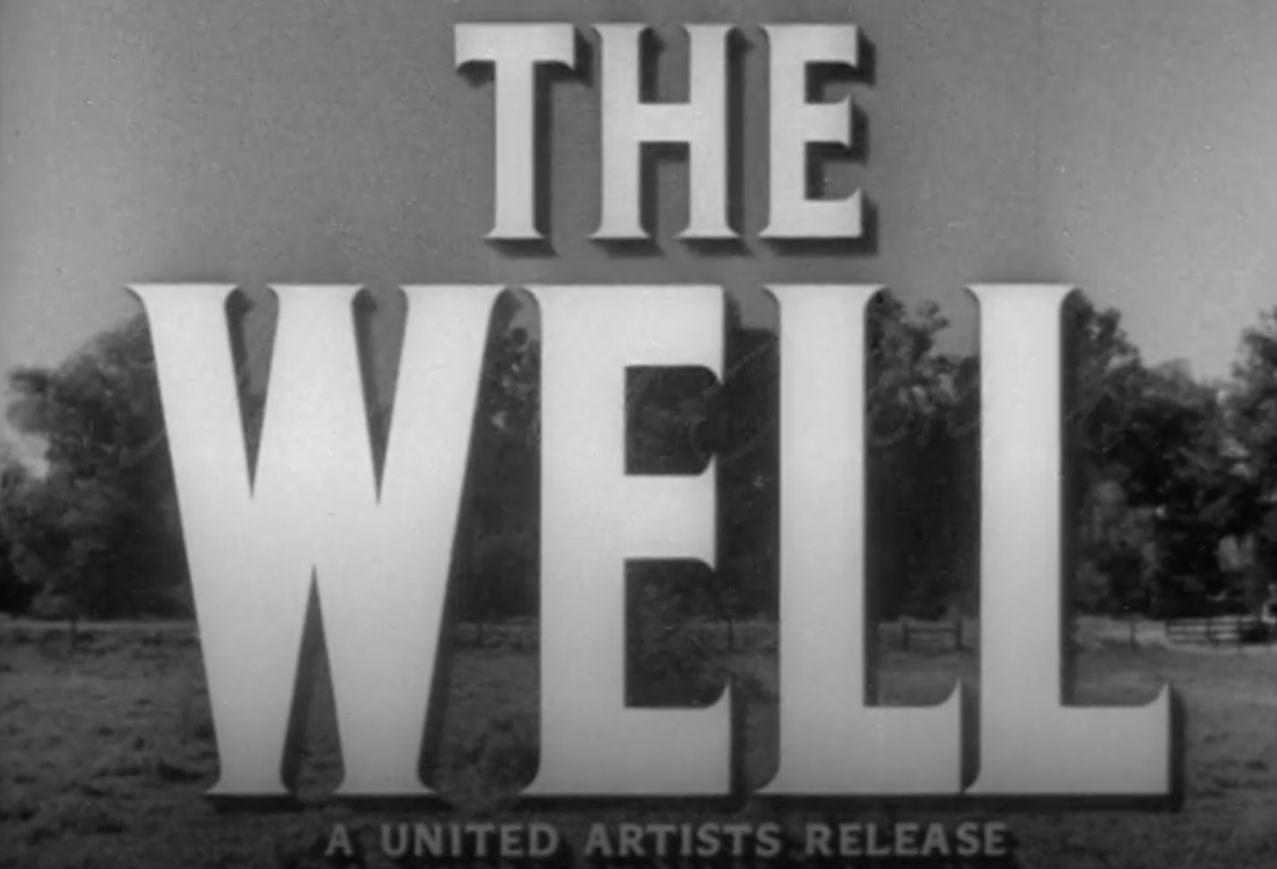
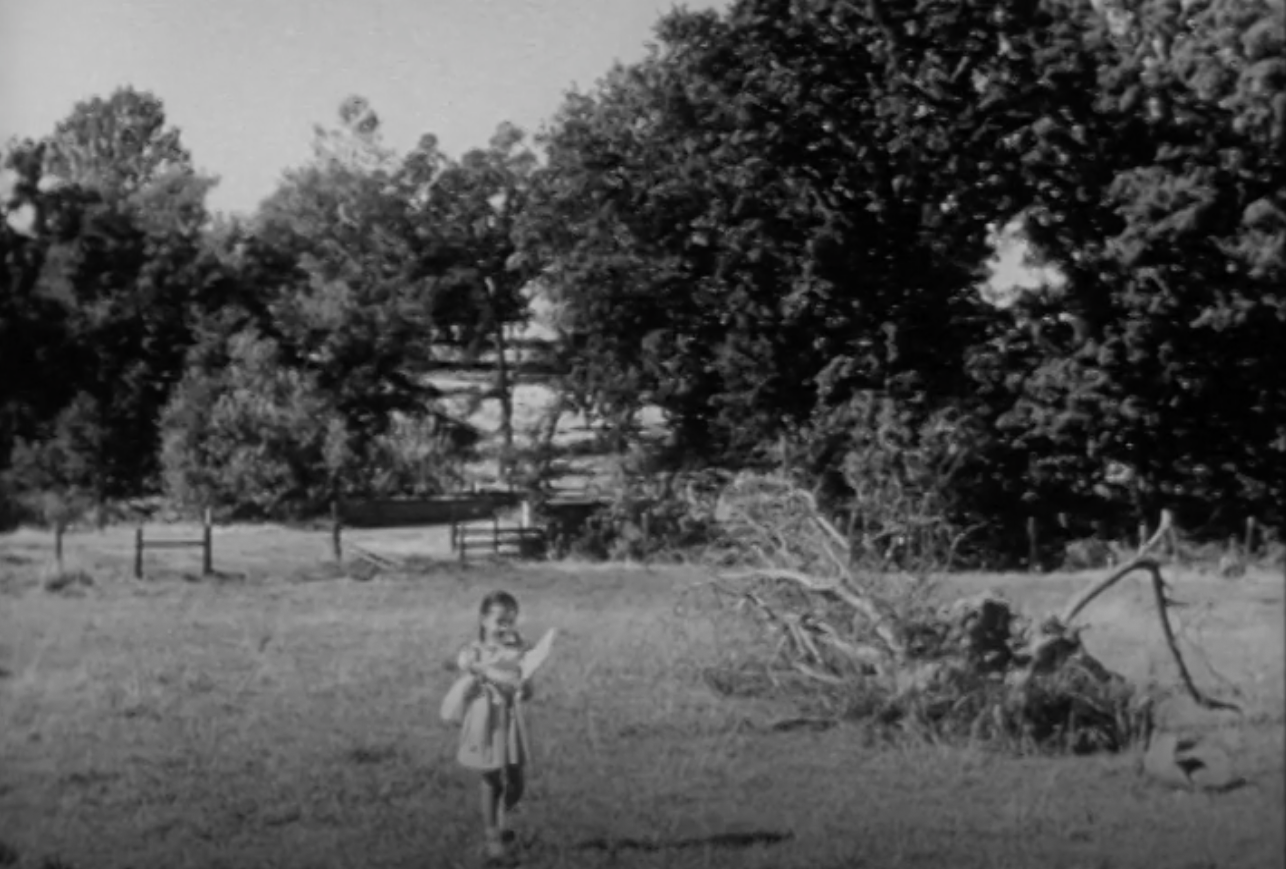
Following this brief musical foreshadowing, a lyrical violin obligato plays under the credits before the piano joins in and the music swells to introduce the triumphal theme that would later close the film. After the final opening credit, the figure of the girl is seen midframe approaching the audience accompanied by lighthearted music. She picks a flower, then a cut to a medium shot is followed by a shot of the girl skipping along, with Tiomkin’s jaunty music capturing the innocence of the moment.
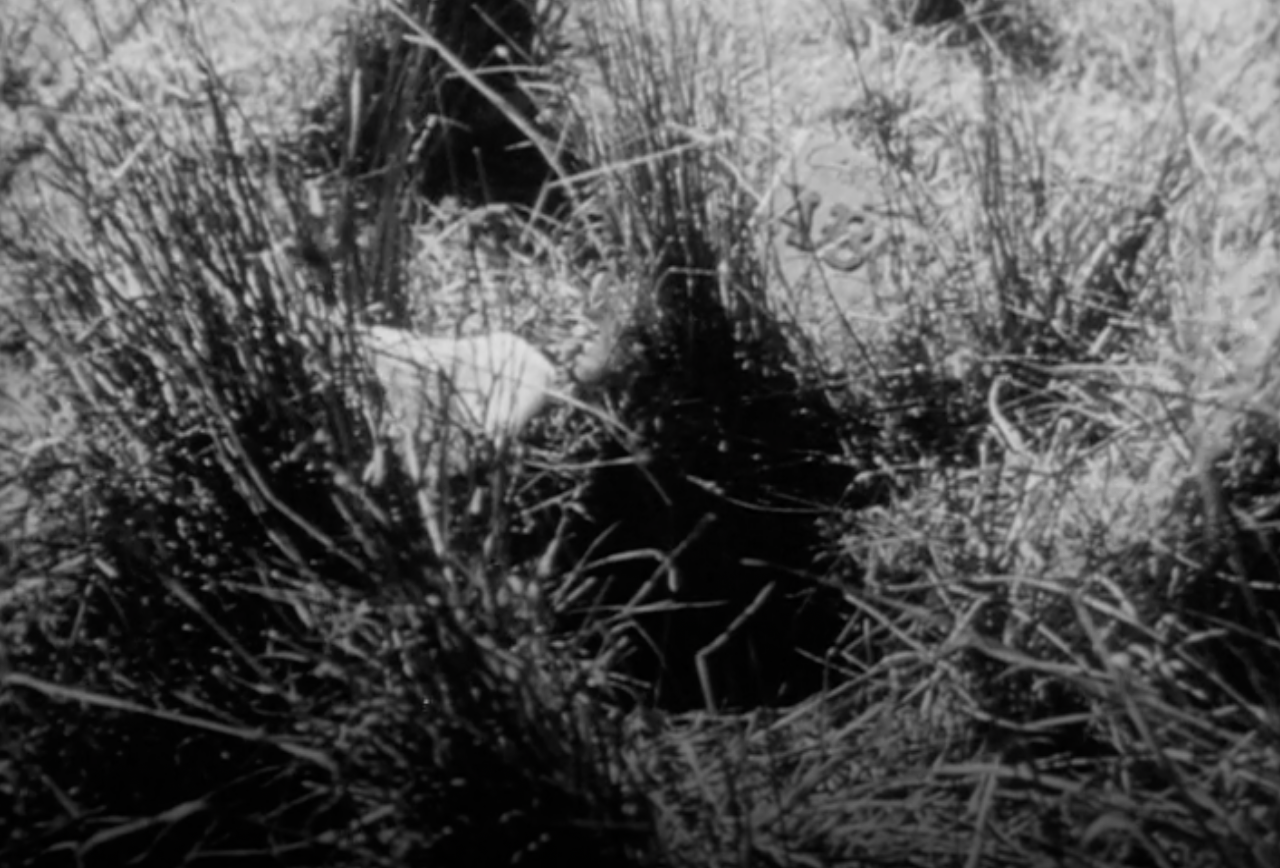
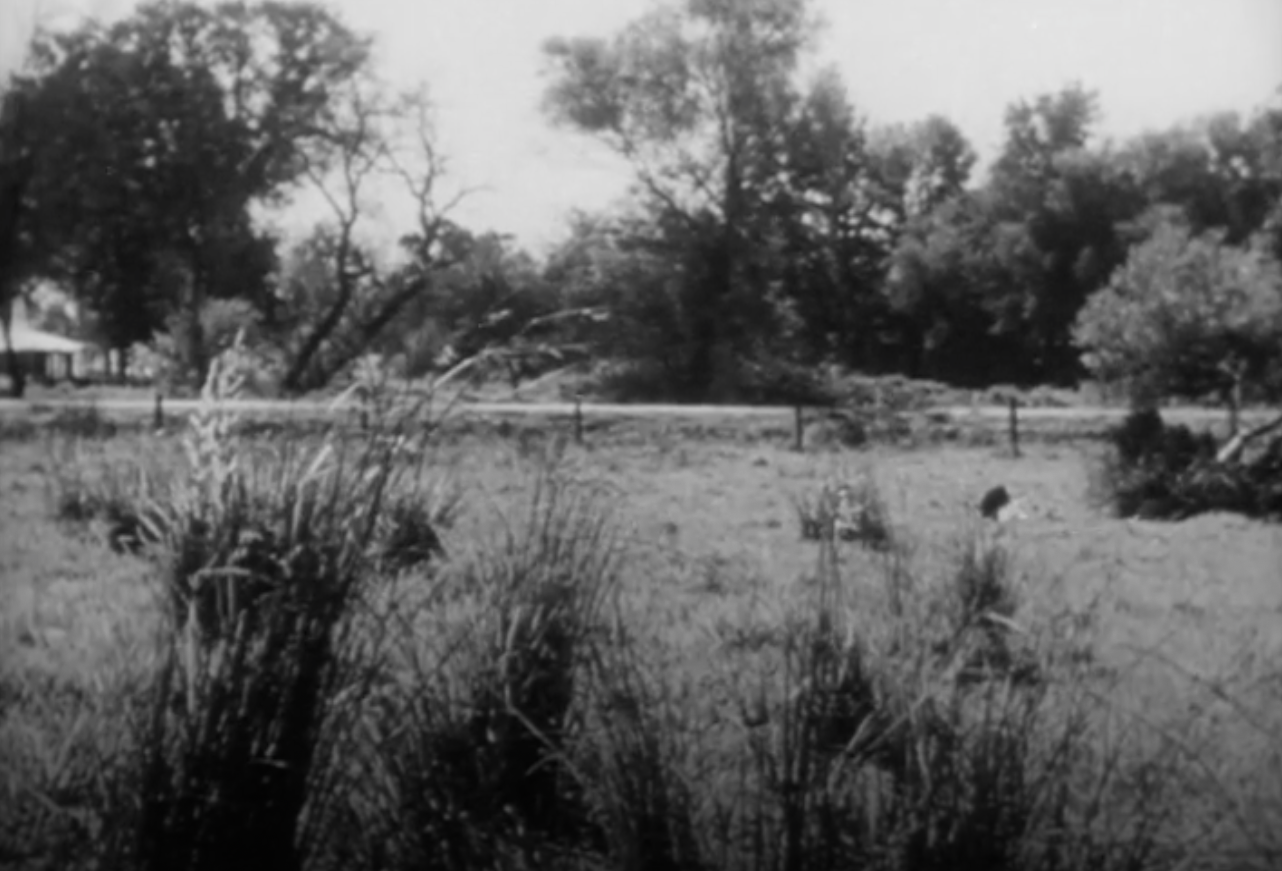
When the girl is suddenly swallowed by the earth, Tiomkin elevates the “horror” of the situation with a discordant blare from the full orchestra. A cut shows the dark hole left behind as the strident music continues, until the camera pulls back to show the field and the music is once again serene.
In the first cue following the Main Title, as with many of the film’s cues, the music enters after a key line of dialogue, in this case a witness blurting out, “He was a white man!” This nearly three-minute sequence sets up the story visually and musically and it is the music during the dialogue-free montage that expresses the spreading news and growing concern in the Black community.
Many Americans may remember the gripping, nationally televised rescue of toddler Jessica McClure from a well in Texas in 1987. The Well is based on a similar story from more than two decades earlier that has been recognized as the first local television coverage of a breaking news story. After three-year-old Kathy Fiscus fell in a well in San Marino, California, in April 1949, coverage by local station KTLA caught the attention of a new and growing television audience and launched the six-decade career of young TV reporter Stan Chambers. Unfortunately, unlike McClure, Fiscus did not survive her ordeal. The static wide-angle shots of the rescue scenes in The Well lend a newscast- or newsreel-like feel.
In addition to The Well, the Fiscus tragedy inspired two other Hollywood films: The Three Secrets, directed by Robert Wise and released in October 1950, and Ace in the Hole, directed by Billy Wilder and released in July 1951. The writers of The Well drew on the Fiscus tragedy to create a story steeped in racial harmony by changing the race of the girl from white to Black. Co-writers Clarence Greene and Russell Rouse, who would also co-direct, completed their script within a year of the tragedy. They also traveled to Wayne University to research the Detroit “hate strikes” of 1943. White workers went on strike to protest Black integration, and racial violence ensued, in which 25 Blacks and 9 whites lost their lives.
The Well would reteam Greene and Rouse with presenter Harry M. Popkin and composer Dimitri Tiomkin, all contributors to the classic film noir suspense thriller D.O.A., also a Cardinal Pictures production. For this film, Harry’s brother, Leo M. Popkin, served as producer and co-director.
Cameras began rolling in September 1950, in Marysville and Grass Valley, two north central California towns meant to stand in for “Anytown, U.S.A.,” and numerous townsfolk can be seen in extra and bit parts. Marysville is 40 miles north of Sacramento and Grass Valley is 30 miles east of Marysville.
During filming, the title was changed to Deep Is the Well and John M. Lee was named technical adviser to Harry M. Popkin. Lee penned a column, “Labor on the March,” and was managing editor of the California Eagle, a prominent left-leaning African American newspaper in Los Angeles that, along with other organizations fighting for minority rights, was considered subversive. Within a week of the announcement of Lee’s appointment, Popkin received letters of protest charging Lee with being an active Communist; it was reported Lee was “on the brink of losing” the enviable position. The aftermath is unclear, and his contributions to the film, if any, are not known. (Less than six months later he was ousted from the Eagle.)
With principal location photography complete, in late October screenwriter Clarence Greene remarked to columnist Ezra Goodman, “The point this picture makes is that ignorance and stupidity can cause intolerance, but that knowledge can cause people to work together.”
Describing the film as a “hush-hush drama of racial prejudice,” another columnist, Erskine Johnson, witnessed the rehearsal of a key interior jailhouse scene at the Motion Picture Center Studios.
Of the Motion Picture Center, Tiomkin writes in his autobiography, “I worked on a number of pictures there; I preferred the excitement and stimulation to the comparative lethargy of a large studio. It was for years a beehive of small independent film producers, some who had jumped in to make a fast buck, other people with sound and original ideas.” (In addition to The Well, films scored by Tiomkin and produced at the Motion Picture Center include Champion and High Noon.)
Harry M. Popkin, eyeing the film’s potential box-office prospects, allocated $300,000 for advertising in national magazines, trade publications, and selected newspapers.
Prior to D.O.A. and The Well, in the late 1930s the Popkin brothers partnered with Black actor Ralph Cooper to form Million Dollar Productions to produce films with African American casts. In the leading roles, the cast for The Wellconsisted of a near equal number of Black and white actors.
Targeted copy was prepared for Black newspapers. Marketing to Black audiences formed part of a somewhat unusual—for the time—campaign that included special screenings for Black dignitaries, coordinated transportation by bus and car to theater parties, and outreach to Black ministers to urge their congregants to see the picture. Under the title Deep Is the Well, the film was set to be released by United Artists in February 1951.
Reaction was mixed. The Sentinel, an African American owned weekly newspaper published in Los Angeles, labeled the film “another Hollywood-solved race problem,” decrying, “The Hollywood treatment of race themes is too often over-imaginative, over-dramatized, and definitely over-worked, and shows a lack of knowledge or insight into conflicting…race views.” The publication continued, “Purely in the interest of interracial understanding, we look forward to the day when Hollywood produces a film intelligently depicting everyday Negro life, which, strangely enough, is remarkably similar to everyday ‘white’ life.”
Some of the film’s actors, however, did praise its handling of racial themes, as covered in Ebony magazine.
The Well appears to be the sole film acting credit for five-year-old Gwendolyn Laster, a Los Angeles native and daughter of a schoolteacher, who plays the child trapped in the well. Even though her role was fleeting, Laster’s name would appear in newspaper ads for the film throughout the 1950s and in television listings in later decades. Maidie Norman and Ernest Anderson play her parents, Alfred Grant is her uncle, George W. Hamilton is the grandfather, and William H. Walker, the family physician.
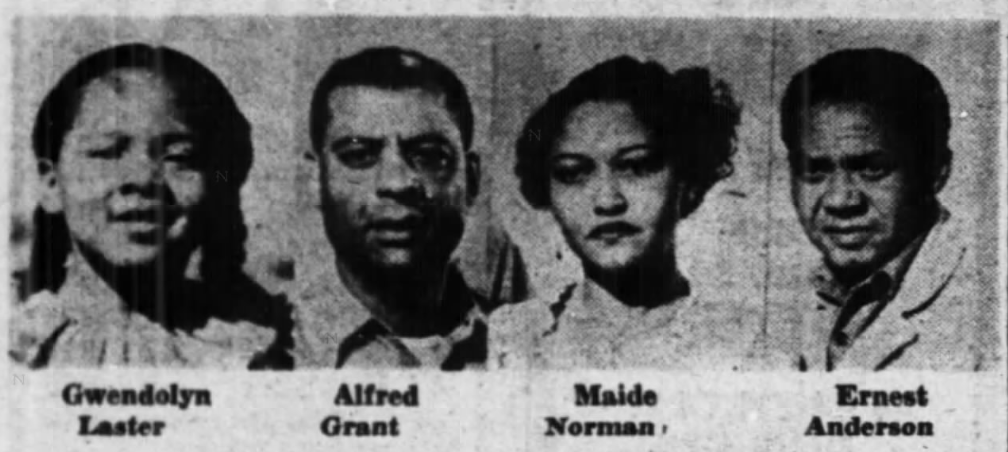
During what was then called Negro History Week* in Los Angeles in February 1951, four actors “from the forthcoming picture ‘Deep Is the Well’” appeared in a program, “Portraits of Pioneers—In Color,” a dramatic review of early Californians. Norman, Walker, Hamilton, and Laster were featured. (Jester Hairston, a previous Black History Month subject, also took part.)
(*The name is a precursor to Black History Month. It was launched by Carter G. Woodson in 1926, ten years after a discussion with friends concerning the racist film The Birth of a Nation resulted in Woodson forming the organization that published The Journal of Negro History.)
The film’s release was jeopardized when Popkin decided “under present circumstances” not to deliver the film as promised to United Artists. At some point, he began negotiations with Columbia for distribution. Columbia announced it would release the film before a deal was signed, prompting United Artists to threaten legal action. United Artists prevailed, and in June announced a fall release as The Well.
The press preview took place at the Academy Award Theater on Melrose Avenue in Los Angeles on August 31, 1951. The film went into general release on September 10, 1951.
In the days leading up to the world premiere and during opening week in New York, visitors to Times Square might have seen a float—a flatbed trailer with large blowups of key dramatic scenes, taglines, and four women in bathing suits that had nothing to do with the film or its contents—circling the theater district touting the film and its presentation at Loew’s State Theater. Other hype included Strobe camera pictures (capable of taking pictures in the dark) that caught the faces of moviegoers at dramatic moments in the film and excerpts from Preview cards that included audience reactions from “tense” to “powerful” to “heartwarming.”

The climactic rescue scene at the well is a virtuosic tour-de-force. Tiomkin musically dramatizes and anthropomorphizes the rotary digger, a massive drill, crane, and shovel illuminated by automobile headlights. Here the music supplies the sounds and impressions of the outsize equipment at work. As the machinery pounds the ground, its impact is punctuated by the music, which stops, then builds again as the equipment is raised for the next stroke. The result transcends realism as the simultaneity of the musical thrusts with the machine provides more drama than the sound of the machine itself. Following this, a mesmerizing repetitive vamp underscores the rescue effort.
Music for cue 9M3, “She’s Alive,” is prompted by the line of dialogue, “She’s gonna be all right,” as triumphant music wraps up the picture before we hear the End Cast music. Such music did not go unnoticed. Variety pointed out, “Dimitri Tiomkin’s dramatic musical score contributes strongly to the buildup of suspense.”
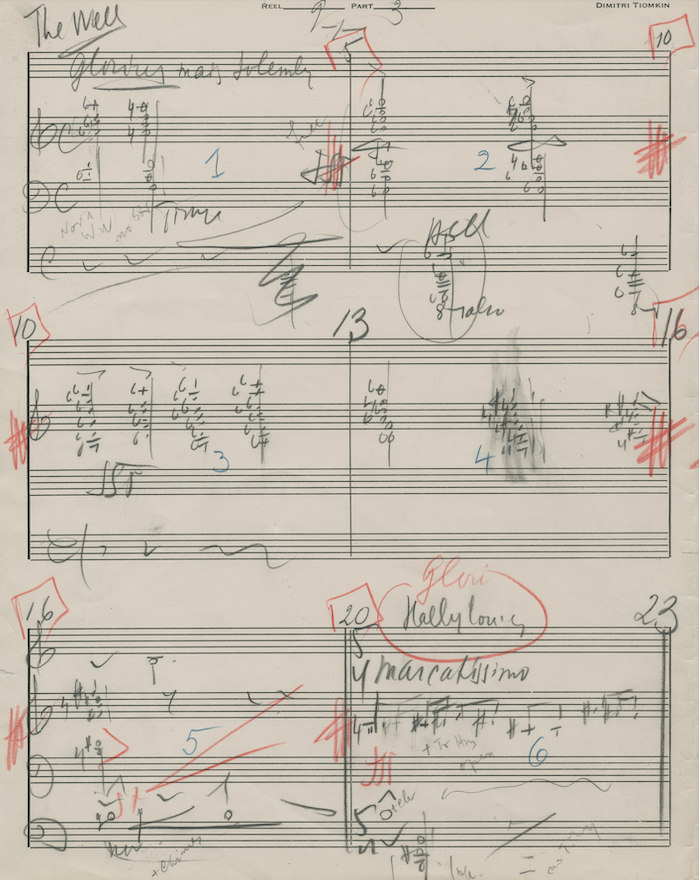
Dimitri Tiomkin’s handwritten music sketch for music cue 9M3.
Richard Griffith in the Los Angeles Times praised the film’s “uncommon freshness” and concluded the picture “must rank as one of the best, most generally stimulating of the year.”
A liberal publication, New Statesman & Nation, wrote, “The Well belongs to that decently exciting class of American film which deals, or attempts to deal, with race conflict.”
Variety also reported that the Ohio Film Censor Board had concerns with the presence of Black actors. Four months passed before approval was forthcoming.
The film was honored by Holiday magazine with the Holiday Award “for the low-budget picture which does the most to present an honest picture of American life to the rest of the world.” The Pittsburgh Courier, an African American weekly newspaper, selected the film as best of the year.
The Well received Academy Award nominations in the Film Editing and Writing (Story and Screenplay) categories.
In 2004, Silva Screen issued a four-CD set, The Alamo: The Essential Dimitri Tiomkin Film Music Collection, that contains just over four minutes of music from The Well. I assisted Patrick Russ in selecting and arranging this track. In working with Pat on many film music concert suites over the years, this is the only occasion I can recall where we opted to repeat an 8-bar section of music—for the thrilling, Prokofiev-like thrusts accompanying the digging machine—while making slight changes to the orchestration in the repetition.
To date, the entire soundtrack from The Well has not been released.

Sources
“L. A. Editor Is Advisor On Film,” Arkansas State Press, September 15, 1950
“this day and age,” by Clyde O. Jackson, Arkansas State Press, September 22, 1950
“New Slant,” New York Times, October 1, 1950
Announcement of title change to Deep Is the Well, Boxoffice, October 7, 1950
Erskine Johnson column, Los Angeles Daily News, October 28, 1950
Ezra Goodman column, “Behind the Camera,” Los Angeles Daily News, October 30, 1950
“UA Approaching Crisis, Prospects Grim for Acquiring More Product,” Variety, November 15, 1950
“Hollywood Report,” by Ivan Spear, Boxoffice, November 18, 1950
“Deep Is the Well” and “Negro Actors Praise Film’s Handling of Racial Theme,” Ebony, volume 6, 1950
“Made in Hollywood,” Los Angeles Sentinel, January 18, 1951
“Reception, Citations Climax History Week Observance,” Los Angeles Sentinel, February 15, 1951
Popkin Back in UA’s Camp,” Variety, June 27, 1951
“Film Preview: The Well,” Variety, September 5, 1951“Human Tragedy Re-Created in ‘The Well,”” by Gladwin Hill, New York Times, September 9, 1951
Newsweek, September 24, 1951
Eleanor Roosevelt quote from her newspaper column, “My Day”
“Economical Artistry of ‘The Well’ Hailed,” Los Angeles Times, October 1, 1951
“Remade in Hollywood,” Los Angeles Sentinel, October 25, 1951
“The Holiday Awards for 1951,” Holiday magazine, January 1952
Variety, February 19, 1952
New Statesman & Nation, February 23, 1952
The Well entry in the American Film Institute Catalog