

To create the biographical novel, The Day on Fire (1958), American writer, adventurer, and mountaineer James Ramsey Ullman at age 50 traveled to Europe and Africa to retrace the steps of the 19th-century French poet Arthur Rimbaud. Upon his return, Ullman spent eighteen months at a typewriter transforming his experience and research into a fictional narrative of his subject, an enigmatic figure—a poet turned wanderer—who left behind influential youthful works that foreshadowed surrealism.
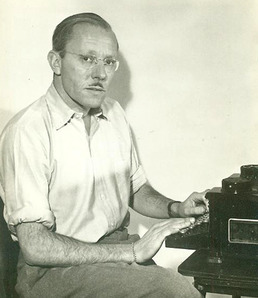
James Ramsey Ullman at the typewriter. https://www.valancourtbooks.com/the-day-on-fire-1958.html
After working as a newspaper reporter and producing plays by George Bernard Shaw and others on Broadway in the 1930s, Ullman spent the remainder of his life combining his love of writing with world travel and mountain climbing.
Ullman shared similar interests with Tiomkin’s friend, the writer and traveler Lowell Thomas. Both men enjoyed travelling to remote areas of the globe in the decades before international travel became more accessible to the masses when commercial jet planes replaced smaller and slower propellor-driven planes. After long flights, Ullman was known to explore the South Pacific, the Caribbean Islands, and the Amazon River in small boats.
Nearly ten years after the publication of The Day on Fire, Tiomkin began his pursuit of the motion picture rights. In July 1967, Peter H. Matson, the nephew of literary agent Harold Matson, sent Tiomkin two copies of The Day on Fire. Tiomkin previously interacted with the Harold Matson Company to option Isabel Colegate’s novel, Statues in a Garden. Now Tiomkin was staying at the Savoy Hotel in London and weeks before had met Peter in London where the two discussed The Day on Fire. Two months later a cable from Hal Matson in New York arrives at the Savoy Hotel on September 11 and outlines the terms of an option. Meanwhile, Tiomkin is producing Tchaikovsky and has left London for Russia when a follow-up cable from Matson arrives at the Savoy Hotel. In a move exemplifying hotel service in a bygone era, the Savoy sends a cable at the hotel’s expense which Tiomkin receives at the National Hotel in Moscow on September 23 that quotes the entire Matson cable.
By mid-October Tiomkin is back in the United States and staying at the Hotel Sherry Netherland in New York City. Harold Matson sends a letter there with the agreed upon terms for a 30-month option. Tiomkin signs the agreement dated October 23, for and on behalf of Tiomkin Musical Enterprises.
Unlike the writers of other story properties that Tiomkin sought to bring to the screen, Ullman had already had four of his novels, including High Conquest, The White Tower, Windom’s Way, and Banner in the Sky adapted to the big screen. Banner in the Sky was made as Third Man on the Mountain. (The 2006 film written and directed by Jay Anania, Day on Fire, is unrelated to Ullman’s book.)
Tiomkin draws up a short list of potential collaborators to send copies of the book, The Day on Fire, to.

As 1967 draws to close, Ullman writes to Tiomkin from his home in Boston. The author is delighted with the option on The Day of Fire, “It happens to be my own best-beloved among my books, and I’m full of hope that it can become a picture of which we’ll both be proud.”
Tiomkin’s reply on January 13, 1968, is lengthy and detailed. He believes the timing is right to bring the story of the dynamic and colorful life of the great rebel and poet to the screen and to illuminate, “this continuous enigma of the suffering and creative problems of great personalities.” He asks the author if a French translation exists. “This is most important to me on account of my connections in France and the necessity of following the authenticity for this period in France to the highest degree.” Ullman replies, but alas there is no French edition or translation of the book.

Letter from James R. Ullman to Dimitri Tiomkin decrying a lack of a French edition or translation of his book, January 24, 1968.
Tiomkin sends the book to British director and producer Jack Clayton, noted for his ability to bring literary works to the screen. Clayton returns the book in May 1968 with a note, “it isn’t really the subject I am looking for at the moment, although I am sure it would make a splendid film.” (Clayton was about to enter a long drought, his only film between 1968 and 1982: The Great Gatsby released in 1974.)
Tiomkin signs Leah Wycliffe to write an adapted screenplay in March 1969. No information about Wycliffe could be found, her identity appears to be even more elusive than Haskell Brown.
Tiomkin approaches Gene Frenke, but the two have difficulties connecting. (Eugene Frenke, a Ukrainian-born film producer, director, and writer was married to actress Anna Sten.) Frenke runs Springfield Productions out of his home on Coldwater Canyon in Beverly Hills. Frenke writes, “Let me know if there is any objection to my submitting this book to MGM, because we have one unfulfilled contract there.” Nothing further comes from the Frenke connection.

Draft of letter to Gene Frenke (Eugene Franke) from Dimitri Tiomkin, May, 29, 1969
With time running out and not much progress, Tiomkin sends Harold Matson two thousand dollars in April 1970 to renew the option for one year.
Ullman writes to Tiomkin in May 1969 regarding new Doubleday editions, both hardcover and paperback, of The Day on Fire and mentions a new novel. That novel, And Not to Yield, set in the mountains of Nepal and published in 1970, would be his last. Ullman died in Boston from cancer on July 5, 1971. An “In Memorium” for Ullman in the American Alpine Club magazine lauded the climber for introducing “Americans of all ages to the world of the high mountains.”
After the option expires, there is one last letter in Tiomkin’s Day on Fire file from Harold Matson, dated November 30, 1971, asking if Tiomkin is still interested in Ullman’s novel.

Letter from literary agent Harold Matson, November 30, 1971.
Sources
Correspondence courtesy of Olivia Tiomkin.
“Movie Call Sheet,” Los Angeles Times, March 20, 1969. On signing Leah Wycliffe.
“James Ramsey Ullman, 1908–1971,” by Samuel C. Silverstein, American Alpine Journal, vol. 18, no. 1, 1972.