
PART 1 of 2
Do you have a bottle of Mr & Mrs T® Bloody Mary Mix in your refrigerator? (If not, I highly recommend it.) Perhaps you’re at an age where you remember when flight attendants were called stewardesses and they would hand you a small chilled can of Mr & Mrs T® Bloody Mary Mix to blend with a miniature glass bottle of vodka on your business flight to New York or London.
How did a career musician, Herb Taylor, and his homemaker wife, June, break into the food and beverage industry, creating and selling Cocktail Barbeque Sauce and a Bloody Mary Mix that today is an international brand that has outlived the couple, namely Mr & Mrs T®?
Part one of this two-part article will feature the first-ever in-depth biography of Herb and June Taylor. Music arrangers often toil in obscurity, in fact, in books on film music the name Elizabeth Taylor appears in indexes with far greater frequency than that of Herb Taylor.
Part two will document the fascinating history of Mr and Mrs T® brand and the corporate history of Taylor Food Products. In the 1950s and 1960s, before Shark Tank was created for entrepreneurs, Herb and June Taylor took their home business to market the old-fashioned way. Three products created in the couple’s kitchen were bottled and sold to friends and fellow musicians, then convenience and liquor stores, and finally, through a distributor to businesses and consumers around the world.
Composer Dimitri Tiomkin and arranger Herb Taylor began a professional working relationship in 1944, when Tiomkin hired Taylor to provide arrangements for the film Dillinger. By the time Taylor retired twenty years later, they had collaborated on the music scores for dozens of classic films, from Dial M for Murder to High Noon.
Herb and June Taylor
Herb Taylor (1905–1983) was born George Herbert Taylor to Herbert and Florence Jennie (Goward) Taylor in Monterey and raised in Stockton, California. June Taylor (1906–1993), as she became known during her married life with Herb, was born Viola May Gofield in Stockton. Her parents were John E. and Margaret Edith (Stevenson) Gofield. When Viola was five, her father was gunned down on the last day of the year in 1911 by the husband of a woman who admitted to having an affair with John Gofield. (The killer was sentenced to life in prison in 1913, paroled in 1920, and pardoned by Governor Earl Warren in 1951.) When Viola’s mother remarried less than a year later, Viola took her stepfather’s surname of O’Dair.
Herb’s father, a barber, started his school-age son on cornet and lessons with a local music teacher and pianist, Henry E. A. Glameyer, soon followed. As a charter member and chief trumpeter of the Stockton Moose Lodge No. 391 Drum, Fife, and Bugle Corps, at age 10 Taylor performed in the group’s first public appearance in February 1916. Herb earned some pocket money with a newspaper route, beginning on May 19, 1917. By high school the boy became a virtual one-man band after he took up drums and trombone. Taylor drew attention to his multiple instrument skills as a teenager when he performed proficiently on cornet, trombone, and piano.
His musical outlet and training ground proved to be a band sponsored by the local newspaper, the Stockton Daily Record, under the direction of Charles D. Smith (also the band instructor at the Captain Charles M. Weber Institute of Applied Science and Technology, known locally as the Weber Institute). The unique concept of the Record Carrier Boys, as the band was known, was simple, the boys who delivered the newspaper would comprise the thirty-piece band. An inaugural member, Taylor spent four years with the group.
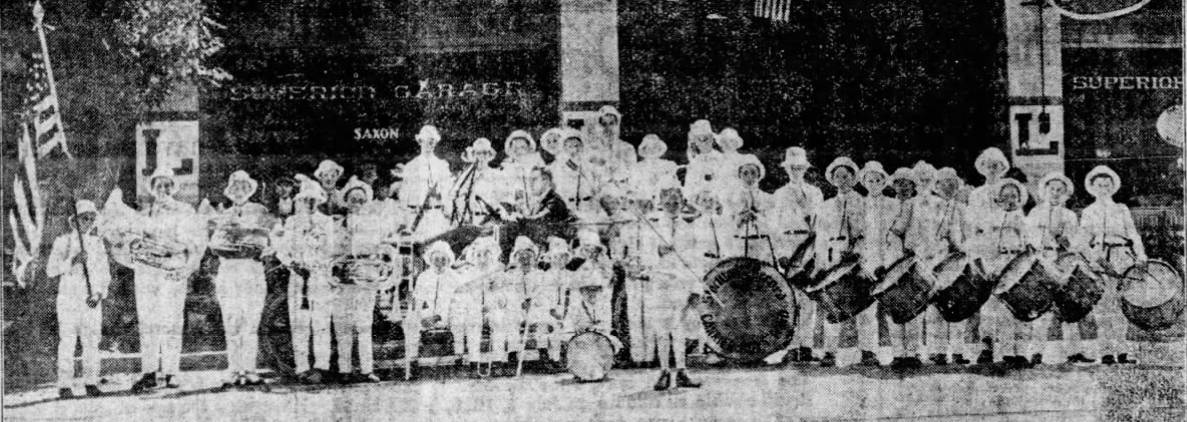
The Stockton Record Carrier Boys band in October 1917. V. Covert Martin, photographer.
As the cornet soloist, “Herbie,” as he was the known around Stockton, drew ovations. “Little Herbert Taylor’s cornet solo, ‘Silver Threads Among the Gold,’ was encored” at a February 1918 concert. When actress Baby Marie Osborne came to town to open one of her films, Taylor led the parade to the Hippodrome Theater, all pomp and circumstance. On slide trombone he entertained the Mayor and gathered town folk as service men returned from World War I. Called a “clever pianist” and billed in a program as “The Boy Wanderer,” he often entertained at social and civic events.
The Dancing Arcade: a clever pianist and fox trot dancer fall in love
Herb and June met at the Dancing Arcade, a Dancing Academy specializing in ballroom dance in Stockton. Chosen for the “Variety Fox Trot Contest” in mid-January 1922, Viola O’Dair danced to music of the house band, Jack Coale’s Orchestra.
Three months later, under new management, one of first actions manager Frank T. Quirk took was to replace the house band with Herb Taylor’s Arcade Orchestra. The bandleader was only 17 years old. Perhaps it was Herbie Taylor at the piano playing “Kitten on the Keys” that caught the attention of Viola May O’Dair. Taylor’s rein at the Arcade was short-lived, when after only a few weeks Quirk was replaced, Taylor was out, and a new orchestra opened the first week of the following month.
Taylor moved on immediately with his band to other local venues, including the Oak Park amusement grounds open-air dance facility and Palm Gardens. In April 1922, Taylor got a glimpse of his future, performing in movie theaters, when he opened with “Sang and His Syncopators” at the Rialto.
Meanwhile, that summer Viola was among the top contenders for the Veteran of Foreign Wars Flag Day pageant contest.
According to family lore and a later newspaper interview, Herb and June wed as teenagers, apparently in the summer or fall of 1922. Prior to their marriage, at age 16, Viola was living with her stepfather and brother and, no longer a student, working as a telephone operator. At 18, Herb’s occupation was listed as musician and he was living away from his parents in downtown Stockton at the Henery Apartments, a fashionable brick and terra-cotta building notable for its Tiffany-style street awning.
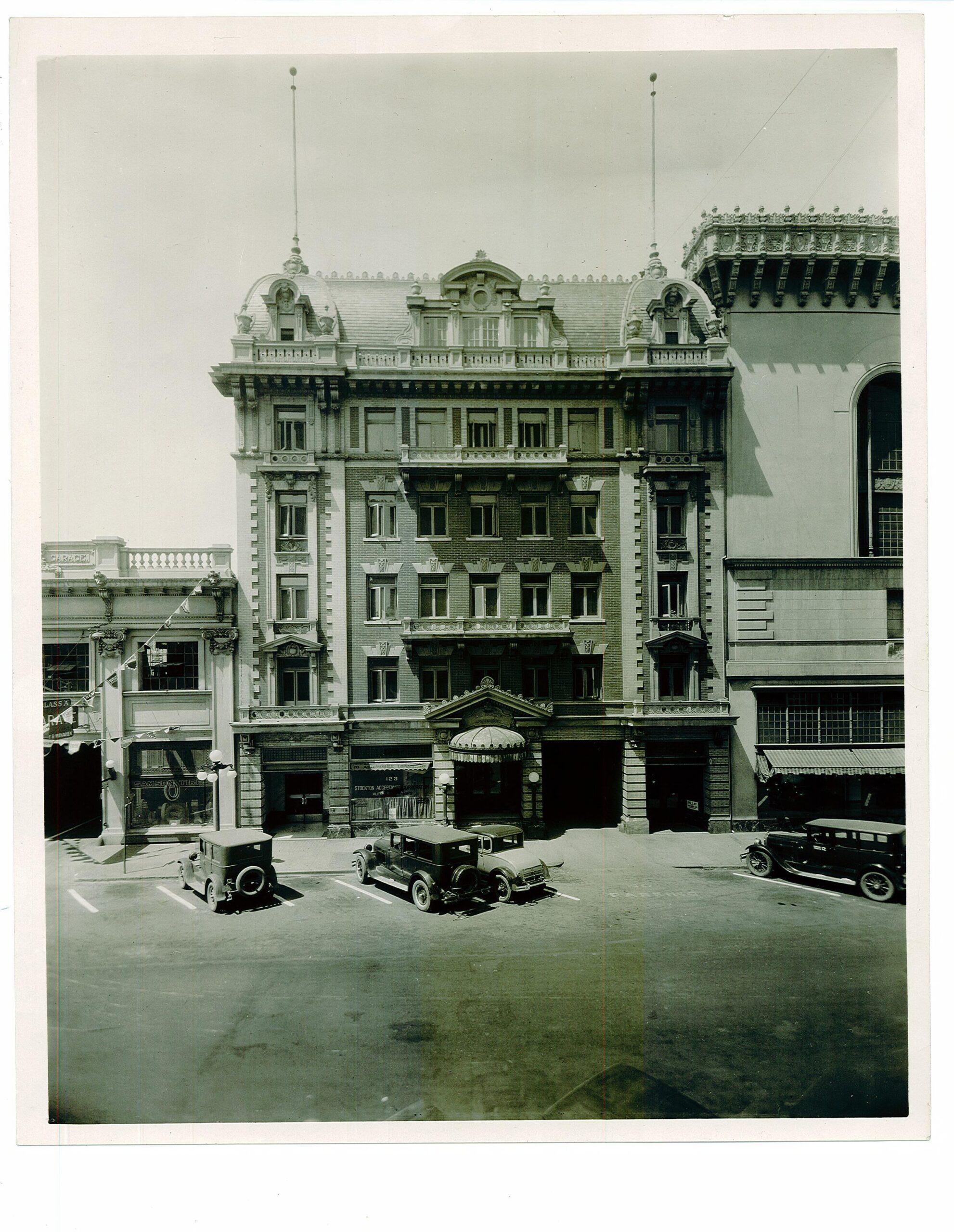
The Henery Apartments, 121 S Sutter St., Stockton, circa 1930. Van Covert Martin, photographer. Holt-Atherton Special Collections, University of the Pacific Library. Resource Identifier: P77-3742.
Married Life
The couple moved to San Francisco where Herb made ends meet playing horn in a taxi-dance hall. (When Herb first ventured beyond Stockton, performing at the Modesto Wintergarden in September 1922, he and June may have already been married. No public announcement or official record of their marriage could be found online.)
Not long after Viola changed her surname to Taylor, in December 1922 her stepfather Fred O’Dair, a Stockton police officer, filed for divorce from Viola’s mother accusing her of “frequent intoxication.” (Fred O’Dair would go on to marry a Russian woman, Marie Fillie Zavodnek, in 1924, and Viola’s mother, Margaret Edith O’Dair would marry John Louis Aratta in 1927.)
Herb Taylor’s new life as a married man, breadwinner, and professional musician began by the Fall of 1922 and developed under bandleaders Paul Ash and Max Dolin at the Granada and California Theaters in San Francisco. (Some years later, composer Dimitri Tiomkin and Paul Ash had a tangential association through the musical The Racketeer.) Taylor played with Ash and his Synco-Symphonists and under conductor Dolin with the California Orchestra. Beginning in December 1922, Ben Black oversaw the band at the California Theater and Taylor would follow Black to the Alexandria Theater in November 1923.
Next, Taylor joined Henry Halstead and His Hotel St. Francis Orchestra on trombone. After Halstead’s contract with the hotel ended late in 1924 he took the band on a California road trip. The first stop in January 1925 was Stockton, where Herbie and June Taylor’s friends were probably in attendance. Upon their return to San Francisco the Orchestra became an added attraction at the Orpheum, a popular vaudeville theater, while also performing dance music broadcast on radio from the Garden Room at the St. Francis. Sixteen recordings released by the Victor Talking Machine company brought additional fame to the group that took a symphonic approach to dance music and jazz. In the Fall of 1925 the Orchestra was scheduled to head to the East Coast.
According to the Taylor’s son and daughter-in-law, Herb returned to the Bay Area in January 1926 to perform with Herbert Meyerinck at the State Theater in Oakland. The stage band of Herb Meyerinck and the State Synco-Symphonists entertained before films such as The Cohens and the Kellys, “one of the funniest pictures ever made” according to a newspaper ad. After a Farewell Concert at the theater, Meyerinck a fixture of the Oakland dance band scene moved to the Clift Hotel in San Francisco where “HM and His Radio Band” filled the airwaves before his next venture brought a return to performing at movie houses.
If Herb Taylor remained with the band he would have accompanied the Pola Negri film, Barbed Wire, when it opened at the Alexandria in November of 1927.
Pushed out of movie houses with the advent of Movietone and sound on disc, Meyerinck returned to hotel entertainment, then disappears from the music scene by the summer of 1928. In September of 1928, when June’s grandmother passed away, Herb and June were still living in San Francisco, and the couple is listed as residents in city directories residing at 340 Hayes in 1929, and 2035 Hayes in 1930, although as we will learn the Taylors had relocated to Los Angeles by the time of the 1930 census in April.
The next bandleader to employ Herb appears to be trumpeter Red Nichols. (The family notes that Phil Spitalny, best known for leading an all-girl band in the 1930s, employed Herb although I wasn’t able to confirm the information.) Did Taylor join Nichols and His Five Pennies at Fatty Arbuckle’s Plantation Café in Culver City in February 1929 or when the band headed East later in the year?
Taylor’s appearance with Nichols in a Vitaphone musical short in 1929—the same year that Dimitri Tiomkin was gravitating toward film work, pulled between New York and Hollywood—served as an introduction to synchronized sound and the film world where he would later carve out a lengthy career, notably as Tiomkin’s go-to arranger.
The Nichols eleven-piece band, often billed as a Brunswick Recording Orchestra, toured in the East during the summer of 1929. The Recording Orchestra was a band to be reckoned with. The three trombonists were Glenn Miller, Jack Teagarden, and Herb Taylor, with Jimmy Dorsey on sax. Leo Arnaud would fill in for Taylor. In the months leading up to the Stock Market Crash of 1929, Taylor could be heard on more than a dozen recordings with Nichols.
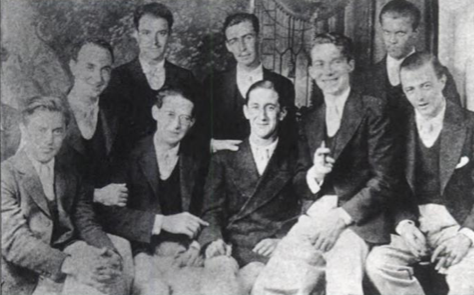
The Red Nichols Band, 1929. Herb Taylor is seated on the far right, next to Nichols. The original photograph is in the Duncan Schiedt Collection at the Library of Congress.
Making a Living in Los Angeles
When bandleader Abe Lyman returned to Los Angeles from London, Paris, and New York in January 1930 after a notable absence, Herbert Taylor joined the band replacing trombonist and arranger J. King Ross. The Lyman band opened at Grauman’s Chinese Theater on January 17 for the premiere of The Rogue Song. Two days before, composer Dimitri Tiomkin and his wife, choreographer Albertina Rasch, arrived by train from New York. With Taylor on the stage and Tiomkin in the audience the assembled crowd included Arthur Freed, Eddie Mannix, B. P. Schulberg, Mack Sennett, and other famous and powerful film folk. As the Los Angeles Evening Express described it, “One of the spectacular scenes shows the Albertina Rasch ballet of a hundred girls, filmed in natural colors and striking costumes, dancing to the modernistic music of Dimitri Tiomkin, played by a symphony orchestra in the palace episode of the picture.”
One memorable Saturday evening the Lyman band performed in the Chinese Theater forecourt at 11 p.m. preceding the Midnight Frolic screening of The Rogue Song. The outdoor frolic, dubbed “Dancing under the stars,” was open to the public.
With the advent and popularity of sound films, both the Taylors and Tiomkin could be found living in the vicinity of Paramount Studios by April 1930. Herb’s teenage brother, Harry, was living with the couple. The Taylor boy’s mother died of meningitis in 1914, when Harry was an infant, and their father remarried the following year. Harry played trumpet and would also find music work in Hollywood. As an adult he could be found in the MGM music department as a copyist; a role he played on Dimitri Tiomkin’s score for 36 Hours, released in 1964.
Herb had hooked up with Abe Lyman, himself a former local newsboy and a “Favorite of the Movie Stars,” to provide the lanky bandleader with symphonic concert arrangements for his jazz band, considered the best stage band west of the Rockies. Taylor served as chief arranger and trombone soloist. After opening at Grauman’s Chinese, the band moved the Carthay Circle Theater, catering to the moneyed-class in neighboring Beverly Hills. The live band followed the newsreel and animated and live action film shorts, swinging the house with arrangements by Taylor, Lyman, and Arthur Johnston.
Whereas the average cost for a movie ticket was 35 cents, entry to the evening’s entertainment would set you back five bucks. The Lyman appeal was based on extraordinary arrangements, typically four contrasting numbers. In one somewhat unusual booking, shortly after performing live in the theater Lyman’s band could be seen and heard on the big screen in a musical number in the feature film, Just Imagine.
The Carthay would have been on Tiomkin’s radar for movies and music, since films he provided ballet music for, including The Rogue Song and Devil May Care, played the theater. It’s conceivable that he witnessed the Lyman band performing there. Tiomkin and Taylor are in neighboring news items on page 12 of the October 25, 1930, issue of Inside Facts of Stage and Screen. Taylor for his special arrangement of “I’m Confessin’” and more at the Carthay and Tiomkin for playing for the first time his latest music composition, “Moderns in Music” from the forthcoming film Resurrection at his home studio in Hollywood.
The Lyman band appeared in a number of early sound films, including the MGM musicals Good News and Madam Satan and Paramount on Parade (Galas de la Paramount). A staple on radio, Lyman’s band could be heard on the Hit Parade Show sponsored by Lucky Strike, a cigarette brand, broadcast from Hollywood in 1932.
In 1933, the Lyman band migrated east to New York, which is where Herb and June’s only child, Warren Lee Taylor, was born. Appearances in musical shorts ensued for the wildly popular and entertaining Lyman band stationed at the Hotel New Yorker.
After four years in his dual role as player and arranger, the day after Lyman announced the band would be leaving the New Yorker in February 1934, Taylor decided to move on. Returning to his old stomping grounds, he found a change of scenery in Fresno and Oakland when he joined Claude Sweeten’s Orchestra during the summer of 1934. After a stint with Rube Wolf, he departed Wolf’s band along with Bob Kimie and Clarence Hayes for Bob Beal’s band.
In mid-August 1934, the new 15-piece dance orchestra led by Beal and Taylor found a home at the swanky Fairmont in San Francisco in the hotel’s Terrace room. Radio audiences who couldn’t see the floor show live could tune in to KGO radio, an NBC affiliate, three nights each week to revel in the rhythms permeating the airwaves. The Beal and Taylor band was on radio into April 1937, at which time Beal and Taylor went their separate ways.
In 1938, Taylor became a charter member of ASMA, the American Society of Music Arrangers. For the 1936 film, Go West, Young Man, Taylor and Arthur Johnston, who knew each other from the Lyman band at the Carthay, contributed arrangements.
If having a servant, or “mother’s helper,” is a positive indicator for wealth, the Taylor’s were doing well financially by 1940, when Taylor’s occupation is listed as Movie Studio Musician with an annual income of more than $5,000 ($5,000 in 1940 is equivalent in purchasing power to more than $100,000 today). Frankie Sorrels, a seventeen-year-old in her first year of high school, is living with the Taylors, apparently to help with their six-year-old son, Warren.
A stint as arranger for Chico Marx and His Ravellis—named after the bandleader Chico portrayed in the film, Animal Crackers—when that swing band toured the country in 1941 led Taylor to provide vocal and orchestra arrangements for the next Marx Brothers film, The Big Store (1941), where he worked alongside orchestrator Leo Arnaud.
Despite having gotten his foot in the door with arranging for movies, during World War II Taylor fell back on his band leading and performance skills to earn income.
Drawing on his experience with other bands, he created the Herb Taylor Orchestra that could be heard between at least January and June 1942, in his old haunting grounds of Oakland and Stockton among other cities covered by the NBC (Red) radio network.
In 1943 and 1944, Taylor played trombone on a half dozen tracks featuring singer Frank Sinatra.
Arranging Music for Dimitri Tiomkin and others
After the war, Taylor finally settled into a career as an arranger for films that included a lengthy association with Dimitri Tiomkin, as noted before, beginning with the 1945 film, Dillinger.
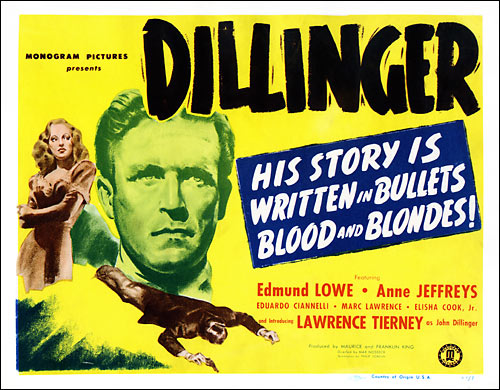
Dillinger lobby card A
While working for Tiomkin certainly paid the bills, Taylor continued to pursue freelance work with other composers. After Taylor provided arrangements for both of the Academy Award-winning scores of 1946, The Jolson Story, for musical picture, and The Best Years of Our Lives, for dramatic or comedy picture, he would be in demand for film work for the remainder of his career. For Best Years Taylor composed and orchestrated the musical montages: “Montage Jump,” “Louie and Ernie’s,” and “Midnight Gardens”; and provided a dance arrangement, “Marie”; and a song arrangement, “You’re the Cause of It All.”
Composer Hugo Friedhofer who took home the Oscar® for Best Years—widely considered one of the best scored films of all time—in an oral history with Irene Kahn Atkins recalled, “I know there was some gal, whose name I can’t remember, who did a kind of early bop type thing in it, called ‘Ee Bop a Ree Bop.’ I know that was prescored.” The prescored number Friedhofer is referring to is a vocal arrangement by Herb Taylor of “E-Bob-O-Lee-Bop” by Tina Dixon for singer-dancer Gloria King.
Gloria King may have appeared in “E-Bob-O-Lee-Bop” for the Soundies Distributing Corp. in 1946; she can be seen in other Soundies, an early proprietary video juke box that often featured African American musicians and dancers, such as Hula Rhumba. (The song, “E-Bob-O-Lee-Bop,” is not to be confused with Lionel Hampton’s “Hey-ba-ba-re-bop,” a similar but different song in release at the same time, let alone the similar sounding lyrics for “Tutti Frutti” by Little Richard ten years later.)
For Dillinger, Jolson Story, and Best Years, Taylor’s arrangements were largely for music cues that incorporated elements of popular music and jazz or included jazz musicians or jazz instrumentation, notably saxophones. He specialized in arranging the source music, that is music simultaneously seen coming from an onscreen source, such as live musicians or a radio, while heard on the soundtrack, including popular, dance, and saloon music. Taylor’s arrangement of “Fisherman’s Jive” for D.O.A. is the perfect example.
In one of the few film music books that mention Herb Taylor, American Film Music—wherein Elizabeth Taylor is indexed four times to Herb Taylor’s one—writers William Darby and Jack Du Bois note, “Throughout his Hollywood career Tiomkin relied on a series of orchestrators to whom he showed remarkable loyalty.”
Tiomkin was decidedly loyal and Taylor did serve as a core member of the composer’s staff of arrangers and orchestrators. According to musicologist William H. Rosar, Taylor was one of nine men who worked with Tiomkin on a regular basis. (Consider that Rosar names more than three dozen other orchestrators of Tiomkin’s film music.) Taylor may have worked on more films with Tiomkin than any other, a remarkable 35 motion pictures between 1945 and 1964. Among them, Champion, Fall of the Roman Empire, Guns of Navarone, The Old Man and the Sea, Red Light, Rio Bravo, and Wild Is the Wind.
READ: Red Light: Gideon Bibles and vengence or film noir meets religion
Known as an arranger, performer, and composer, in that order, Talyor did conduct source music for one Tiomkin-scored film. Taylor is acknowledged as the conductor of “Mosquito Parade” by Howard Whitney and “Dance at the British Embassy (The Belfry Two-Step)”; both were used in 55 Days at Peking.
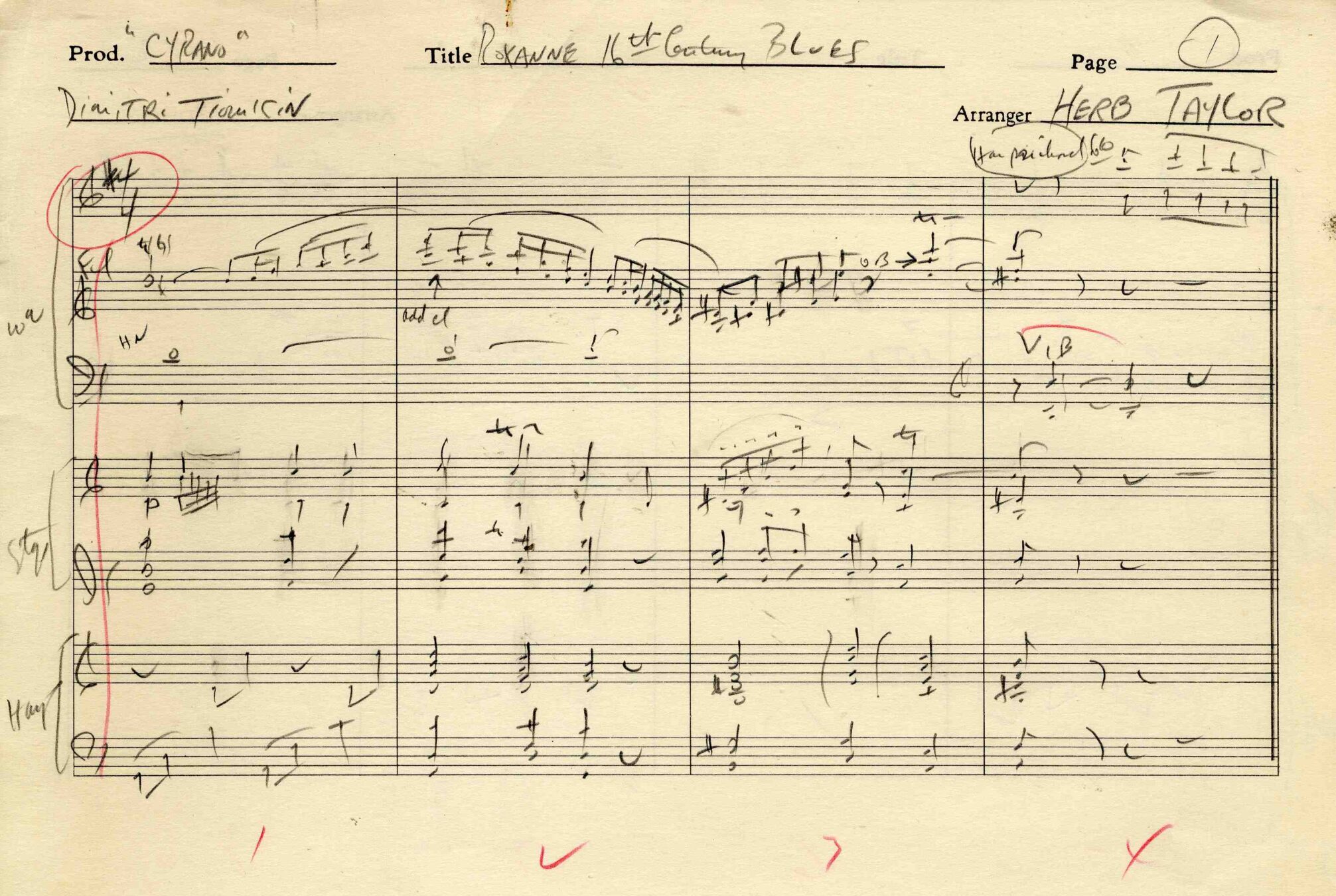
Roxanne 16th Century Blues by Dimitri Tiomkin, arranged by Herb Taylor, from Cyrano de Bergerac.
Television Music and Session Musician
Television was the new kid on the block in the 1950s and television shows also needed music.
Singer Penny Singleton hired Taylor for her television appearances and live act in 1950, resulting in a notable association with Ken Murray.
With Mutel, short for Music for Television, company founder David Chudnow would create a library of music to meet the increasing demand by paying a flat fee to a composer to write dramatic music cues, from love themes to chases, that were then recorded overseas and made available to Hollywood television producers and music editors to track into television programs.
Herb Taylor got in on the ground floor. That led him to writing “Twenty Mule Train,” the theme for the television Western series Death Valley Days, that opened the show from 1952 to 1961. Taylor wrote the tune with a lyric supplied by Milton Raskin. (With Raskin, Taylor later wrote “Watcha Doin’ With ‘Em?” copyright August 5, 1959, by Palm Springs Music Co.) For Mutel, Taylor also wrote the Annie Oakley theme.
Taylor had a somewhat unusual parallel career as a performing musician in Hollywood supplementing his earnings as an arranger with work as a studio musician on trombone. A recording session photo depicts Taylor sporting a tie and a warm and engaging smile.
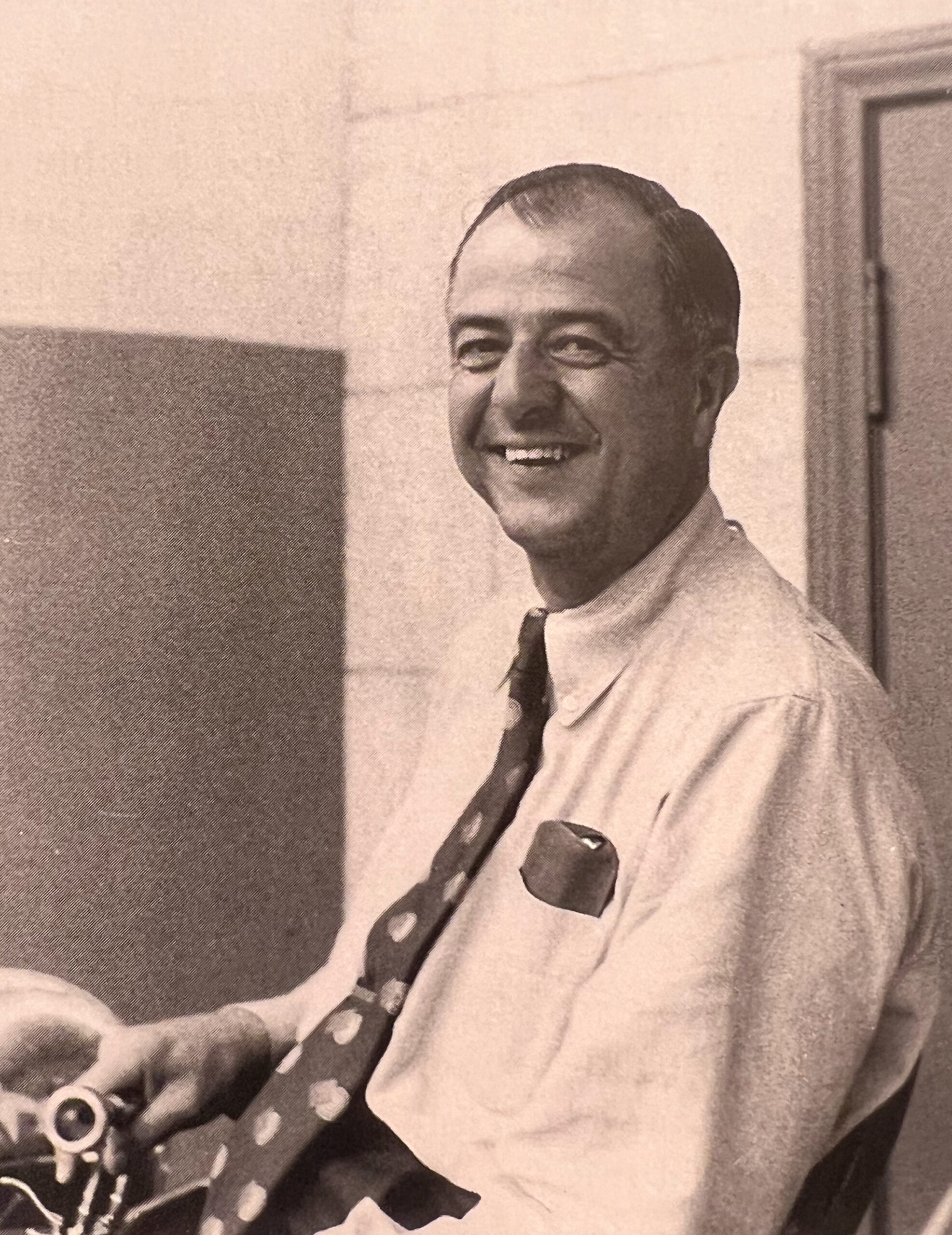
Herb Taylor at a recording session, circa 1950.
As a studio musician, Taylor’s work on trombone can be heard on numerous soundtracks, including Tiomkin’s 1953 score for Take the High Ground! There is evidence thanks to a Film Score Monthly recording (FSM Vol. 7, No. 17) of a number of sessions for Miklós Rózsa in 1954 and for Alex North, I’ll Cry Tomorrow in 1955. Taylor played trombone in the MGM Studios orchestra conducted by Johnny Green and featuring singers Frank Sinatra and Bing Crosby for the 1956 film High Society. One of his last documented recording dates is for sessions for the Elvis Presley film, Viva Las Vegas, in 1963.
By the end of his career Herb Taylor had transcended his roots arranging source music to become a full-fledged orchestrator. On his last professional gig with Tiomkin, Taylor single-handedly orchestrated the composer’s score for Circus World (1964). (A bit ironic, Herb Taylor shares his name with a big top circus clown.)
As we will see in part two of this unusual story, before leaving behind a lengthy and illustrious career as a musician in the mid-1960s, Herb Taylor with his wife, June, had already embarked on a second career when the couple formed Taylor Food Hobbies in 1953. Incorporated as Taylor Food Products in 1961, Mr and Mrs T® would become an international brand.