

Maurice Jarre provided the music score for director Fred Zinnemann’s 1964 film, Behold a Pale Horse; however, we recently learned that Zinnemann’s first choice was Dimitri Tiomkin. Even before the production was announced in the press, Zinnemann asked Tiomkin to not take any jobs in the Summer of 1963 that might interfere with scoring the film. Ultimately, probably due to scheduling conflicts, a third film collaboration between Zinnemann and Tiomkin would not materialize.
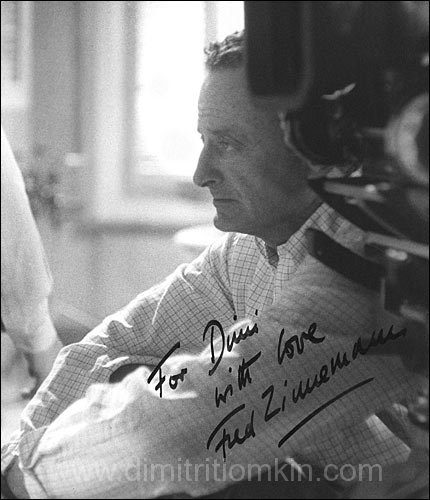
Fred Zinnemann
Zinnemann and Tiomkin previously worked together on High Noon (1952) and The Sundowners (1960). For The Old Man and the Sea (1958), after Zinnemann left the production Tiomkin would score the film for director John Sturges. Curiously, High Noon alumns including director Zinnemann, cameraman Floyd Crosby, and actor Gary Cooper were each at one time associated with The Old Man and the Sea. Tiomkin would receive an Academy Award for scoring the film.
For his next film after The Sundowners, Zinnemann, an enigmatic director if there ever was one, chose to adapt a novel by Emeric Pressburger. Pressburger, a Hungarian-British screenwriter, film director, and producer is best known for his film collaborations with Michael Powell, notably The Red Shoes (1948). No stranger to screenwriting, Pressburger would pen two novels during his lifetime, the first published in 1961, was Killing a Mouse on Sunday. The story, set after the conclusion of the Spanish Civil War and featuring a violent chase across the Pyrenees Mountains, appealed to Zinnemann “because it has elements of surprise and excitement. The characters are both unusual and interesting…The plot is different and not what one sees in most films. The background is romantic—the Spanish-Franco border is beautiful.”
In the weeks before columnist Louella Parsons breaks the story that Fred Zinnemann will direct “Killing a Mouse” for Columbia Pictures, the studio for which Zinnemann made the highly-awarded 1953 film, From Here to Eternity, Zinnemann is already courting Tiomkin and asks him to keep his schedule open. A burst of correspondence in October and November 1962 sheds new light on initial plans for the film.
In early October, Zinnemann writes to Tiomkin that the film is a “strong possibility.” He envisions it as a very good movie—a High Noon with Flamenco music—with filming to take place in April to June of 1963, so that he can report back to film Hawaii on September 1, 1963.
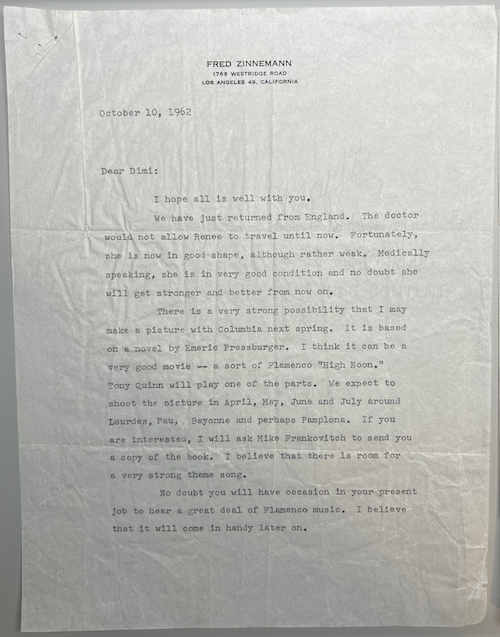
Letter from Fred Zinnemann to Dimitri Tiomkin, October 10, 1962, page 1
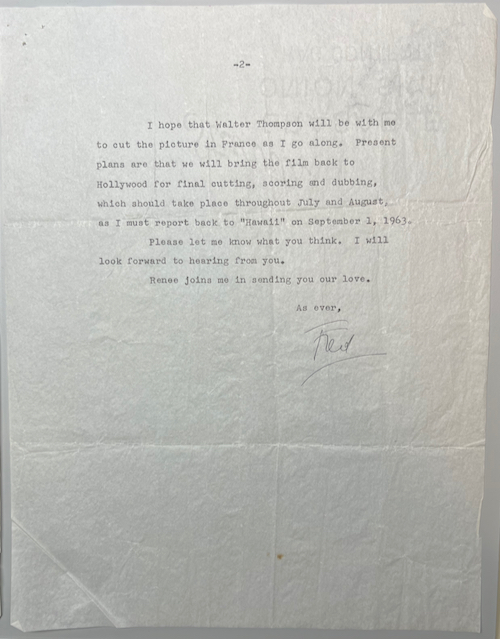
Letter from Fred Zinnemann to Dimitri Tiomkin, October 10, 1962, page 2
As Zinnemann’s letter makes it way to Los Angeles or London, Tiomkin is jetting off to Spain, via New York, to record his score for 55 Days at Peking. Knowing the composer’s Iberian travel plans, Zinnemann believes Tiomkin will “hear a great deal of Flamenco music” and “that will come in handy later on” for scoring “Killing a Mouse.”
Initial press made clear the title of the book would not survive as the release title of the film. Comments ranged from Parsons’s snippy “thank heavens” the title “will be changed” and later “one of the world’s worst titles” to “Is this a title, boys?” and “when the suspense melodrama is brought to the screen…it will arrive under another name, yet to be decided.” Columnist Hedda Hopper piled on, writing “Killing a Mouse on Sunday” “sounds more like a Bugs Bunny cartoon than a Zinnemann masterpiece.” It wasn’t until May 1963 that the final title, Behold a Pale Horse, was settled on, replacing the working title, “The 25th Hour.” (Was the latter a nod to the clocked-themed film, High Noon? This time instead of the hour before noon it’s the hour after midnight.)
Coincidentally or not, the quotation from the Bible containing “behold a pale horse” from the Book of Revelations was evident in popular culture in 1962 at the same time Zinnemann and Columbia were seeking a more filmic title for “Killing a Mouse.” The passage from the King James Version reads, “And I looked, and behold a pale horse: and his name that sat on him was Death, and Hell followed with him.” A 1962 episode of the television medical drama Ben Casey bore the title and brought recognition to co-star Suzanne Pleshette long before her starring turn on The Bob Newhart Show, a popular 1970s sitcom. After Ben Casey aired, the biblical quote served as an ad tag line for the film The Four Horsemen of the Apocalypse, starring Glenn Ford. Not to mention the Agatha Christie book, The Pale Horse.
After Tiomkin writes to Zinnemann and before the end of October 1962, Zinnemann replies that he is happy to hear of the composer’s interest in working together again. There is no script yet; however, Emeric Pressburger is working on one according to Zinnemann.
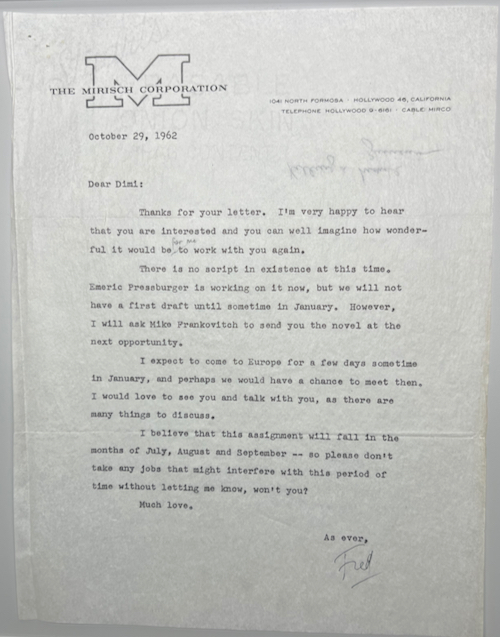
Letter from Fred Zinnemann to Dimitri Tiomkin, October 29, 1962
A scope and content note in the inventory for the Emeric Pressburger Collection at the British Film Institute (BFI) notes that Zinnemann paid Pressburger thirty thousand British pounds to adapt his novel to the screen. “However, Zinnemann was not happy with the result so EP withdrew.” The screenplay by Pressburger in his Collection at the BFI is dated November 1962.
Adapting Pressburger’s novel then fell to screenwriter JP Miller, who like e e cummings shunned punctation in his name. Miller wrote for Playhouse 90 the original “Days of Wine and Roses” teleplay that spawned the feature film released in December 1962, and with it the Henry Mancini eponymous hit song that is now a standard. Miller came on board in January 1963, soon after the departure of Pressburger, and the scripts for Behold a Pale Horse listed in the Fred Zinnemann papers inventory, which I helped create, date between May and September 1963.
As an aspiring “filmwright,” a term Miller coined while adapting “Killing a Mouse” designated for a filmmaker who controls the script by serving as writer-director, citing Fellini, Bergman, and Wilder as examples, Miller’s plan was to learn from observing Zinnemann direct the film. Overshadowed by Billy Wilder, Zinnemann, not a writer himself, was a master at taking source and script material and molding into his singular vision. In fact, his pan-genre oeuvre is remarkable, encompassing a Western (High Noon), stage adaptation (From Here to Eternity), musical (Oklahoma!), period piece/costume drama (A Man for All Seasons), film noir (Act of Violence), and political thriller (Day of the Jackal).
Uber-agent Paul Kohner writes to Tiomkin in November 1962, to inquire if he can represent the composer for the Zinnemann scoring assignment.
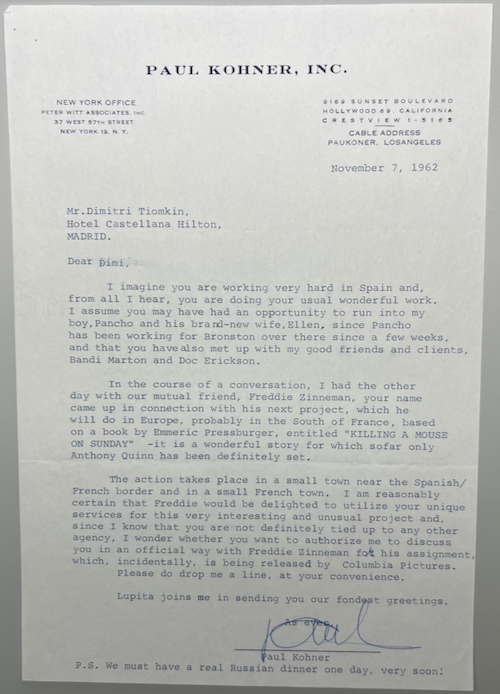
Paul Kohner letter to Dimitri Tiomkin, November 7, 1962
Meanwhile, in lieu of a script, Zinnemann sends Tiomkin a photocopy of his letter, dubbed “letter number two,” the director sent to Pressburger with “additional thoughts about our script.” “Our” probably refers to the film as a whole and is further evidence of the director’s critical role as a story editor for his films.
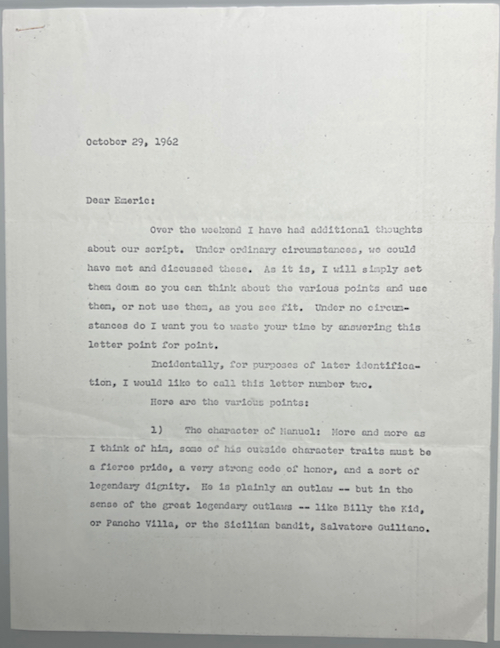
Copy of letter from Fred Zinnemann to Emeric Pressburger, October 29, 1962, page 1
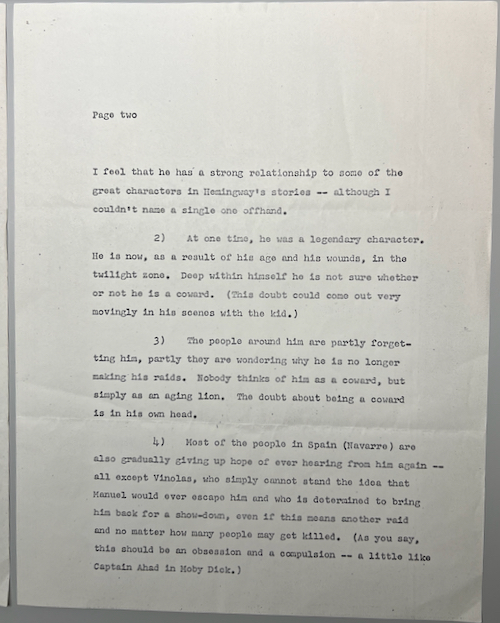
Copy of letter from Fred Zinnemann to Emeric Pressburger, October 29, 1962, page 2
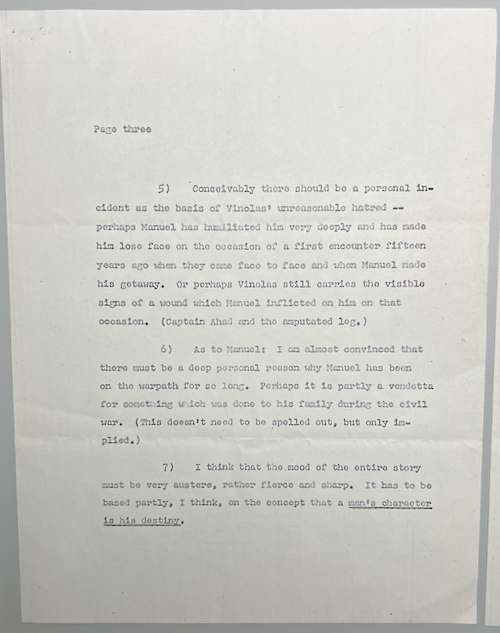
Copy of letter from Fred Zinnemann to Emeric Pressburger, October 29, 1962, page 3
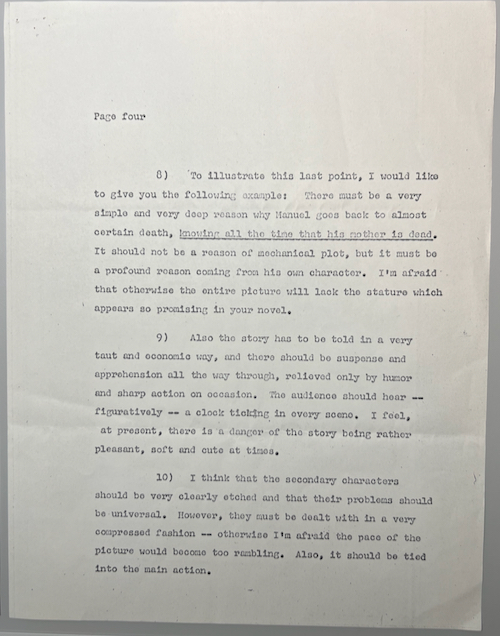
Copy of letter from Fred Zinnemann to Emeric Pressburger, October 29, 1962, page 4
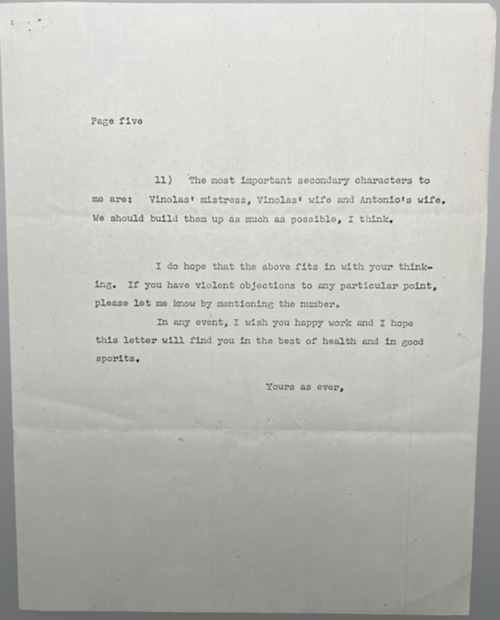
Copy of letter from Fred Zinnemann to Emeric Pressburger, October 29, 1962, page 5
Zinnemann pictures the character of Manuel as an outlaw with pride, dignity, and a strong code of honor clouded by his age and self-doubt. Vinolas is obsessed—to the degree of Captain Ahab in Moby Dick—that Manuel not escape him. Zinnemann suggests new material to show or suggest motivation for both characters. “A man’s character is his dignity” sums up “the mood of the entire story” which the director sees as “very austere, rather fierce and sharp.” The actual clock as depicted in High Noon should be figuratively heard or felt by the audience. The letter proves Zinnemann’s mettle as he suggests to the author of the original source material motivation for the film characters and plot compressions to adapt the book to the screen.
Anthony Quinn is first aboard, soon followed by Omar Shariff and Gregory Peck. The trio of name actors would film on location in the South of France. As filming of Behold winds down in mid-August 1963, Zinnemann attempts to deflect criticism concerning Hawaii as press headlines blare, “‘Hawaii’ Has Cost 2 Million—Without a Foot of Film; ‘Burned’ companies cautious about starting it,” with a prominent headshot captioned, “Fred Zinnemann / Got tired of waiting.” This at a time when yet-to-be-released pictures from Cleopatra to The Greatest Story Ever Told were weighing heavy on studio finances. By September 1, 1964, George Roy Hill had taken over direction of Hawaii after Zinnemann withdraws.
With the exception of A Man for All Seasons, the 1960s were not kind to Zinnemann, his four years spent on Hawaii pre-production were eclipsed when MGM abandoned Man’s Fate after three years of pre-production just as filming was set to begin in 1969. Zinnemann spent an additional four years in a legal battle with the studio. Looking back, the breakup of the studio system and changing audience tastes negatively impacted Hawaii and Man’s Fate.
As 1963 dawns, Tiomkin remains in Spain where in January he would conduct the music score for The Valley of the Fallen, a dramatized documentary on, depending on your point of view, the mass grave masquerading as a memorial; a fascist temple; or a monument to the Spanish Civil War. The site, Santa Cruz del Valle de los Caidos, near Madrid is now known as The Valley of Cuelgamuros. Journalist and columnist Jim Bishop, who publicized the monument in 1961 and 1962, a few years after it opened to the public, narrates with a soundtrack comprised of the basilica choir of 100 voices.
A continuity script by Bishop dated November 2, 1962, can be found in the Dimitri Tiomkin Collection at the Cinematic Arts Library at the University of Southern California (USC). The dialogue is spoken in Spanish by the actors, but not recorded. The thirty-minute color film was produced by Ralph Wheelwright and paid for by Samuel Bronston Productions. Directed by Andrew Marton, his collection at the Margaret Herrick Library includes the continuity script, crew list, and clippings. Tiomkin’s 1963 schedule would be filled with scoring other films for Samuel Bronston from The Fall of the Roman Empire to Circus World.
Tiomkin must have opted out of scoring Behold a Pale Horse by January 1963 because at that time Zinnemann begins to search for a composer. Recommendations are received from Jonie Taps, an exec at Columbia, and agent Sam Adams of The Jaffe Agency who suggests Richard Markowitz.
What to make of the statement in composer Georges Delerue’s obituary in the New York Times, “He wrote soundtracks for Fred Zinnemann’s ‘Behold a Pale Horse’?” There is evidence in the form of two disc recordings dated April 1964 in the Zinnemann collection that Delerue wrote and recorded some music for the production. The music must have resonated with Zinnemann since he chose Delerue to score his next three films: A Man for All Seasons (1966), The Day of the Jackal (1973), and Julia (1977).
Enter Maurice Jarre
Hoping to repeat the musical success of High Noon, in the place of a Western song Zinnemann’s original concept for Behold a Pale Horse was to use gypsy music to punctuate the story. “I believe that there is room for a very strong theme song,” Zinnemann had early on written to Tiomkin. Composer Maurice Jarre would provide that theme in the form of a recurring march. The previous year, Jarre’s breakout film, Lawrence of Arabia, also produced by Columbia Pictures, catapulted the French composer to international recognition and earned Jarre an Academy Award. In fact, in 1964 Jarre was better known in the U.S. than Georges Delerue, and after a false start by Delerue, by May 1963, Maurice Jarre had been signed to score Behold a Pale Horse.
Jarre’s melodious and contrapuntal score for the film gives “a suggestion of the locale in the instrumentation and the rhythms” and features guitar, clavichord, ondes martinet, and harp, and is punctuated by the recurring brassy march with hymn-like attributes. For much of the underscore Jarre favors a small ensemble, only 12 musicians, to capture the suspense of the hunter and the hunted: flute, oboe, bassoon, percussion, and strings. The picture daringly opens with solo castanets.
The composer sought to provide a “clear theme,” and as Jarre said through an interpreter at the time, “It’s important to achieve a theme that’s basic enough and clear enough to catch the public ear. Always try to retain a clear theme for your movie public.”
Jarre and his fiancée actress Dany Saval attended the film’s premiere in New York at the Victoria Theatre in August 1964.
Those wishing to take a deeper dive into the film can consult the Emeric Pressburger Collection at the BFI or the following collections at the Margaret Herrick Library: Fred Zinnemann papers, Gregory Peck papers, Jack Atlas papers for advertising, William “Billy” Gordon collection for casting, and the MPAA-Production Code file on Behold a Pale Horse.
Fred Zinnemann would underestimate Spain’s reaction to the film. Government officials were not pleased that the film was shot in Southern France and had issues with the content and as a result, for this film and their other studio product, Columbia Pictures failed to obtain distribution covered by import licenses. After a three-year ban, in April 1966, Columbia resumed distribution of its films in Spain.
Meanwhile, Tiomkin continued to score Samuel Bronston films produced in Spain and in the month before the 1964 premiere of Behold a Pale Horse the Spanish government awarded the composer the Order of Queen Isabella, one of Spain’s highest decorations.
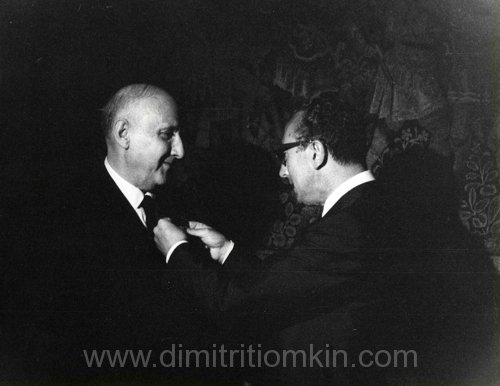
Andrés B. Zala presents the La Cruz de Caballero de la Orden de Isabel la Católica to Dimitri Tiomkin, Perino’s Restaurant, Los Angeles, July 30, 1964.
Sources
Correspondence courtesy of Olivia Tiomkin.
“Biggest Monument in World Is in the Valley of the Fallen,” by Jim Bishop, Macon News, September 4, 1961.
Emeric Pressburger Collection, Fonds – EPR, Series 6, Novels by EP, Subseries, KILLING A MOUSE ON SUNDAY: Screenplay, November 1962
Display ad for “The Four Horsemen of the Apocalypse,” Austin American, September 12, 1962.
“Same [sic] Verses From King James Version,” News Tribune, September 30, 1962.
“Ace Director Returns to H’wood,” by Louella O. Parsons [syndicated column], Indianapolis Star, October 22, 1962.
“J. P. Miller To Script ‘Mouse on Sunday,’” Variety, January 9, 1963.
“Looking at Hollywood,” by Hedda Hopper [syndicated column], Bangor Daily News, January 16, 1963.
“Basilica Choir Used in Picture,” Los Angeles Evening Citizen News, January 21, 1963.
“Jim Bishop: Reporter,” by Jim Bishop, column on invitations to the premieres of 55 Days at Peking and The Valley of the Fallen, Cumberland News, April 26, 1963.
“Title Change,” Hollywood Reporter, May 9, 1963.
“Change of Title,” Pittsburgh Press, May 17, 1963.
“Writers and Films,” Cumberland News, May 18, 1963.
“Saga of a Tired Spanish Loyalist: Fred Zinneman [sic] Foresees Nothing to Offend Madrid Government,” Variety Weekly, July 10, 1963.
“Tough for Columbia Pics in Spain Until Officials See ‘A Pale Horse’; Peck Underestimated Touchiness,” Variety, July 31, 1963.
“‘Hawaii’ Has Cost 2 Million—Without a Foot of Film,” by Murray Schumach, ©New York Times Service, Courier-Journal, August 18, 1963.
“Spanish Displeasure Over ‘Pale Horse’ Results in Total Ban Of Col. Films, Shooting Affected Too,” Variety Weekly, September 4, 1963.
“Film Composer Here,” Daily News, August 7, 1964.
“Spain Retains Peeve Over ‘Pale Horse’: Resents Slur on Its Elite Cops in Bride-taking, Mistress-Keeping Fictional Chief,” Variety Weekly, August 12, 1964.
“Life Movie Review: High Noon on the Spanish Border,” by Richard Schickel, Life, August 21, 1964.
“Record Shop” by Joan Crosby, Eureka Humboldt Standard, August 31, 1964. On Maurice Jarre’s score.
“Film Director’s Technique Can Make or Break Actor,” by Marjorie Adams, Boston Globe, August 9, 1964.
“French Composer’s Soundtrack Success,” Music Business, September 19, 1964.
“Forgiven,” Films and Filming, April 1966.
“Georges Delerue, 67, a Composer On Truffaut and Stone Films, Dies,” [obituary], New York Times, March 23, 1992.