

With Maestro in movie theaters and an Elmer Bernstein biography on bookstore shelves, two great American musicians of the 20th century with the surname Bernstein are on the minds of filmgoers and readers.
Maestro is bringing awareness to Classical music and the art of conducting thanks to the portrayal of Leonard Bernstein by actor Bradley Cooper, who spent years preparing to conduct for a key sequence in the movie. The Academy nominated the film in seven categories, including Best Picture and Best Actor. At the same time the life of the New York-based Bernstein can be seen on film, the life and work of Elmer Bernstein, the noted Hollywood film composer and conductor, is being remembered through a biography written by his son, Peter, himself a composer and conductor. Elmer and Leonard are not related. I once heard that Elmer chose to pronounce his surname as “Bernsteen” to distinguish himself from Leonard, whose name is pronounced, “Bernstine.” I was fortunate to cross paths with Elmer through his film work and community service. More on that later.
Elmer Bernstein’s enviable career spanned more than five decades. Even given that amount of time, his output is staggering, close to 80 television productions and more than 150 original film scores. My favorites include The Grifters, The Great Escape, Far from Heaven, and the John Landis directed comedies.
Elmer Bernstein, Film Composer: An Authorized Biography by Peter Bernstein is a must-read for film music aficionados and budding media composers as well as movie buffs in general. The reader is drawn into Elmer’s inner circle through Peter’s first-hand accounting of events as well as through anecdotes and stories his father and family shared. To keep the focus on his father, Peter refers to himself in the third person throughout.
Where does this book fit into the literature of film music? For starters, there aren’t as many biographies on film composers as there should be. The last major work is from 2020, Music by Max Steiner: The Epic Life of Hollywood’s Most Influential Composer by Steven C. Smith. (Smith offers a compelling description, among the best-ever written for a lay audience, of Steiner’s music for King Kong, covering the form, function, and purpose of the underscore.) Remarkably, biographies by the children of film composers are rare. The only other instances that come to mind were penned by the daughters of Irving Berlin and Frank Loesser, respectively.
For this biography on his father, Peter takes the reader on a journey through the highs and lows of working freelance as a prominent and prolific film and television composer and the demands and stresses that places on marriage and family life.
The book is filled with interesting anecdotes, such as the backstory to Animal House. And yet the best parts are when Peter offers the reader a behind-the-scenes nugget, as in the footnote to recording the score for Hawaii or on Elmer’s first Golden Globe honoring the score of To Kill a Mockingbird. Among the highlights, excerpts from letters written by Elmer to a female friend from childhood. The diary-like content offers counterpoint to the narrative. A recurring theme, and a great lesson for any budding media composer, is the importance of being flexible on the scoring stage to meet the demands of the project. Peter gives ample examples of that skill that kept Elmer employed over those five remarkable decades. As the book unfolds and Peter grows older, the relationship with his father goes from personal to professional after he begins to orchestrate for Elmer, and the insights grow bolder.
The anecdote for the recording session for “One Tin Soldier” for Billy Jack epitomizes the demands of a film composer on the scoring stage and points to what (helps) make a composer successful. After writing the score, a composer often must make changes, usually subtle, sometimes drastic, to appease all involved.
I witnessed this with Elmer during the scoring sessions for Far from Heaven, on which I assisted with music prep and copying. (Using Finale, a music notation program, the parts were printed and assembled on the floors of Patrick Russ’s home, the living room, dining room, and even the hallway. On the scoring stage Pat’s laptop held all the scores and parts, ready to amend and print via Bluetooth at a moment’s note.)
During playback in the booth, after a run through, Elmer would take into consideration feedback from director Todd Haynes and make subtle adjustments in tempo, timbre, dynamics, or rhythm, add or delete bars, use tacets (silence a player), or dictate from the stand, “violins, play one octave lower from bar 10 to 12.”
I happened to enter Elmer’s world at a low point in his career, in 1995, when he was scoring The Scarlet Letter. It was the first film score that I proofread sketch-to-score for orchestrator Patrick Russ and the score ended up being rejected by the producers. I proofread on several other Elmer projects, from Rough Riders to Wild Wild West.
At the same time, I was elected to and served on the Board of the Film Music Society (FMS) while Elmer was in the role of President. Elmer went on to found the Film Music Foundation (FMF), an organization devoted to education and largely funded by a bequest from Jeanne Woodbury, the wife of orchestrator Al Woodbury.
After Bernstein was established as a leading American film composer he looked for ways to give back, through the FMS, FMF, YMF (Young Musicians Foundation), and other organizations to the profession that had treated him so well. One venture, “Elmer Bernstein’s Film Music Collection,” devoted to recording notable classic film music would include Dimitri Tiomkin’s music from Gunfight at the O.K. Corral (1957), The High and the Mighty (1954), Land of the Pharaohs (1955), and Search for Paradise (1957).
Elmer Bernstein and Dimitri Tiomkin, separated by a generation, crossed paths at least once. In his role as conductor of the San Fernando Valley Symphony Association, Bernstein presented a plaque to Tiomkin, whom he held in high regard, for “Bringing Tchaikowsky to the Screen” in March 1972.
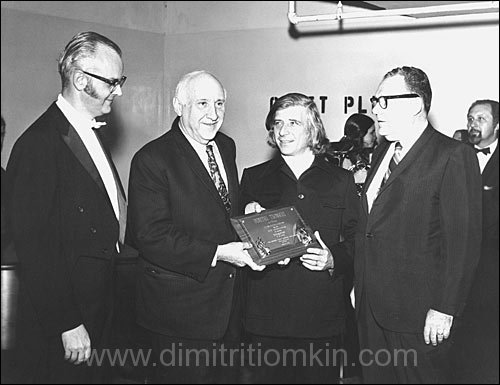
Dimitri Tiomkin with Elmer Bernstein, 1972
Bernstein’s Film Music Collection contains three worthwhile articles on Tiomkin—Christopher Palmer’s “Dimitri Tiomkin: A Biographical Sketch” and “Tiomkin as Russian Composer,” as well as William Rosar’s “Lost Horizon: An Account of the Composition of the Score”—in the final issue of Film Music Notebook, a journal published by Bernstein and distributed concurrently with the LPs.
Both composers were scrutinized by the FBI during the McCarthy era. Elmer would on occasion mention the Blacklist and the fact that it did affect him personally; however, never in any detail that I heard. Peter gives Elmer’s experience context and meaning.
It’s a testament to Elmer’s music that it has permeated popular culture around the world: in a child’s mechanical horse ride in Spain, as a football fight song in South Carolina, and as a repurposed music cue in a Quentin Tarantino film.
The writing is genuinely engaging and by the closing chapter one should walk away feeling a connection to Bernstein and have a greater understanding of the film scoring process.
Books lacking citations are not among my favorites; however, in this case, outside of Elmer’s voice, the other quotations all appear to have been directly collected by Peter.
Elmer died in 2004 and it’s about time a worthy accounting of his life and work is available.
I read the book from cover to cover, or, since I read the Kindle version from starting to ending pixel.
If you’re interested in knowing why Elmer collected pigs, check the book out.
Elmer Bernstein, Film Composer: An Authorized Biography by Peter Bernstein, was published by Rowman & Littlefield in 2023. In addition to this biography, the publisher has available a number of books and film score guides for those seeking more on the music of Elmer Bernstein and Leonard Bernstein.
FURTHER READING: Excerpt from “The Elmer Bernstein Collection,” Introduction by Patrick Russ