
Dimitri Tiomkin’s unconventional scoring of High Noon, released in the summer of 1952, “in which Tex Ritter strums his guitar as a sort of narration while hero, heroine and villain, love, hate and kill,” began a trend in Hollywood to popularize such singers whose ballads were skillfully woven into the background of a film. Incorporating the title song’s melody and rhythms repeatedly into the dramatic underscore was a novel idea and would change the course of film music scoring.
As the year drew to a close, Tiomkin was engaged by Metro-Goldwyn-Mayer (M-G-M) to score Take the High Ground!, directed by Richard Brooks. Within days High Noon lyricist Ned Washington was reteamed with Tiomkin to provide lyrics.

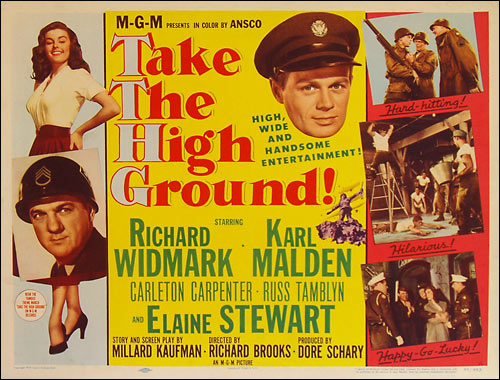
Take the High Ground one sheet poster
As columnist Louella Parsons reported, “[Producer] Dore Schary has signed Dimitri Tiomkin to score and write original songs for ‘Take the High Ground’ in the fond hope, I suppose, that he’ll come up with another ‘High Noon,’ touted as an Academy possibility.”
While the film’s music would resemble the treatment given the theme in High Noon, High Ground replaces the Western setting with a military one. Take the High Ground! stars Richard Widmark as an U.S. Army infantry sergeant relieved of combat duty to whip raw recruits into a precision fighting unit to send to the battlefields of Korea. Filmed on location at Fort Bliss in Texas, supporting roles are filled by Karl Malden and Russ Tamblyn.
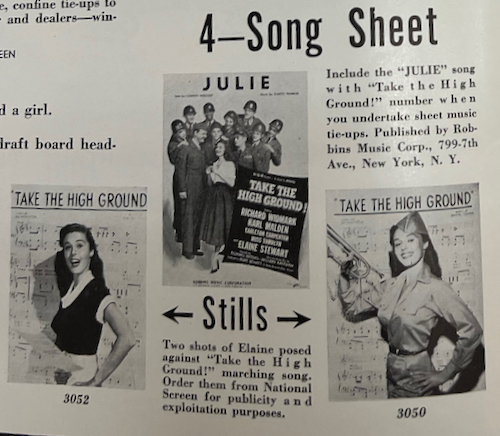
The fleeting love interest, “Julie,” an Army widow is played by model-turned-actress Elaine Stewart. Stewart joins the all-male cast as the only credited female and is billed in sexist ads as “a real baby with a purple past!” Drawing on her experience as a model, one unusual newspaper promotion depicts a beaming Stewart in uniform holding a trumpet with a blow-up of the title song as background and a similar promotional still shows her singing.
RECORDING A MARCH, AND A SONG CALLED JULIE
First up on the recording schedule was the all-important title music, a march, that would figure prominently in the underscore. For the recording on February 2, 1953, music director Johnny Green conducted the M-G-M Orchestra in three versions: the band alone, the band with vocal, and a marching version.
The march, heard in the film’s teaser trailer, is dedicated to the Army’s infantry. The Army’s Office of the Chief of Information wrote to Dore Schary at the studio in Culver City authorizing the Department of Army public information officers’ cooperation at showings of the film that “pays high tribute to the U. S. Army soldier.
Tiomkin would conduct the music underscore on May 18 through 22. The weekend after the recording sessions, on May 24, Johnny Green guest conducted the U.S. Army Field Band at the Hollywood Bowl in the main title song, “Take the High Ground.” The Sunday afternoon concert was sponsored by the Los Angeles County Council of the American Legion.
FURTHER READING: Dimitri Tiomkin and the Hollywood Bowl
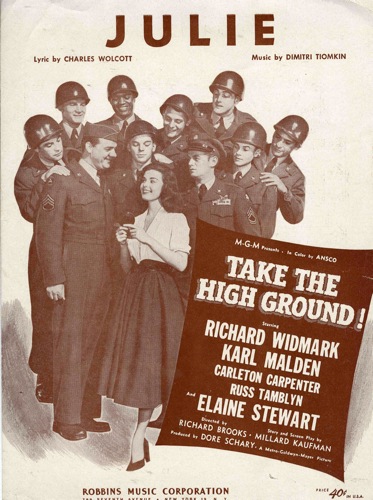 For reasons unknown, M-G-M staff composer Charles Wolcott, best known for his contributions to Disney animated films, took on the job of supplying lyrics for the song for “Julie.” (At the end of the decade he would leave the music business to take a position as the national secretary of Bahá’í, a religious faith founded in the 19th century.)
Tiomkin conducted the recording of “Julie” on June 16 with singer Bill Lee. The latter, not to be confused with Spike Lee’s father, was just breaking into the vocal dubbing business that would flourish in the 1950s and 1960s; as a playback singer he and other talented vocalists would anonymously sing the voice parts for leading screen actors. His uncredited performance of “Julie” was one of the first of many, including for The Sound of Music, Mary Poppins, The Jungle Book, and Charlotte’s Web.
Tiomkin himself weighed in on the new song when he addressed a group of Los Angeles Adult Education music students. Tiomkin believed that songs that caught on quickly would not last long. The composer believed a song needs to be heard many times before one falls in love with it.
Robbins Music would publish the sheet music for the title song, described as “non-danceable” and “Julie,” also published in a dance band arrangement by Johnny Warrington.
READ: The Sheet Music of Dimitri Tiomkin
PRESENTING THE FILM
The Fort Bliss band was on hand to perform the title march in front of the Plaza Theater in El Paso, Texas, for the premiere on September 21. Appearing on the stage with Hollywood master of ceremonies George Murphy were Dore Schary, Richard Widmark, Elaine Stewart, and Russ Tamblyn. The film would open in Los Angeles on December 4, at the Loews and Egyptian theaters.
Presented in stereophonic sound the “fine title song” “stirringly sung by a male chorus” was noted by one film critic. Another critic felt the film “benefits considerably by the stirring martial music,” “an invaluable ally in any photoplay.” Columnist Dorothy Kilgallen went further touting the title song as a candidate for the U.S. Army which had “been seeking an official song along the lines of the Navy’s Anchors Aweigh and the Marine’s Halls Of Montezuma.”
With High Ground, Dimitri Tiomkin built on a scoring method he introduced in High Noon that would influence the way films were scored and create a lasting effect to this day.
Sources
“Lloyd Douglas Book Slated as ‘Remake,’” by Louella O. Parsons, Solano-Napa News Chronicle, December 26, 1952.
“Song by Prize Winners,” Lincoln Sunday Journal and Star, May 3, 1953.
“Green to Conduct Army Band Concert,” Los Angeles Times, May 24, 1953.
“Quick Song Hits Die Quicker,” by Walter Hackett (Journal Hollywood Correspondent), Lansing State Journal, July 19, 1953.
“‘Take the High Ground’ Gets Stars’ High Praise,” El Paso Herald-Post, September 21, 1953.
“Hollywood Wants Folk Singers,” The World’s News, October 17, 1953.
“Voice of Broadway: U.S. Army May Find Official Song In MGM’s ‘Take the High Ground,’” by Dorothy Kilgallen, Arizona Republic, November 5, 1953.
“On the Screen: ‘Take the High Ground,’ Story of Basic Training In The Army, At Century.” Evening Sun, November 28, 1953.
“Charles Wolcott Forsakes Riches For Like of Peace,” Ventura County Star, January 30, 1960.
Take the High Ground!, pressbook.