


Dimitri Tiomkin, circa 1926-1927
Dimitri Tiomkin’s long association with the Hollywood Bowl and the Los Angeles Philharmonic has been documented on this website; however, we have neglected to likewise shine light on performances of his music by the New York Philharmonic. This is possible thanks to documents in the New York Philharmonic’s Digital Archive.
Before Tiomkin settled in Hollywood to become the film composer we all know, he spent ten years, largely as a classical pianist drawn to jazz and as a composer for Albertina Rasch ballets, in New York City.
Tiomkin and Sinatra in concert?
Let’s begin in 1943. For summer concerts, Hollywood has the Bowl and New York has Lewisohn Stadium. During the first week of August, under the Stadium Concerts, Inc. banner the Philharmonic-Symphony Orchestra could be heard in its twenty-sixth season at the outdoor concert venue playing “Music from the Motion Pictures and Broadway,” under conductor Max Steiner. Steiner took advantage of this unprecedented and rare opportunity for a Hollywood musician to lead a New York orchestra when he spoke to the local press beforehand to “plead the case of the movie composer and his place in the sun.”
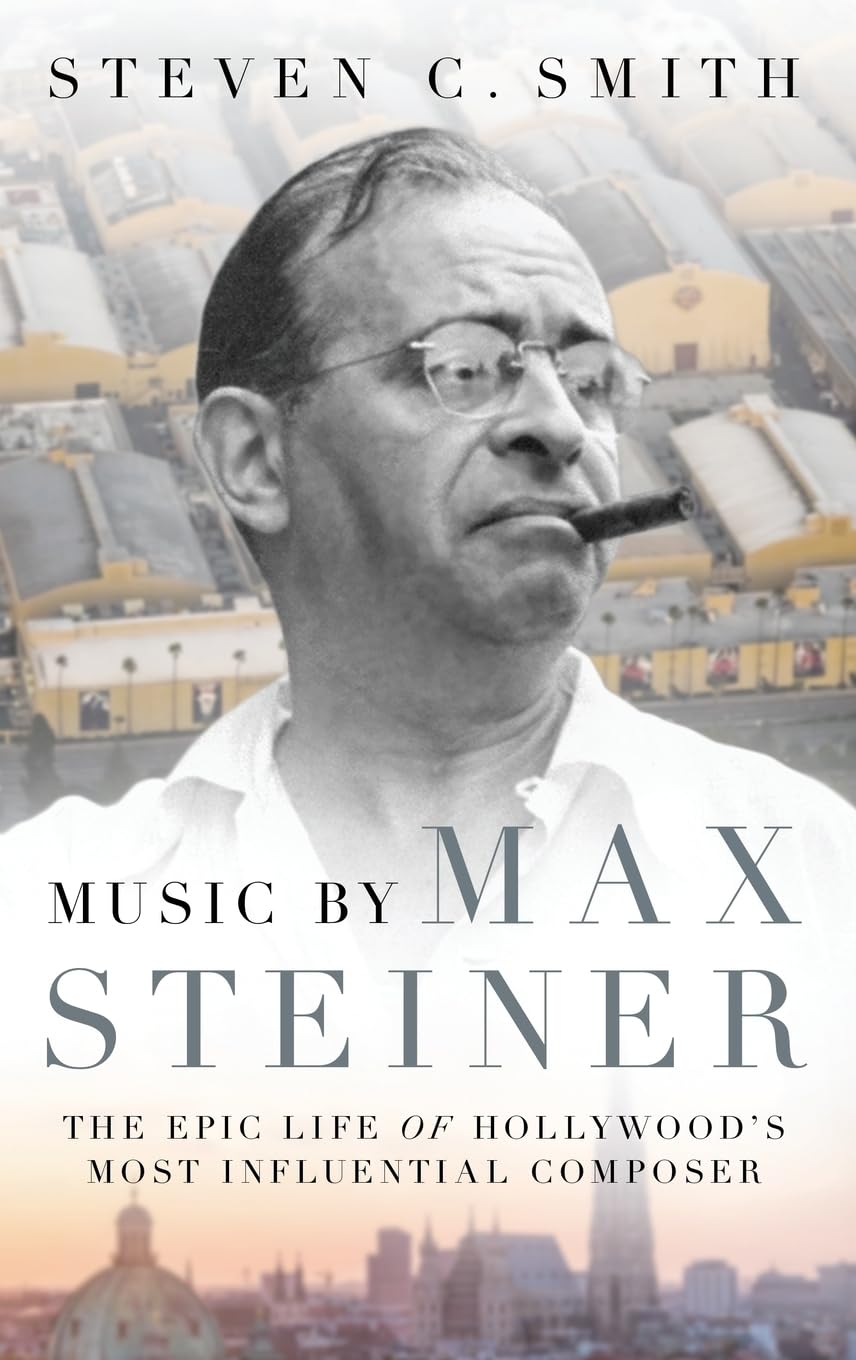
Steven C. Smith, Max Steiner’s biographer, traces the genesis of the concert to Steiner’s friend, writer William G. King of the New York Sun, who proposed the idea to philanthropist Minnie Guggenheimer, founder of the summer concert series.
Most of the music on the concert was either composed by Steiner— beginning with the opening number, the now iconic score for The Informer—or sung by Frank Sinatra, selected after Dinah Shore and Fredric March were considered. Tiomkin was to be represented by a suite from the 1937 film Lost Horizon, at the time his grandest achievement in film scoring. A 12-episode tableau had previously been performed during the summer of 1938 in a concert at the Hollywood Bowl that also served as Tiomkin’s conducting debut.
Now in the summer of 1943, America was at war, Lost Horizon had been re-released, and Tiomkin’s music was being heard by a new wave of theatergoers, many of them seeking to escape to the cinema to see a fantasy film.
Publicity was calling attention to the role of Tiomkin’s music, “there is more to background music than just notes…a superior score can definitely heighten the dramatic feeling of a story, and carry its mood smoothly from scene to scene.” “Frank Capra was apparently fully cognizant of this fact when he signed Dimitri Tiomkin, Max Steiner and the Hall Johnson Choir to provide the musical score…”
As Smith points out, it was director Frank Capra who came up with the idea to team Steiner with Tiomkin. By the mid-1930s Capra and Tiomkin had become fast friends but had yet to work together professionally. Columbia Studio’s president, Harry Cohn, was not thrilled when Capra wanted to hire Tiomkin to write the music score since the composer did not have a large body of dramatic film work and certainly had yet to work on a feature film with a $2.6 million budget. So, Capra suggested Max Steiner serve as musical director and conductor.
READ: Max Steiner and Dimitri Tiomkin
Given his close connection to Lost Horizon and familiarity with the music score, it’s not surprising that Steiner decided, after much deliberation, to include a suite from the film for this concert in New York. Aside from programming the musical selections, among his concerns were the lack of rehearsal time and that fact that “the Philharmonic plays only classical music.” It didn’t help Steiner’s insecurity that Sinatra was getting top billing in the press (and would receive the most post-concert coverage from reviewers).
Keeping in mind the performance of film music in concert was largely nonexistent in the first decade of sound films, a letter from Steiner to his wife acknowledged producer Hal Wallis’s high expectation that the New York Philharmonic concert would be “the most important thing that has ever happened to Music in Pictures.”
The “most important thing” would turn to disappointment after the sole rehearsal the day of the concert did not suffice, remember that the entire program of music would have been unfamiliar to the Philharmonic players. Steiner would later look back at the concert as “a miserable evening.” Lost Horizon, as listed in the program as the last piece before intermission, was not performed that night.
A scrapbook in the Digital Archive sheds light on the concert as it unfolded, as reviewer Grena Bennett notes after the first medley of songs, “Sinatra addressed the audience in this fashion: ‘We are now going to have a short intermission and I hope you excuse us.’” Bennett also notes that the last four vocal numbers in the printed program to be sung by Sinatra were not performed, meaning Sinatra—who reportedly took the gig without pay to help the venue overcome financial woes— sang only seven of the planned eleven songs.
The five unperformed numbers were apparently a casualty of a lack of rehearsal time. If so, it might mean that Tiomkin’s music required more rehearsal time than the other two non-Steiner works that were performed: Alfred Newman’s The Blue Bird and Victor Young’s For Whom the Bell Tolls, or it became a victim of the rehearsal order schedule when time ran out.
Curiously, the New York Post critic John Briggs is the only writer to cite Dimitri Tiomkin, doing so in his review that appeared the day after the concert, “Max Steiner, who led the orchestra in Sinatra’s accompaniments, rounded out the program with movie music written by Alfred Newman, Victor Young, Dimitri Tiomkin and himself.” One can only wonder if he either wasn’t there or wasn’t paying attention and perhaps was rehashing copy from a previous unattributed Post article with similar wording, “The orchestra will be conducted by Max Steiner, composer of many Hollywood scores, who will accompany Sinatra and present film music written by Ernest [sic] Newman, Victor Young, Dimitri Tiomkin and himself.”
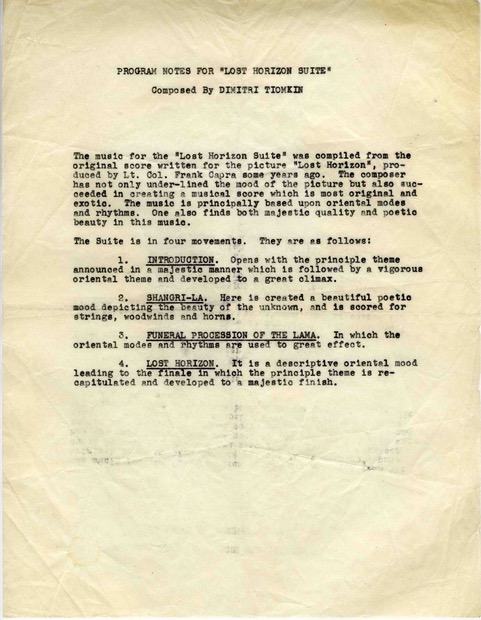
In the program, the name of Sinatra’s arranger, Axel Stordahl, appears as Axel Stohldar. And while Max Steiner merits a page-long biography, neither Sinatra or Tiomkin appear in the program notes. Tiomkin retained a carbon copy of what appear to be the program notes for the New York concert for a Suite in four movements, seen below.
Had the concert been scheduled the following evening it would have been rained out as happened to conductor Alexander Smallens and his program of classical music.
Finally, it should be noted that the Tiomkin and Albertina Rasch dance program performed by the New York Philharmonic at Lewisohn Stadium over three nights in August 1932, drew larger audiences each night compared to the Sinatra-Steiner concert.
Happy New Year!
Music from a picture similar in size and scope to Lost Horizon, the 1957 Cinerama travelogue documentary Search for Paradise, would be performed by the New York Philharmonic for a “Winter Holiday” program, a New Year’s Eve concert of popular music conducted by Skitch Henderson.
Henderson dabbled in film scoring and his musical score for a racing short film, Zero to Sixty, was in theaters preceding the feature Come Dance with Me!, the adult-themed French-Italian drama with Bridgette Bardot.
For the New Year’s Eve concert Henderson would stitch together six unrelated works under the title “For Beachcombers Only.” Preceding that work was the Fourth Tableau from “The Seasons” by Alexander Glazunov, Tiomkin’s composition teacher in Russia. “For Beachgoers Only” opened with music by Tiomkin from Search for Paradise, followed by Debussy’s La Mar. The overly-imaginative programming on a water or beach theme ended a bit far afield with España by Chabrier.
Showing the headwinds that popular music was facing in the traditional concert hall in the 1960s, a promotional blurb for Henderson’s concert in the New York Daily News was headed, “Light Stuff.”
Let’s not forget that the acceptance of film music in the concert hall took a generation. Ironically, in the late 1920s and early 1930s Tiomkin himself foresaw the brilliant future that music for motion pictures would assume.
Hitchcock!
New York audiences would have to wait until 2013 to hear premiere performances by the Philharmonic of music written by Tiomkin for the suspense films of Alfred Hitchcock. Suites by Christopher Palmer for Strangers on a Train (1951) and Dial M for Murder (1954) were performed at Avery Fisher Hall on September 17 and 18.
The program, “The Art of the Score: Film Week at the Philharmonic – Hitchcock!,” was conducted by Constantine Kitsopoulos in his debut with the orchestra and hosted on separate evenings by actors Alec Baldwin and Sam Waterston.
Segue to “I’m in Love with Vienna”
A fun fact: Tiomkin’s music was again featured on a New Year’s Eve concert, this time in 2018, when soprano Renée Fleming sang, “I’m In Love with Vienna” from the 1938 film The Great Waltz, with music by Johann Strauss as arranged by Dimitri Tiomkin at David Geffen Hall (Lincoln Center) on December 31, 2018, conducted by Jaap van Zweden.
READ: The Great Waltz orchestra
This was not the first time Fleming sang the tune in New York. For an encore for “Vienna: Window to Modernity,” at the last concert of her Perspectives series at Carnegie Hall in May 2013, Fleming performed “I’m in Love with Vienna” from The Great Waltz, with pianist Jeremy Denk and the Emerson String Quartet, in what would be the final performance by the founding members of that ensemble.
Music lovers can purchase a concert performance by Fleming accompanied by pianist Maciej Pikulski in “A Recital With Renée Fleming: Vienna At The Turn Of The 20th Century,” recorded live at the Golden Hall of the Musikverein Vienna in 2012, and released by Arthaus Musik in 2014.
It all started with ballet music
Circling back to 1932, the first performances of Tiomkin’s music by the New York Philharmonic took place as noted above when the Albertina Rasch Dancers presented a 1932 concert at Lewisohn Stadium that featured three Tiomkin ballet numbers influenced by African American music and two pieces incorporating jazz elements. “Cakewalk,” composed prior to Tiomkin’s arrival in America according to the program notes, may be one of his earliest original compositions. By this time the cakewalk had crossed over from its Negro dance origins and found acceptance with white audiences. Likely conceived for solo piano, the marchlike work was orchestrated by Ferde Grofé in New York before he moved to Santa Monica, California, where he wrote his memorable Grand Canyon Suite.
Grofé orchestrated another Tiomkin work on the program, “Negro Chant.” Hugo Riesenfeld conducted the Philharmonic-Symphony Orchestra and a choir supplemented by the forty-voice Eva Jessye Choir. Jessye (1895-1992), a leading African American choral director, had assembled her group from members of the Dixie Jubilee Singers and led them in spirituals, ragtime, and jazz in a variety of mediums, including film and radio. Incidentally, prior to meeting Hall Johnson, Jester Hairston had been introduced to spirituals as a member of Jessye’s choir. The work, titled simply “Chant,” was performed at the Hollywood Bowl in 1933. Music in the Dimitri Tiomkin Collection at USC indicates at one time the work bore the title “Africano” and the subtitle “Native Jungle Ceremonial Dance.”
Two other Tiomkin pieces on the program incorporated jazz elements. The “Scherzo Humoresque” was full of jazzy accents and blue notes. The work was later performed at the Hollywood Bowl under the title “Ambition.” The closing ballet, “To-Day,” was conceived as “the apotheosis of modern eccentric jazz, atonal, strongly syncopated, with cross rhythms.” “To-Day” became Tiomkin’s “Mars Ballet.”
READ: Dimitri Tiomkin and the Hollywood Bowl
The latter music came full circle back to the West Coast when Michael Feinstein and the Pasadena Pops performed the concert premiere of the “Mars Ballet” on August 19, 2017, at an evening Pops concert. “Gershwin & Friends” was at the Los Angeles County Arboretum and Botanical Garden in Arcadia, yet another summer outdoor venue, and featured the “Mars Ballet” from The March of Time. Feinstein, who happened upon a vintage recording of theballet, had good cause to include Tiomkin on the concert. Tiomkin and Gershwin were friends and musical colleagues. Tiomkin played one of two pianos for performances of the Rhapsody in Blue ballet at the Hippodrome in 1926, and he was at the piano for the European premiere of Gershwin’s Concerto in F in 1928. The musical influence of Gershwin is evident in the “Mars Ballet,” particularly in the jazzy middle section of the work.
As with both the Hollywood Bowl and the New York Philharmonic we look forward to future performances of the music of Dimitri Tiomkin.
Sources
Thanks to Patrick Russ and Paul Henning for bringing awareness to the New York Philharmonic Digital Archives.
Concert program, 3 Aug 1943, Program ID 10771, New York Philharmonic Shelby White & Leon Levy Digital Archives.
Concert program, 9 Aug 1932, Program ID 12441, New York Philharmonic Shelby White & Leon Levy Digital Archives.
Concert program, 31 Dec 1960, Program ID 2764, New York Philharmonic Shelby White & Leon Levy Digital Archives.
Concert program, 17 Sep 2013, Program ID 12085, New York Philharmonic Shelby White & Leon Levy Digital Archives.
Concert program, 31 Dec 2018, Program ID 14222, New York Philharmonic Shelby White & Leon Levy Digital Archives.
1943 Stadium Scrapbook, 27 Apr 1943 – 23 Aug 1943, Folder 555-043-01, Communications/Public Relations Records, New York Philharmonic Shelby White & Leon Levy Digital Archives.
Additional sources
“Musical Background for ‘Lost Horizon’ by Famed Composers,” Lawton (Okla.) Constitution, May 30, 1943.
Schubart, Mark, “Max Steiner Makes a Case For Hollywood Composers” August 2, 1943, in 1943 Stadium Scrapbook, 27 Apr 1943 – 23 Aug 1943, Folder 555-043-01. Viewed online at the link above.
Bennett, Grena, “Frank Sinatra Soloist At The Stadium” in 1943 Stadium Scrapbook, 27 Apr 1943 – 23 Aug 1943, Folder 555-043-01. Viewed online at the link above.
Briggs, John, “Music: Sinatra’s Secret Revealed—It’s Done With Appoggiaturas,” New York Post, August 4, 1943.
“Light Stuff,” New York Daily News, December 1, 1960.
Allen, David, “‘I’m in love with Vienna’: Renée Fleming and friends at Carnegie Hall,” bachtrack.com, May 7, 2013.
Smith, Steven C. Music by Max Steiner. New York: Oxford University Press, 2020.