
New and recent research on Dimitri Tiomkin reveals the broad range and enviable reach of the four-time Academy Award-winning composer’s work in film.
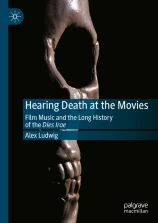
In Hearing Death at the Movies: Film Music and the Long History of the Dies Irae, author Alex Ludwig devotes a significant portion of a chapter to music by Tiomkin. The book, published last month, is a deep dive into Dies Irae, that medieval liturgical plainchant of Last Judgment that continues to permeate mass culture. Ludwig, an Associate Professor of Music at Berklee College of Music in Boston, found the Dies Irae melody in hundreds of films, ranging from Metropolis to The Shining, and Star Wars. The publisher notes that Ludwig “identifies three different versions of the melody, each of which signifies a different function of film music” and “traces the semantic shift of the Dies Irae from its religious roots to its secular perception as a symbol of death.”
Chapter Three situates Tiomkin between silent film traditions and Hammer vampire films. Tiomkin’s use of the Dies Irae is discussed in relation to the wartime documentary, The Battle of China (1944); Search for Paradise (1957); and Red Light (1949). (It can also be heard in Alfred Hitchcock’s 1953 film, I Confess.)
FURTHER READING: Dimitri Tiomkin’s music score for Red Light
Moving from Latin Gregorian Chant to the Bible, author Robert Paul Seesengood unites cultural studies and Biblical studies in his chapter titled “Do Not Forsake Me”: Biblical Motifs in Zinnemann’s High Noon. Seesengood, Assistant Professor of Religious Studies at Albright College in Pennsylvania, discusses the motif of “forsakenness” and notes that “For decades the Western was forsaken in film criticism.”
That brings us to a biographical entry on Dimitri Tiomkin in “A” Western Filmmakers: A Biographical Dictionary of Writers, Directors, Cinematographers, Composers, Actors and Actresses. Tiomkin appears based on his contributions to at least three “A” Westerns.
Moving beyond Westerns, in Alfred Hitchcock and Film Noir, contributing author Elisabeth Bronfen opens Chapter Seven with the observation, “Even before the names of the two stars, Teresa Wright and Joseph Cotten, appear in big white letters in front of blurry shapes in the background of the credit sequence to Alfred Hitchcock’s Shadow of a Doubt, we hear Dimitri Tiomkin’s ominous rendition of Franz Lehár’s ‘Merry Widow Waltz.’” Now that she has piqued your curiosity, check out her essay, “Noir Americana Aesthetics in Shadow of a Doubt (1943).”
In addition to the above books, there are two recent journal articles of note. Musicologist William Rosar has long championed the film music of Dimitri Tiomkin and recent issues of his Journal of Film Music include articles on Jester Hairston as well as Resurrection.
Choral conductor Micah Bland’s article on “Jester Hairston’s Film Music Career” discuss Hairston’s collaborations with Tiomkin in volume 11, number 1. Choral music in film may not get the attention it deserves and Bland brings his background into play by examining the life and career of Jester Hairston (1901–2000)—a multitalented Black entertainer who composed, arranged, and conducted choral ensembles for notable film composers throughout the mid-twentieth century. Hairston worked extensively with Tiomkin for more than twenty years.
Finally, in May 2006 this website featured an article by Warren M. Sherk titled, “Dimitri Tiomkin’s score for Resurrection (1931).” William Rosar, familiar with Sherk’s article, suggested the author take a deeper dive into the genesis of the score by examining trade paper and newspaper articles and archival material that followed its creation and reception in remarkable depth.
The result, “Dimitri Tiomkin’s Music Score for Resurrection: Screen Opera or Incidental Music?,” can be found in a special issue, Music in Early Talkies, by guest editor Michael Slowik published this month. Slowick writes, “Through this case study, Sherk offers a close-up view of the range of factors that could impact film music during this period, particularly the industry’s desire to limit music.”
FURTHER READING: Dimitri Tiomkin’s music score for Resurrection
The article ends with the observation that the scope of Resurrection is impressive and considering the 1931 film contains the first dramatic feature film score by a four-time Academy Award winning composer, a full restoration seems called for.
Sources
Ludwig, Akex. Hearing Death at the Movies: Film Music and the Long History of the Dies Irae. Springer Nature Switzerland, 2025. See Chapter 3: Tracing Film Music’s Most Ubiquitous Melody: Silent Films, Dimitri Tiomkin, and the Long Decade of Vampires.
Seesengood, Robert Paul. American Standard: The Bible in U.S. Popular Culture. Wiley, 2024. See Chapter 6: “Do Not Forsake Me”: Biblical Motifs in Zinnemann’s High Noon.
Hoffmann, Henryk. “A” Western Filmmakers: A Biographical Dictionary of Writers, Directors, Cinematographers, Composers, Actors and Actresses. McFarland, 2024.
Bronfen, Elisabeth. “Noir American Aesthetics in Shadow of a Doubt (1943)” in Alfred Hitchcock and Film Noir, Edinburgh University Press, 2024. Editors: Homer B. Pettey, R. Barton Palmer.
Bland, Micah. “Jester Hairston’s Film Music Career.” Equinox Publishing Ltd. The Journal of Film Music, 11, no. 1 (2024) 5–21.
Sherk, Warren. “Dimitri Tiomkin’s Music Score for Resurrection: Screen Opera or Incidental Music?” Equinox Publishing Ltd. The Journal of Film Music, 11, no. 2 (2024) 73–95.