

Who doesn’t love a good list? Did we miss that trend, has the world move beyond BuzzFeed to short-form videos? In any case, believe it or not, there are antecedents to the listicle, content shared online consisting primarily of a list, that predate the Internet.
Case in point, “The Books That Shape Lives,” was a list of ten or fewer influential books provided by a notable person, in our case, Dimitri Tiomkin. The special feature in The Christian Century, today considered the flagship magazine of US mainline Protestantism, appeared across weekly issues in the late 1970s alongside reporting, commentary, book reviews, and essays on the role of faith in a pluralistic society.
Dimitri Tiomkin received a request from editor James M. Wall in a letter dated September 13, 1978, from the publication’s editorial offices in Chicago. The pitch was simple. Take a few minutes, use the enclosed form, and list ten (or fewer) influential books. Some famous people that were solicited were so busy they replied to the request with a pre-printed index card: <insert famous name> “greatly appreciates your kind interest but is unable to:…answer questionaries…”

Fortunately, Dimitri Tiomkin, with his wife, Olivia, did devote some time to preparing a list of books. The list was printed in the November 22, 1978, issue alongside that of the irreverent harmonica player, Larry Adler. Adler boldly included Why I Am Not a Christian by British philosopher Bertrand Russell in which the author explains why he does not believe in God, immortality, or the divine status of Christ. Kudos to the magazine for printing and not censoring the reply!
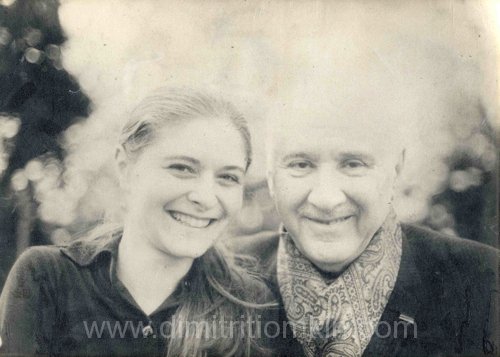
Dimitri Tiomkin with Olivia Tiomkin
Adler aside, for “The Books That Shape Lives,” the Bible was ineligible, the editors fearing it might take up space on many or most lists! US Congressman Brooks Hays bent the rules to include “A childhood volume of Bible stories” on his list. Other than the Bible, any books read “from early childhood right up to this week” could be considered. Titles were required, author’s names were preferred, “if at all possible.” Editors don’t take anything for granted. Consider people in bookstores asking for the “Little Brown” book (that’s a publisher, by the way) or the current “Jorjor Well” meme, for the writer of Animal Farm (George Orwell). Animal Farm did make Garrett Hardin’s list. Hardin served as a professor of human ecology at the UC Santa Barbara (UCSB) Environmental Studies Program.

Here is the list as provided by the Tiomkins.
Christmas Carol – Charles Dickens
Crime and Punishment – Fyodor Mikhailovich Dostoevsky [also on the list of theatrical director Jose Quintero]
Giant – Edna Ferber
The Old Man and the Sea – Ernest Hemingway
Les Miserables – Victor Hugo
The Moon and Sixpence – William Somerset Maugham
Boris Gudonov – Alexander Sergevich Pushkin
Cyrano de Bergerac – Edmond Rostand
War and Peace – Leo Nikolaevich Tolstoy [also on the list of US Foreign Service diplomat Charles W. Yost]
Resurrection – Leo Nikolaevich Tolstoy [also on the list of novelist Jesse Stuart]

Olivia Tiomkin Douglas recalls Dimitri was keen on Charles Dickens and one of his most popular works topped the list. A tally of nationalities reveals the diversity: two American, two British, two French, and three Russian writers. Remarkably, Tiomkin resided in each of the four countries represented and could read Russian, French, and English. The selected books have all been the source for film adaptations and Tiomkin scored motion pictures based on five of the ten.

The list of the people that responded is filled with religious, political, and artistic figures. Imagine the editor’s Rolodex! Or, if Tiomkin’s letter is indicative—it was sent to the address of his accountant at the time in Century City—perhaps the mailing addresses were the offices of agents, managers, and publicists of those solicited.
The requests did get delivered and there were enough replies to warrant publishing the lists of two notables each week. Columnist and humorist Erma Bombeck included one of her own books; New Yorker magazine writer Emily Hahn selected Encyclopaedia Britannica, why not; opera singer Roberta Peters listed 5000 Nights at the Opera: The Memoirs of Sir Rudolf Bing; novelist Sydney Sheldon chose nine novels and the works of Mark Twain. A former secretary of state listed 11 books, maybe to make up for the adjacent entry from the US secretary of the Treasury who named only one book, An Inquiry into the Nature and Causes of the Wealth of Nations.

Virgil Thomson, https://www.virgilthomson.org/about/for-the-media/
Finally, composer Virgil Thomson, obviously well-read, famously witty, opinionated, and fiercely independent did not actually list any titles of books at all. His terse reply: The complete works of Mark Twain, Friedrich Nietzsche, Oscar Wilde and George Bernard Shaw. Choosing four authors raised among different Christian traditions that developed into brilliant skeptics while employing satire, philosophy, paradox, and dramatic argument in their writings certainly set his reply apart. Wouldn’t their complete works number in the hundreds?
My favorite? Anthony Burgess, British novelist and author, listed Orchestration by Cecil Forsythe! With that in mind, check out the self-taught composer’s thought-provoking instrumental combinations in the evocative opening of his Symphony in C (1975). The prolific composer and renegade Catholic wished people would think of him as a musician who wrote novels, rather than as a novelist who wrote music on the side. Sadly, he’s largely remembered for writing the novel A Clockwork Orange. He grew to resent Stanley Kubrick’s film adaptation believing the director missed the point that the story was about the absurdity of violence.
Browsing the 1978 and 1979 issues in search of the Tiomkin entry, one is struck by how little has changed in 50 years, with articles and op-ed pieces on the abortion debate, the challenge of the US-Mexico border, and Taiwan’s future. Not to mention American theologian Rosemary Radford Ruether writing on the ecological crisis and the need to recover an understanding of ecojustice in which the harmony of nature is part of the human historical drama of good and evil. Garrett Hardin, mentioned above, authored a landmark Science magazine essay arguing that individuals acting in self-interest will inevitably deplete shared, finite resources and his New York Times obit subhead line presciently read “Ecologist Who Warned About Excesses.”
If that’s not enough, enlightening reads include “Movie Ratings Room for Improvement” and “Superheroes, Antiheroes, and the Heroism Void in Children’s TV.”
“Movie Ratings” was published on the tenth anniversary of the MPAA rating system. (Recall the National Council of Churches played an outsize role in the development of the Hays Code back in the 1930s through 1950s.) The writer of that op-ed piece was more than a decade ahead of the time when he called for content descriptors, suggesting the R-rated Harry and Tonto add the phrase “contains some strong language.” Phrases and descriptors regarding content were added by the MPAA in 1990, and to the Parental Guidelines television rating system in 1997.
Edward M. Berckman, an Episcopal minister and college English professor born in China to missionary parents, took on superheroes in reaction to a recent two-hour adventure spectacular on CBS television starring Captain America. He argued children did not need more moral heroes, only more relatable, true-to-life, and interesting ones. Touché.
The Christian Century, so named in 1900, managed to survive the 20th century and is now published monthly with the tagline, “Thoughtful, Independent, Progressive.” Proving the point, the current issue features an article on “Understanding polyamory.” Yet tradition runs deep. In “How My Mind Has Changed” notable theologians reflected on alterations in their views based on personal growth. Initiated in the 1940s, it seems to have run its course during the pandemic in 2021.
While the Book department continues to thrive with reviews of relevant current literature, “The Books That Shape Lives” feature ceased during the summer of 1979.
–Warren M. Sherk
Sources
Letter from James M. Wall, the Christian CENTURY: an ecumenical weekly, to Dimitri Tiomkin, September 13, 1978, courtesy of Olivia Tiomkin Douglas.
“The Books That Shape Lives: Book Choices of Larry Adler and Dimitri Tiomkin,” in The Christian Century, November 22, 1978, page 1140. Copyright © 1978 by the Christian Century.
Olivia Tiomkin Douglas, telephone conversation with the author, October 17, 2026.
Thanks to the Wiliam H. Hannon Library and circulation desk staff at Loyola Marymount University for providing access to the original bound volumes of The Christian Century.

