
At first glance, it’s difficult to discern the occasion for this unusual image filled with Russian art and icons. One’s eye is drawn to the bearded old man on the left, possibly because of his outsize proportion. More on the old man later. In the center, the ever-gregarious composer Dimitri Tiomkin and the two women to his left, his personal assistant Olivia Patch and a Russian actress, are all beaming at the camera while artist Ilya Glazunov and Stanislav Belousov, a high-ranking Sovexport Films official who arranged the meeting, are both gazing in the direction of their guests.

Dimitri Tiomkin with Olivia Patch in the studio of artist Ilya Glazunov, Moscow, 1971
Tiomkin was in Moscow to sign a ten-year contract with Mosfilm Studios to exhibit a film, Tchaikovsky, in the United States, United Kingdom, and elsewhere. The film, on which he served as executive producer and music director, was a capstone to the composer’s career. Tchaikovsky would be nominated for an Academy Award in the foreign language film category and Tiomkin would be nominated for adapting the music score.
The road to Moscow began in 1966 with the announcement by Warner Bros. president Jack Warner of an American-Soviet coproduction, the first of its kind, predating glasnost by two decades. By 1969, Tiomkin was traveling between London and Moscow to oversee production. Fast forward two years.

Ilya Glazunov self-portrait, 1999
Preparing the film for release, Tiomkin commissioned Glazunov, then in his early 40s, to paint a portrait of Tchaikovsky for publicity purposes. “Glazunov was renowned for his portraits of famous personages, both Russian and foreign; illustrations for works of Russian literature; and later in life, religious and nationalistic depictions of Russian history.” Popular with the elite and controversial, he was ignored for not embracing Socialist Realism before he became a spokesperson for resurgent Russian nationalism. Glazunov would found the Russian Academy of Painting, Sculpture and Architecture.
 Glazunov’s studio in the 1970s, see Alamy for a glimpse inside in 1977, was located along Kalinin Prospekt, a major street now known as New Arbat Avenue, that ran from Novoarbatsky Bridge on the Moskva River to Arbatskaya Square on the Boulevard Ring. The painting of the bearded old man seen above remains unidentified as large portions of Glazunov’s works remain in Russia; however, compare it to a similar 1973 painting on the left, “Old Man,” and, below, to a 1989 painting, “A Russian Old Man,” that sold at auction in 2018, a year after Glazunov’s death.

Prior to Tchaikovsky, the artist’s painted portraits typically only include the subject’s face and upper body. For example, a 1970 illustration, “The Dreamer,” below, focuses on the subject centered in the frame.

Glazunov’s 1971 oil painting for Tiomkin, titled “Pyotr Il’ych Tchaikovsky,” below, appears to have ushered in a new style for the artist. With “Tchaikovsky,” Glazunov, in support of Tiomkin’s commission and possibly for the first time, juxtaposes the portrait of the subject, off center, with a historical setting, in this case the Red Square. (Glazunov first painted that iconic setting in 1962.)

Compare Glazunov’s later portraits that appear to be stylistically influenced by Tchaikovsky of the King of Sweden (1974) [below], A Russian Old Man (1989) [above], Alexander Pushkin (1994) [below], and even the self-portrait (1999), seen above.


Tchaikovsky would later appear in the monumental work, “The Contribution of the People of the USSR to World Culture and Civilization” (1980), below, that hangs in Paris in the headquarters of UNESCO.

Glazunov probably captured Tchaikovsky’s likeness from a photograph; however, as the photograph of actor Innokenti Smoktunovsky below as Tchaikovsky attests, the hair and makeup by Russian artists was remarkable, even if Smoktunovsky’s face is a bit rounder.

Photograph of 1971 painting Pyotr Il’ych Tchaikovsky by Ilya Glazunov

Photograph of Pyotr Il’ych Tchaikovsky

Photograph of Innokenti Smoktunovsky as Tchaikovsky
A select audience of Russian filmgoers were first to see the completed film on September 2, 1970, in Moscow. After Glazunov completed the commission, “Dimitri displayed the portrait on an easel at the entrance of the Cinemas that were showing the Tchaikovsky film both in LA and the UK,” recalls Olivia Tiomkin (née Patch). She gifted the painting to the Royal College of Music in London in 1984.
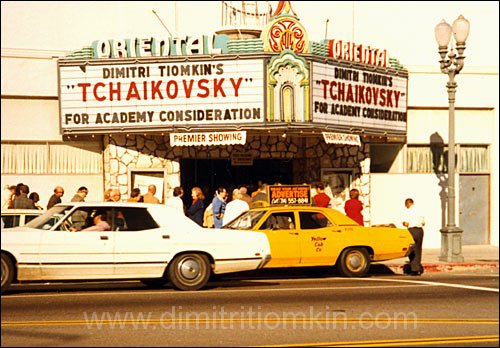
Oriental Theatre marquis, Los Angeles
Screenings of the film, also known as Chaykovskiy, took place in London and Los Angeles in 1973. For those theatrical exhibitions the film was shortened, according to Olivia. She adds, “I believe in the 1980s the film was recut and released by another distributor.” Olivia donated paper material and film elements to the British Film Institute (BFI) in 1983. The BFI has a 70mm print; two separate reels of 70mm, one of which is described as a cutting copy; a 35mm print and cutting copy; additional 35mm tracks; and a single 35mm reel of a duplicate negative. In addition, the BFI has two 35mm prints from other sources.
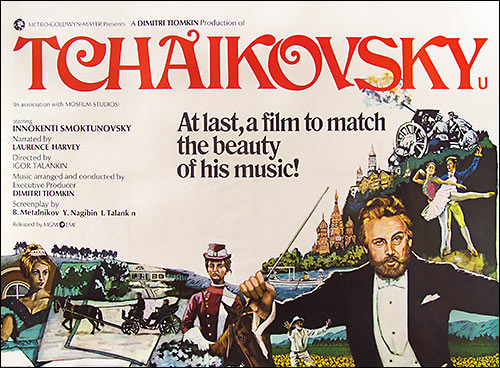
Tchaikovsky British Quad
On the fate of the film, Olivia concludes, “One day I would love to have it restored and see it in its original form.”
Check back later this year for our feature article on the making of Tchaikovsky.
Sources
“Tchaikovsky Story: Warners, Soviet Join To Co-Produce Movie,” Victoria Advocate, March 6, 1966.
“Dimitri Tiomkin Returns to Russia To Produce Film on Tchaikovsky,” Lexington Herald, January 30, 1969.
“New Film Is Shown To Russians,” Richmond Times-Dispatch, September 3, 1970.
“Ilya Glazunov, Controversial Painter Favored by Kremlin, Dies Aged 87,” by Michele A. Berdy, Moscow Times, July 10, 2017.
Electronic communication between Robin Baker, BFI, and Patrick Russ, October 26, 2011.
Electronic communication with Olivia Tiomkin, August 20, 2023.
(Fifteenth in an occasional series featuring rare or unusual photographs.)