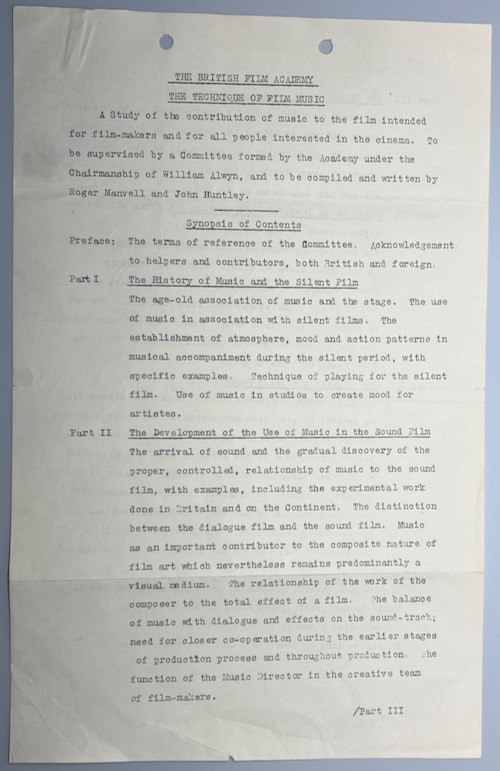
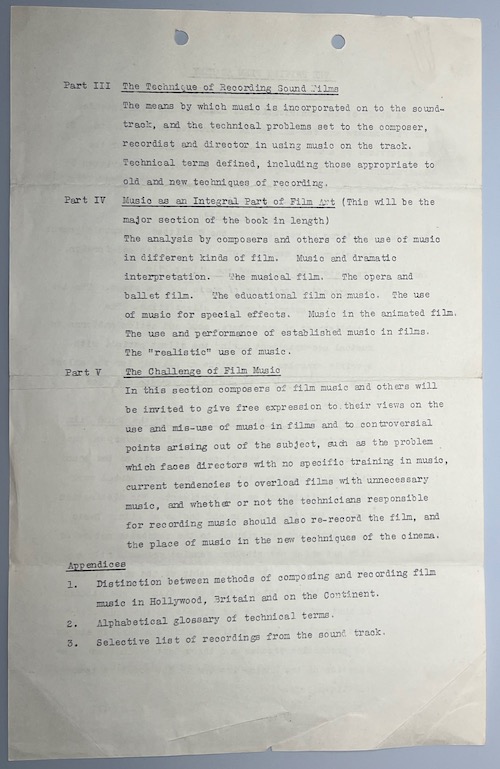
When composer William Alwyn wrote to Dimitri Tiomkin in 1954 on behalf of the British Film Academy as the Chair of the Music Committee, the book project under discussion was in its proposal stage. The Technique of Film Music, first published three years later, written and compiled by Roger Manvell and John Huntley, was one of the earliest books of its kind. Filling a void in music literature the work was so unique and popular there appeared thereafter three reprintings, in 1967, 1969, and 1971, culminating in the revised and enlarged edition of 1975.
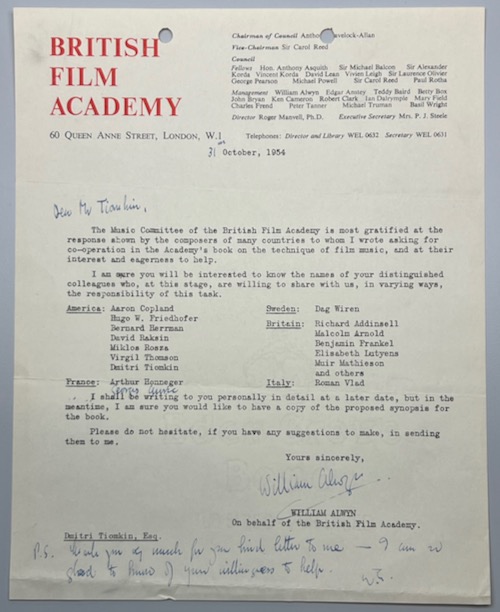
Letter from William Alwyn to Dimitri Tiomkin, October 31, 1954
The 1975 work, in the chapter on the function of music in sound films and section “Filmed Lives of the Composer,” gives space to Tchaikovsky (1971), a film on which Tiomkin served as producer, music director, and composer.
Manvell and Huntley compiled the book under the guidance of a committee appointed by the British Film Academy that in addition to Alwyn, included Ken Cameron, Muir Mathieson, and Basil Wright. Alwyn pieced together an international who’s who of composers to the inform the book, thus his letter to Tiomkin. There are chapters on the music director and sound recordist, music and the silent film, music in the early sound film, and the function of music in the sound film with coverage of dramatic, animated, documentary, and musical films. The analyses of single cues—from William Walton’s Henry V, Virgil Thomson’s Louisiana Story, Miklós Rózsa’s Julius Caesar, and William Alwyn’s Odd Man Out—and a discussion of the emotional aspect of music were groundbreaking.
The insert in Alwyn’s letter, reproduced below, contained the proposed synopsis for “A Study of the contribution of music to the film intended for film-makers and for all people interested in cinema.” Some elements changed prior to publication. “Part V: The Challenge of Film Music” wherein composers and others would give free expression to the views on the use and mis-use of music in films, the problem facing directors with no specific training in music, and current tendencies to overload films with unnecessary music became Chapter 5: “The Composer View.” The three proposed Appendices were replaced with three new ones. The Postscript (“P.S.”) indicates Tiomkin’s willingness to help.