

From ballerina to businesswoman, Albertina Rasch would carve a unique path for a female in the dance world progressing from dancer to choreographer to dance director, in the process transcending her vaudeville roots to embrace the newest creative sensation, sound motion pictures.
In Hollywood, Rasch signed a contract with Metro-Goldwyn-Mayer (MGM) in 1929. Now, less than a year later, she was looking to expand her empire, that included multiple dance troupes and her own dance academy. Max Hart, a prominent booking agent for R-K-O Vaudeville, had an exclusive contract with Rasch to negotiate for both her services as a choreographer and for that of her eponymous dance troupe. Hart opened an office in Hollywood and with Richard La Marr sought to gain a foothold in talkies. (During vaudeville’s peak in the mid-1920s, live shows included an intermission with pipe organ music and a film reel, giving audiences time to stretch and visit the lobby for a smoke. Within a few years, movies replaced live entertainment.) What better way than to use vaudeville talent, beginning with the dancers led by Rasch, to provide talent?
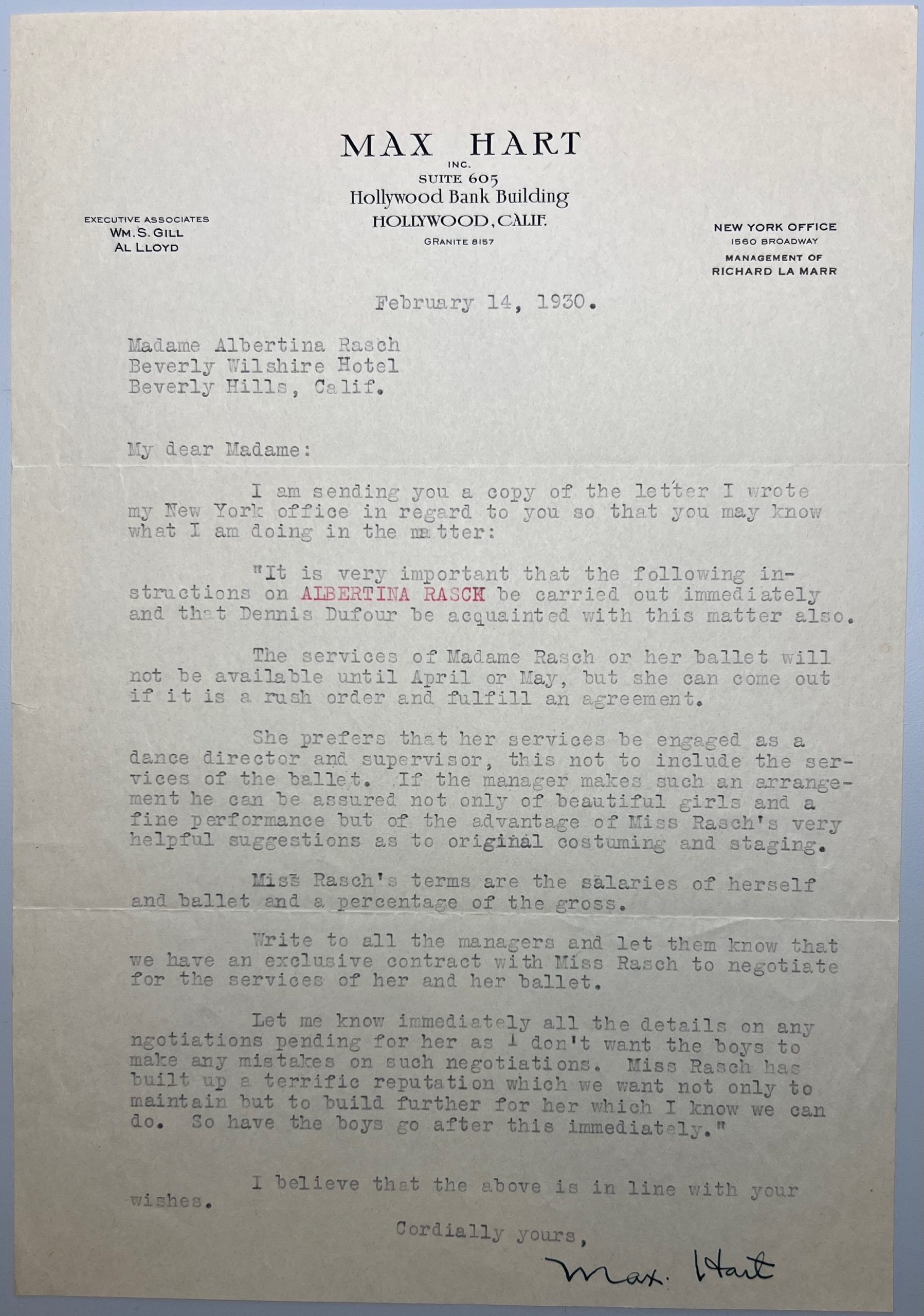
As outlined in the accompanying letter from Hart, Rasch would seek a percentage of the gross for her services and ballet. The terms: her own salary, a salary for the Albertina Rasch dancers, and a percentage of the gross. Preferring to be engaged as a dance director and supervisor in early 1930 places her alongside the other two major figures that brought camera-centric dancing to the movies, Busby Berkeley and Jack Cole.
While Hart was promoting Rasch, the film Sally was in theaters, with dancers under the personal direction of Albertina Rasch backed by a large orchestra on Vitaphone disc. The cameras and microphones had captured a new way to view movement and hear synchronized music and Rasch would go on to spend the decade at the forefront of dance film choreography.
 The Intrada Records release of Dimitri Tiomkin: From New York to Hollywood: Music for Albertina Rasch and Classic Films is a great starting point to appreciate the development of the art form of dance in films.
[Letter courtesy of Olivia Tiomkin.]