
by Warren M. Sherk

Alexander Glazunov
The single greatest musical influence on Dimitri Tiomkin is arguably the Russian composer Aleksandr Konstantinovich Glazunov. When Tiomkin’s mother sought to enroll her son at the St. Petersburg Conservatory, young Dimitri had to pass muster with Glazunov, the conservatory’s director, after taking the preliminary exams. The tall, ponderous, and peculiarly proportioned Glazunov listened as Tiomkin played a short sentimental piece he had composed in the style of Schumann.
Looking back years later, after achieving success as a film composer in Hollywood, Tiomkin realized that encounter with Glazunov had been his defining moment. The director had recognized Tiomkin’s potential, and soon Dimitri was studying harmony and counterpoint with Glazunov, one of Russia’s foremost composers at the height of his renown. Tiomkin recalls, “His music was performed wherever there were concert halls. Orchestras played his superb C-minor Symphony, ballet troupes danced his beautiful suite Raimonda, and for violinists his concerto was standard repertoire.”
Glazunov’s classes in composition, orchestration, and counterpoint were popular among students eager to learn from the master, whose teaching method involved not technical drilling and academic routine but “spiritual inspiration,” as Tiomkin tells it. That didn’t mean the basics were neglected, however; Tiomkin remembers being schooled in strict conformity to part writing, the proper use of suspensions and modulations, and the avoidance of parallel fifths—not to mention modernism. Woe to the student who made a mistake while performing, for Glazunov had a keen ear and knew the repertoire from memory. “After someone had played a sonata or a prelude and fugue, he might remark shyly with his voice trailing off, ‘In the third section, page seven, bar twenty-six, you neglected to play the F sharp,’ and cock his head to one side and chuckle.”
Tiomkin describes Glazunov as a Petrogradezt (in Russian, a typical citizen of the city of St. Petersburg, or Petrograd); a towering musical genius; a composer of captivating symphonies, ballets, songs, instrumental works, and stage music; and an incomparable pedagogue. Tiomkin could be talking about his own music when he describes Glazunov’s work as simple, romantic, melodic, and captivating in form and imagery, filled with emotion and soul, the music seemingly interwoven deeply with his personality.
On a more personal note, Tiomkin recalls the director’s magnanimous personality and devotion to ideals. Glazunov was born into a family of wealth and gave freely to those in need. Tiomkin taught piano to Glazunov’s niece and others upon Glazunov’s recommendation. Through his influence with the Ministry of the Interior, the director made it possible for Jewish students to be granted special permission to reside in St. Petersburg prior to admittance into the conservatory. Upon graduation, the title of “free musician” granted a Jewish musician the right to reside anywhere in Russia.
It was Glazunov who suggested that Tiomkin study composition. Tiomkin’s autobiography, Please Don’t Hate Me, is filled with stories involving the director. At the conservatory, Glazunov cut an imposing, robust figure. He dressed like a character from a Tolstoy novel: a flowing double-breasted knee-length coat, striped dress pants, and a large black tie. (“Glazunov makes me wonder—what did he look like naked? It was impossible to guess,” was the original opening line of the autobiography, then titled Hollywood Harmonies. A similar sentiment appears on page 11 of the published work.) More bohemian than aristocrat, Glazunov was a bon vivant who loved good food and drink and was partial to smoking long black cigars. Lebemann is the German word Tiomkin uses to describe his mentor.
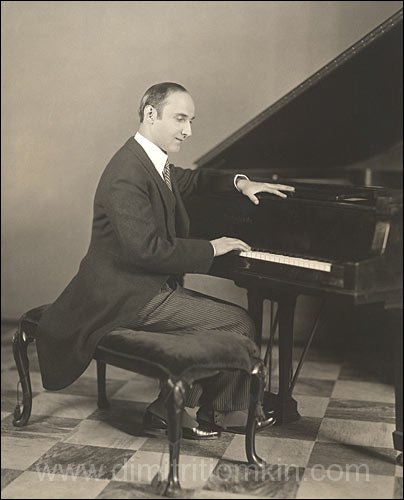
Dimitri Tiomkin, circa 1926-1927
In 1929 Glazunov arrived in the United States from Russia for a conducting tour that would take him to Boston, Chicago, Detroit, and Philadelphia. At the time Glazunov was the last surviving master of the Russian Nationalist School, founded by Balakirev, Borodin, Cui, Mussorgsky, and Rimsky-Korsakov, which rebelled against the romanticism of Tchaikovsky. In mid-November Tiomkin and Albertina Rasch were guests at a reception for Glazunov at Wm. Knabe & Co.’s Ampico Hall in New York, celebrating the piano maker’s ninety-second anniversary. When Tiomkin spotted his former teacher, he was stricken by how thin and haggard the larger-than-life director had become. (The writer H. G. Wells had a similar reaction upon seeing Glazunov exactly nine years earlier.) Life had been hard for the master composer in post-revolutionary Russia, and enrollment at the once thriving conservatory had shrunk to 650 students from its heyday of 2,500. By this time Tiomkin had established a reputation in New York as a concert pianist, embracing the modernists that Glazunov despised: composers like Debussy, Ravel, and particularly Scriabin. On the other hand, Tiomkin’s recitals almost always included a composition by J. S. Bach, and Glazunov’s tutelage in fugal writing stayed with him throughout his career as a film composer. On Glazunov’s love of fugues, Tiomkin wrote in 1959, “To this day in Hollywood I am happy if I can sneak a fugue into a score for a motion picture.”*
*For a particularly germane example, listen to music from The Well on disc 3, track 2 of The Alamo: Dimitri Tiomkin: The Essential Film Music Collection, where the triumphant music includes a fugue that begins 2:30 in.
Sources
- Please Don’t Hate Me by Dimitri Tiomkin and Prosper Buranelli (Doubleday, 1959)
- “Alexander Constantinovich Glazounov: Reminiscences of One of His Pupils of the Conservatory of Petrograd” by Dimitri Tiomkin (typescript in the Dimitri Tiomkin Collection at USC’s Cinematic Arts Library, courtesy of Ned Comstock)
- “Glazounov to Play Here: Former Pupil of Imperial Russian Conservatory Reminisces on Musical Genius” by Dimitri Tiomkin, Los Angeles Times, November 3, 1929
- “Russia in the Shadow” by H. G. Wells, New York Times, November 14, 1920
- New York World, November 19, 1929
- “Music Notes Afield” by Mary Manners, Winnipeg Free Press, November 30, 1929, accessed at Access Newspaper Archive, January 2010