

by Warren M. Sherk
When faced with the COVID pandemic and working from home, I decided to attempt to read in its entirety the ten-volume series, “History of the American Cinema.” Nearing the end of that journey it struck me that a good number of films scored by composer Dimitri Tiomkin are cited due to their unique place in history. As a career-long freelance composer Tiomkin was not assigned films, he was free to choose the films he worked on which makes his choice of films even more remarkable. (And we know he turned down two films directed by Robert Aldrich.)
READ: Why did Dimitri Tiomkin bow out of scoring two Robert Aldrich films?
Here are some historical facts for films scored by Tiomkin.
A recording session for The March of Time, for a ballet sequence choreographed by Albertina Rasch with music by Dimitri Tiomkin, marked the first time a full symphony orchestra was used for background music in a Hollywood film, according to Metro-Goldwyn-Mayer (MGM) studio publicity.
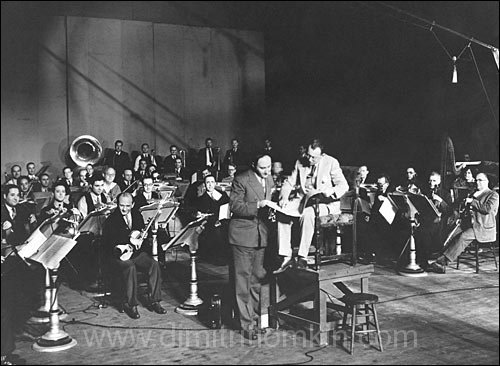
Dimitri Tiomkin, Arthur Lange, and the MGM Studio Orchestra, 1930
Under the influence of the 1925 Paris Exposition Internationale des Arts Décoratifs et Industriels Modernes, Cedric Gibbons showcases art deco and art moderne in the design for Our Blushing Brides (1930), the third in a trilogy of MGM films starring Joan Crawford. The highly stylized look of these films “was to cause a major revolution in movie décor.”

ROGUE SONG sheet music cover
Based on an operetta by Franz Lehar, The Rogue Song (1930) became only the second sound film screen adaptation of a Broadway operetta one year after the release of The Desert Song, based on an operetta by Sigmund Romberg.
Being first doesn’t always translate into boxoffice dollars. MGM’s attempt to broaden the scope of American horror films by introducing psychological horror in Mad Love (1935)—featuring actor Peter Lorre in his American film debut—fared poorly at the box office in spite of casting the international star of Fritz Lang’s M (1931) in the lead role as Doctor Gogol.
Lost Horizon (1937) has the distinction of being Columbia Pictures most expensive film of the decade. (Tiomkin was drawn to score some of the most expensive pictures made in their time!) As the trend for prestige pictures gained momentum with the major film studios in the 1930s, Columbia, one of the “Little Three” studios at the time, could only muster one prestige picture, Lost Horizon. The film would provide director Frank Capra with cache as “a filmmaker controlling all aspects of his work within the context of the studio system.” Columbia’s promotional campaign “stressed Capra’s direct supervision of all aspects of the lavish production.” “Columbia, which lacked big-name stars, had created a star out of its top director.” Ironically, the film furthered the careers of Capra and Tiomkin, earning Columbia prestige, but not profits.
The Great Waltz (1938), a musical biopic about composer Johann Strauss inspired by the financial and critical success of The Great Ziegfeld (1936), a musical biopic about master showman Florenz Ziegfeld, accelerated a trend in 1947 when it was reissued theatrically—some American theaters had recently decided to exclusively show first-run reissues for A-class product—and earned more money than it had in its initial release. Reissues became a major development in the postwar film industry.
Best comedy of the year? You Can’t Take It With You (1938) “was hailed by Time [magazine] as ‘The Number 1 cinema comedy of 1938.’”
Director Howard Hawks, with Only Angels Have Wings (1939), helped establish a significant stylistic alternative to deep focus promoted in many early sound era films “by staging in significant depth but framing the foreground plane only in medium shot.”
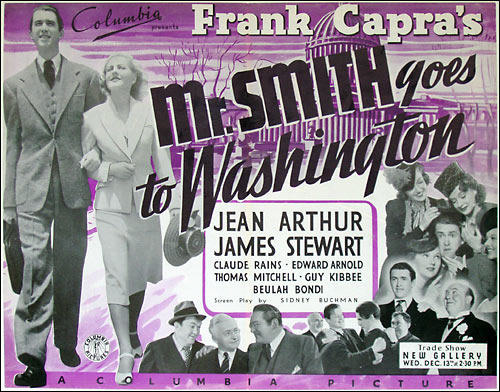
Mr. Smith Goes to Washington magazine ad
Holding the premiere of Mr. Smith Goes To Washington (1939) in the nation’s capital in October 1939 was not in keeping with tradition. Prior to 1939 nearly all prestige films were launched in New York with a Broadway premiere. Variety’s 1939 year-end survey called out the location premiere as a “revolutionary method of exploitation.” Although a December 1939 screening of Gone With The Wind in Atlanta is often cited as the most influential location premiere, the location premiere of Mr. Smith Goes To Washington preceded that event by two months. The film is ranked number 26 in the 10th anniversary edition of AFI’S 100 YEARS…100 MOVIES.
The orientation films from The Battle of Russia to War Comes to America made during World War II are among the most influential and well-remembered war-time documentaries. The films were required viewing for Americans in uniform and some were released commercially to home-front theaters. The “Why We Fight” series incorporated combat footage, captured enemy film, newsreel footage, and re-enactments in transformational forms effectively integrating fiction and nonfiction techniques with strong narratives and dramatic lines.
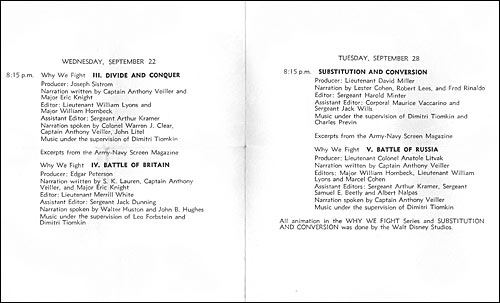
Why We Fight screening program, 1943
In its first fifteen years of existence, Monogram Pictures—a B-movie studio noted for its Western films—had never earned more than $1 million for a single film until Dillinger (1945), a gangster-themed film now acknowledged as a progenitor of the trend in the mid- to late-1940s to make “exploitation pictures,” low-budget genre films that seek financial success by exploiting current trends.
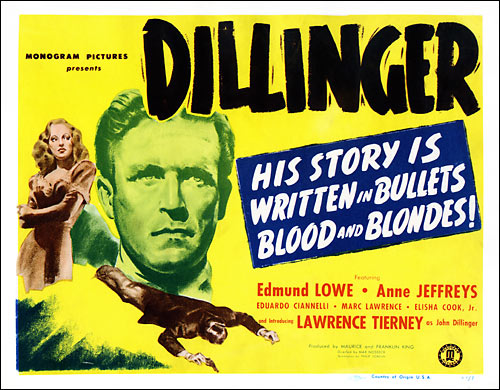
Dillinger lobby card A
A box-office flop, It’s a Wonderful Life (1946)—made for around $3 million, far above the industry average in 1946 of $665,000—proves that the original release of a film is not always indicative of that film’s potential audience over time. The film did not fit the emerging trend after World War II toward realism and it seems initial audiences did not relate to the film’s themes. Later, both the director, Frank Capra, and star, Jimmy Stewart, heralded the film as their favorite. In spite of its initial lukewarm reception the film is now considered a classic and in 1990 it was added to the National Film Registry of the Library of Congress as a “culturally, historically or aesthetically significant” American film. The film is ranked number 20 in the 10th anniversary edition of AFI’S 100 YEARS…100 MOVIES.
WATCH from the BBC Archive: James Stewart talks to Michael Parkinson of the BBC about his favorite film role
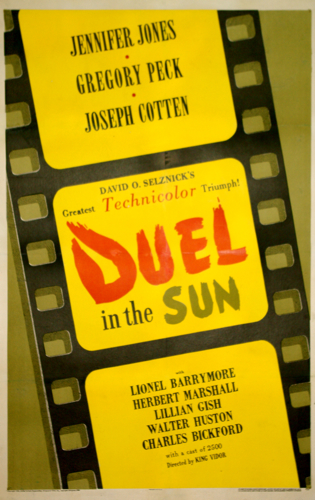 With a reported budget of $5 million, Duel in the Sun (1946) became the most expensive picture in Hollywood history to date. The road-show release of Duel in the Sun and the film’s marketing campaign set new standards that became the blueprint for subsequent blockbuster films of the 1950s through 1970s, including such films as The Alamo (1960). Duel “played some 8,000 road-show dates, nearly twice the number of Gone with the Wind, and in far less time.” The film radically redefined exhibition and distribution and coined the term “blitz booking,” opening a film simultaneously in as many theaters as possible.
The “race drama” trend in the late 1940s was epitomized by The Home of the Brave (1949), a war drama featuring a Black soldier. Critic Bosley Crowther cited the film as ‘a most propitious ‘first’ in the cycle of Negro prejudice pictures which Hollywood now has in the work.”
A few years later, The Well (1951) became an exception to the rule when, “The subject of race relations was considered too liberal or even Communistic for Hollywood films at the height of the blacklist period.”
In the early 1950s, for a three-picture deal with RKO, director Howard Hawks established short term production companies to maximize his autonomy and compensation. All three films were scored by Tiomkin, The Thing from Another World (1951) and The Big Sky (1952), for Winchester Pictures, and Land of the Pharaohs (1955), for Continental Company. The Thing from Another World (1951) became the first Hollywood film to link alien invasion with the Red Menace, or a Russian Communist invasion.
High Noon (1952) brought innovation to the narrative structure of the Western by taking place in “real time.” Further, according to his autobiography, Tiomkin convinced associate producer Stanley Kramer to allow him to write a main title ballad that would be sung, whistled, and played by the orchestra throughout the film, even though singing and talking (dialogue) did not mix, according to the rules of filmmaking at that time. For his efforts, Tiomkin earned two Academy Awards, one for dramatic music score and the other for the popular song “Do Not Forsake Me.” Tiomkin’s score and song would influence the role, use, and placement of songs in film scores and main titles forevermore. The film is ranked number 27 in the 10th anniversary edition of AFI’S 100 YEARS…100 MOVIES.
During a brief boom in 3-D films in 1953 and 1954, Alfred Hitchcock shot Dial M For Murder (1954) in both 2-D and 3-D. The 3-D version remains an outlier since it differs from most 3-D films from the early 1950s that had fantastical elements, were largely shot outdoors, or exploited dimensionality by filming moving objects as they approached the camera lens. Dial M For Murder shares none of those traits, it is based on a play, is set indoors in a London flat, and as a dialogue-based film features little or no “action.” Hitchcock brilliantly uses the dimensionality to immerse the viewer in the film world.
The epic film Giant (1956) is considered by film historian Thomas Schatz, author of The Genius of the System: Hollywood Filmmaking in the Studio Era, to be one of the eighteen most important melodramas of the mid to late 1950s.
Search For Paradise (1957) is a Cinerama film made with the company’s proprietary widescreen process that projects images simultaneously from three synchronized 35mm projectors onto an enormous deeply curved screen. Dimitri Tiomkin joins a handful of notable composers who provided scores to Cinerama films, including Morton Gould, Jerome Moross, Alex North, David Raksin, and Max Steiner.
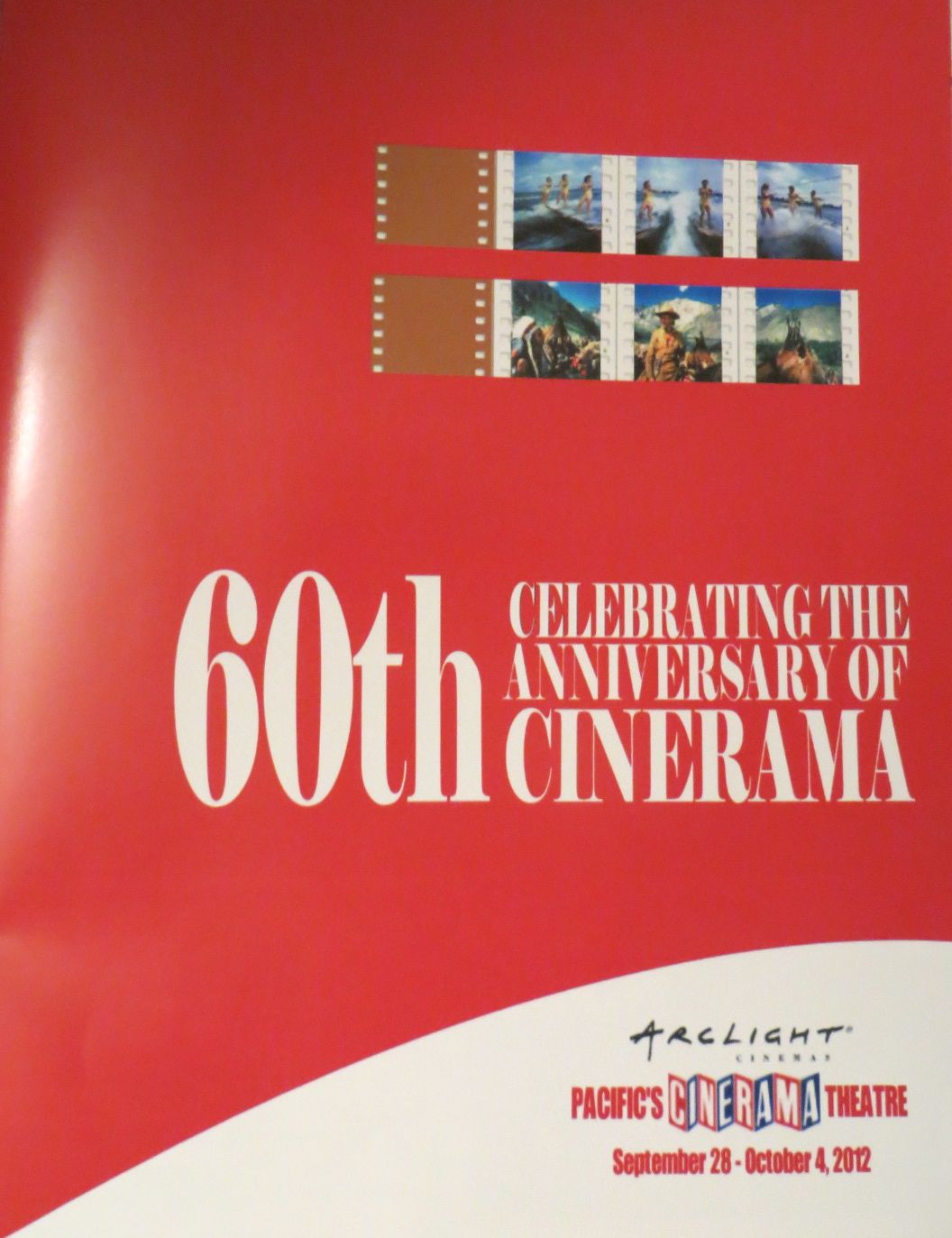
Cinerama Festival program

Search for Paradise postcard

Search for Paradise recording session, circa 1956-1957
Rio Bravo (1959) “refines the Western down to a few characters” by focusing on a ragtag group that supports the sheriff against a gang of outlaws. It’s of interest that Tiomkin scored this film for director Howard Hawks, since Rio Bravo supposedly originated from the director’s disgust with High Noon (1952).
By the end of the 1950s, the aspect ratio for American films was widely standardized at 1:85:1. The Guns of Navarone (1961) was one of a handful of films of the early 1960s, shot in a 2:35:1 aspect ratio, known as Full Scope. Others include Lawrence of Arabia (1962), Doctor Zhivago (1965), and The Sound of Music (1965).
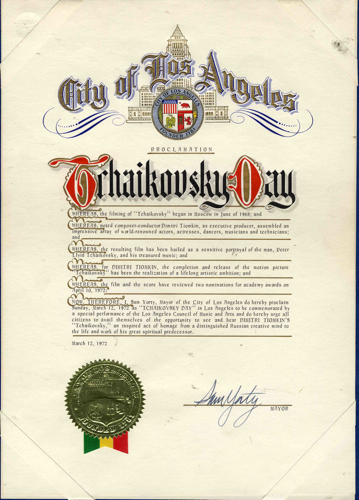
Proclamation, Tchaikovsky Day, 1972
In 1966, Tiomkin became the key player in what was conceived as an unprecedented Soviet-American film coproduction. Barely a year after the first glasnost rally took place in Moscow, Tiomkin began pre-production on Tchaikovsky, a musical biopic on the Russian composer. Tiomkin would executive-produce and arrange the music for the film. After filming at Mosfilm, the major Soviet studio, Warner Bros., acting as a guarantor for certain payments, would release the film in all countries outside the Soviet bloc and Finland. Before the film was completed Warner Bros. pulled out and upon the film’s eventual release in the U.S. in 1971, Tchaikovsky was nominated by the Academy of Motion Picture Arts and Sciences in the categories of best Foreign Language Film and Music (Scoring: Adaptation and Original Song Score).
READ: Dimitri Tiomkin in Moscow (Behind the Photograph)
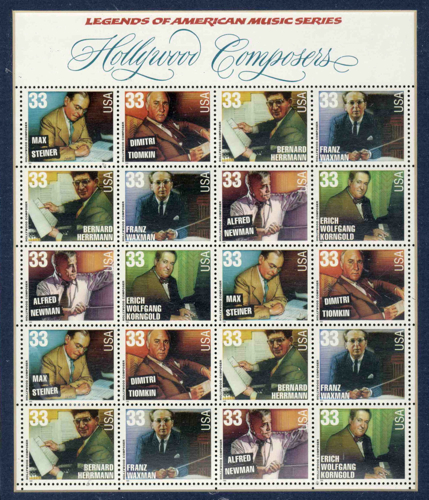
As a foreign-born composer in America freelancing during the classic studio era, Dimitri Tiomkin joins a handful of major composers in Hollywood: Bernard Herrmann, Erich Wolfgang Korngold, Alfred Newman, Miklos Rozsa, Max Steiner, and Franz Waxman, who together created a musical language and film-scoring tradition.
Sources
History of the American Cinema, New York: Charles Scribner’s Sons, 1990-2003. A ten-volume set examining American films. Each volume includes comments on film music, see my Film and Television Music: A Guide to Books, Articles, and Composer Interviews.
“Co-Producing Cold War Culture: East-West Film-Making and Cultural Diplomacy,” by Marsha Siefert