
Introduction
When Tchaikovsky, the first film coproduction between the United States and Soviet Union, was released in Russia in 1970 and the US in 1971, it represented a notable point in composer Dimitri Tiomkin’s professional career. This capping achievement, the “realization of the artistic ambition of a lifetime,” drew on both his music composing and arranging and film production skills resulting in a film based on the life and music of composer Peter Ilyich Tchaikovsky (1840–1893).
Looking back, in what may be a classic understatement, a book on wide screen movies posited, “There is much confusion regarding this project.” Taking that as a challenge, this multi-part article will attempt to bring some clarity to a project that overcame amazing odds and will tell the saga, because it is that, in its entirety and in context. During the Cold War an American born in Russia would produce a motion picture that was filmed in Russia, with a Russian cast and crew, and in the Russian language. The film wouldn’t be dubbed in English for Western audiences, English subtitles and narration would suffice because Tiomkin felt, “If Tchaikovsky spoke English, you’d laugh.
The music would be the star, after all, this was a biographical film, please don’t call it a biopic, that would dramatize the life of a beloved Russian composer who penned some of the world’s most popular symphonic music. Corporate mergers and reorganizations and a lack of faith in the project’s commercial potential and appeal led the American distributor to walk shortly after the completion of principle photography. And, finally, before worldwide distribution could be lined up, the leadership of the Soviet film studio that produced the film was ousted. Should we mention the film would earn two Academy Award nominations, in the categories of best Foreign Language Film and Music?
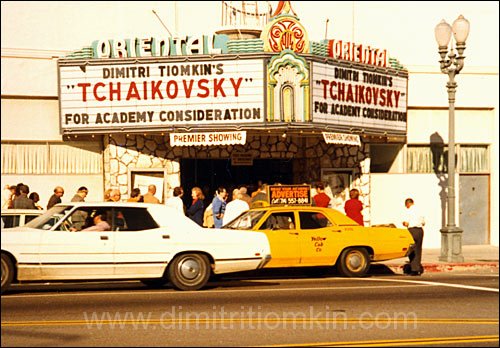
Oriental Theatre marquis, 1971
The hurdles were many, traveling between the US and the USSR during the Cold War was highly restricted and complex for both citizens, journalists, and filmmakers with significant bureaucratic hurdles and ideological barriers. (Tchaikovsky unit publicist Bill Stern was initially turned away when seeking a visa for Russia in New York.) A visa was always required and the Soviet tourism agency, Intourist, managed all Western visitors. Once there, movement was monitored and limited. On the positive side, the jet age brought the countries closer together. Tiomkin settled in London by 1968, having sold his home in Los Angeles after the death of his first wife, choreographer Albertina Rasch, and he could hop on an Aeroflot flight in London and be on the ground in Moscow four hours later.
As a naturalized American citizen, Tiomkin would enjoy political freedom; however, it was financial freedom, earned through his critical and financial success as a composer, that would allow the composer to purchase options on story properties by Jorge Amado, Isabel Colegate, Will Henry, James Ramsey Ullman, and others, and to pursue producing films.
The Tchaikovsky project would bring Tiomkin full circle, he would return to his Russia roots for the first and last times in his life.
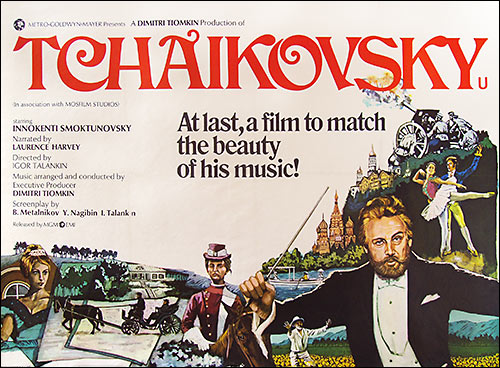
Tchaikovsky British Quad
Part 1 (to come)
Part 2 (to come)
Part 3 (to come)